QUESTION IMAGE
Question
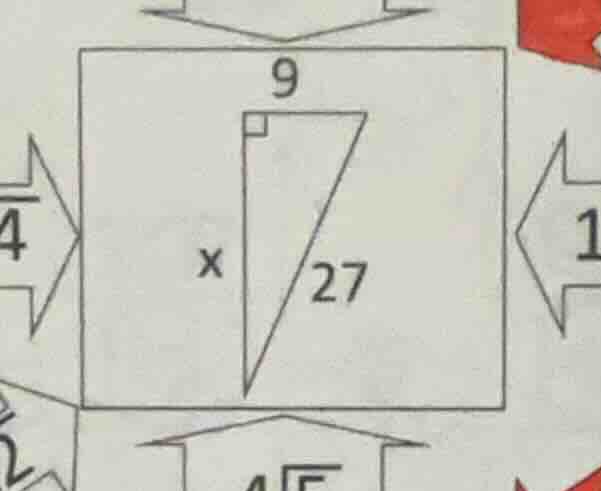
in the figure, there is a right triangle with one leg 9, hypotenuse 27, and the other leg is x. there are also some arrows with numbers 4, 1, etc. around a square - shaped figure containing the triangle.
The figure shows a right - triangle with one leg equal to 9, the hypotenuse equal to 27, and the other leg equal to \(x\). We can use the Pythagorean theorem, which states that in a right - triangle, \(a^{2}+b^{2}=c^{2}\), where \(c\) is the hypotenuse and \(a\) and \(b\) are the legs of the right - triangle.
Step 1: Identify the values of \(a\), \(b\), and \(c\)
Let \(a = 9\), \(b=x\) and \(c = 27\). According to the Pythagorean theorem \(a^{2}+b^{2}=c^{2}\), we can rewrite it as \(x^{2}=c^{2}-a^{2}\) (since we want to solve for \(x\)).
Step 2: Substitute the values of \(a\) and \(c\) into the formula
Substitute \(a = 9\) and \(c = 27\) into the formula \(x^{2}=c^{2}-a^{2}\). We get \(x^{2}=27^{2}-9^{2}\).
First, calculate \(27^{2}=729\) and \(9^{2}=81\). Then \(x^{2}=729 - 81=648\).
Step 3: Solve for \(x\)
Take the square root of both sides to find \(x\). \(x=\sqrt{648}\). We can simplify \(\sqrt{648}\) as follows:
\(648=36\times18 = 36\times9\times2\)
So \(\sqrt{648}=\sqrt{36\times9\times2}=\sqrt{36}\times\sqrt{9}\times\sqrt{2}=6\times3\times\sqrt{2}=18\sqrt{2}\approx18\times1.414 = 25.452\) (if we want a decimal approximation) or we can leave it in the simplified radical form \(18\sqrt{2}\)

Snap & solve any problem in the app
Get step-by-step solutions on Sovi AI
Photo-based solutions with guided steps
Explore more problems and detailed explanations
If we leave it in radical form, \(x = 18\sqrt{2}\); if we want a decimal approximation, \(x\approx25.45\) (rounded to two decimal places)