QUESTION IMAGE
Question
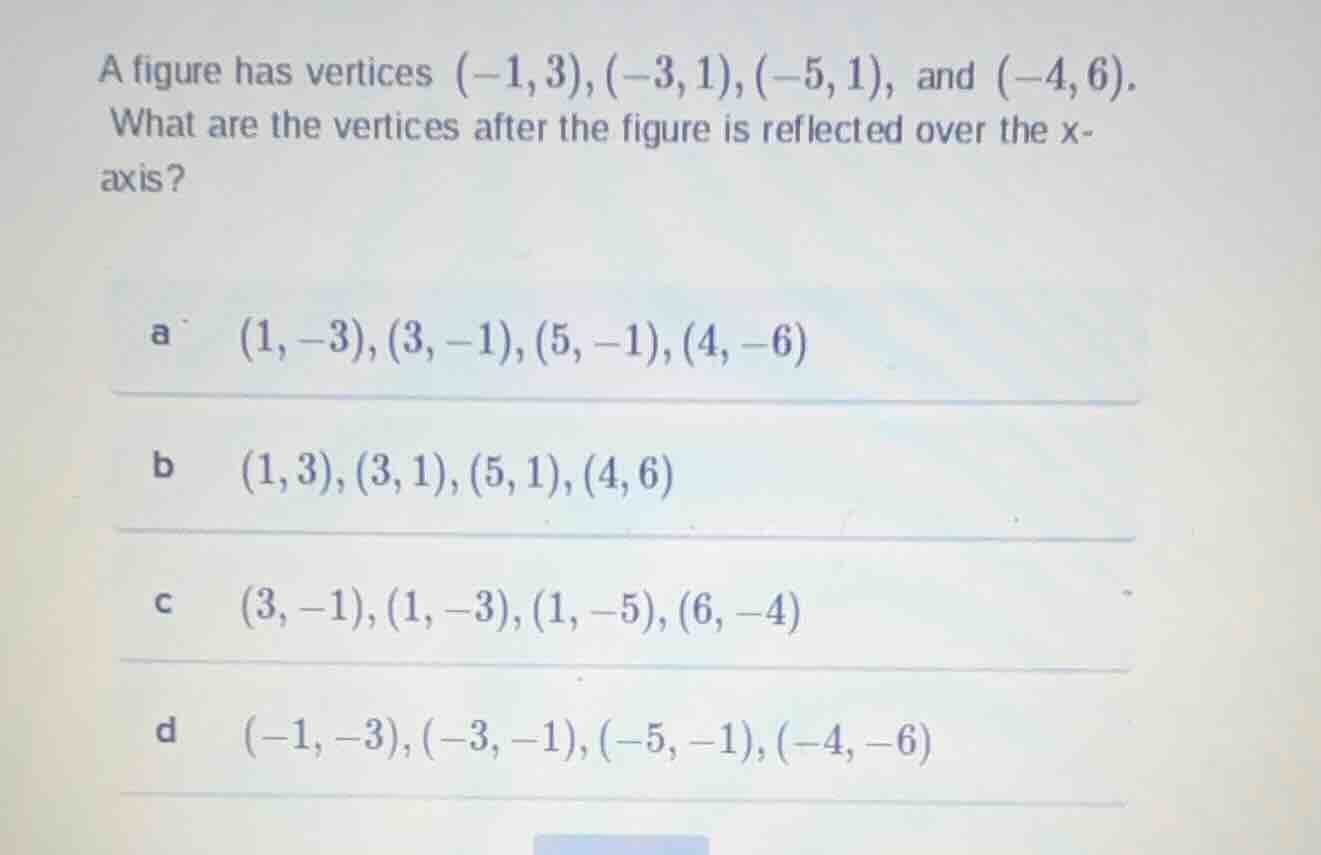
a figure has vertices $(-1, 3), (-3, 1), (-5, 1),$ and $(-4, 6)$. what are the vertices after the figure is reflected over the $x$-axis?
a $\\ (1, -3), (3, -1), (5, -1), (4, -6)$
b $\\ (1, 3), (3, 1), (5, 1), (4, 6)$
c $\\ (3, -1), (1, -3), (1, -5), (6, -4)$
d $\\ (-1, -3), (-3, -1), (-5, -1), (-4, -6)$
Step1: Recall reflection over x - axis rule
The rule for reflecting a point \((x,y)\) over the \(x\) - axis is \((x,y)\to(x, - y)\). This means that the \(x\) - coordinate of the point remains the same, and the \(y\) - coordinate changes its sign.
Step2: Apply the rule to each vertex
- For the vertex \((-1,3)\):
Using the rule \((x,y)\to(x, - y)\), when \(x=-1\) and \(y = 3\), the new point is \((-1,-3)\).
- For the vertex \((-3,1)\):
When \(x=-3\) and \(y = 1\), the new point is \((-3,-1)\).
- For the vertex \((-5,1)\):
When \(x=-5\) and \(y = 1\), the new point is \((-5,-1)\).
- For the vertex \((-4,6)\):
When \(x=-4\) and \(y = 6\), the new point is \((-4,-6)\).

Snap & solve any problem in the app
Get step-by-step solutions on Sovi AI
Photo-based solutions with guided steps
Explore more problems and detailed explanations
d. \((-1, - 3),(-3, - 1),(-5, - 1),(-4, - 6)\)