QUESTION IMAGE
Question
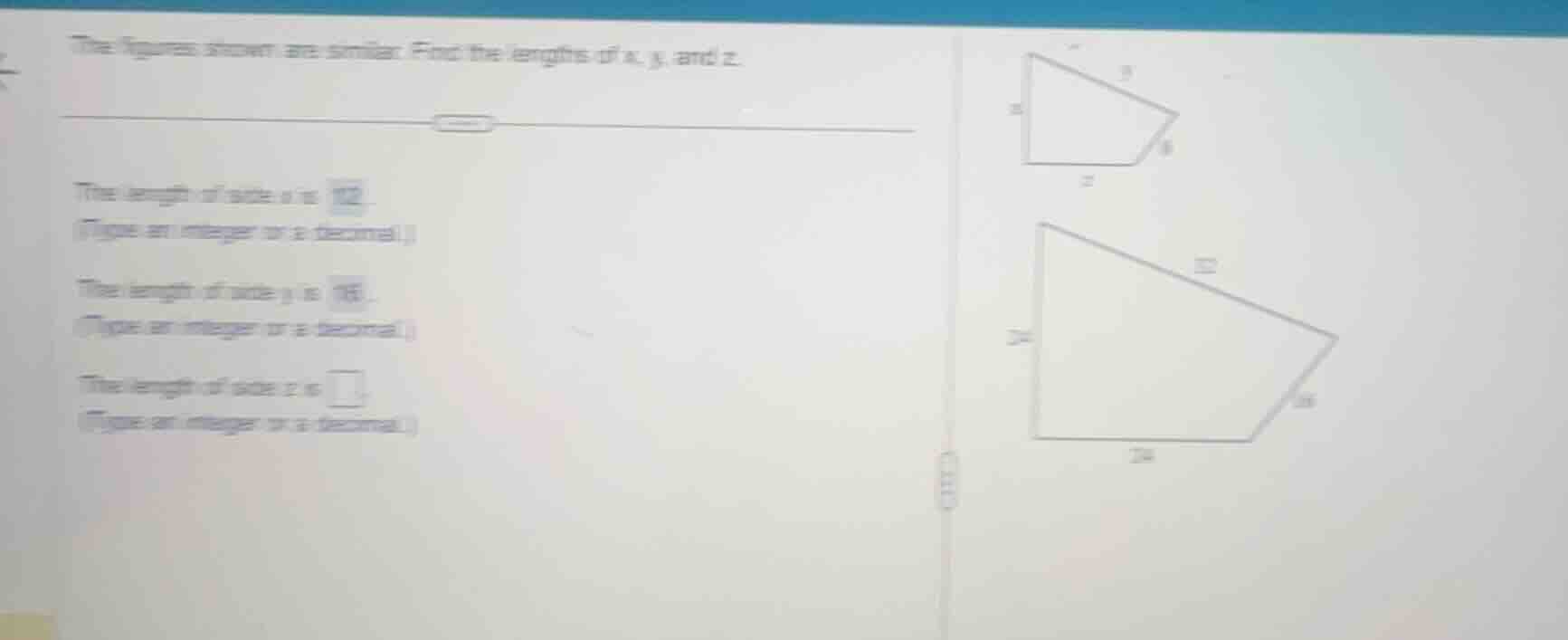
the figures shown are similar. find the lengths of x, y, and z.
the length of side x is \boxed{12}.
(type an integer or a decimal.)
the length of side y is \boxed{16}.
(type an integer or a decimal.)
the length of side z is \boxed{?}.
(type an integer or a decimal.)
images of two similar quadrilaterals: top one with sides x, y, 8, z; bottom one with sides 24, 32, 16, 24
Step1: Find the scale factor
The corresponding sides of similar figures are proportional. Let's take the sides with lengths 16 (in the smaller figure) and 32 (in the larger figure). The scale factor \( k \) is \( \frac{32}{16}=2 \)? Wait, no, wait. Wait, the larger figure has a side of 32, and the smaller has 16? Wait, no, looking at the figures: the smaller figure has a side of 8 (wait, no, the smaller figure: let's check the sides. Wait, the larger figure has a side of 24 (the bottom side), and the smaller figure's bottom side is \( z \)? Wait, no, the larger figure's side with length 16 (the right side) and the smaller figure's right side is 8. So the scale factor from smaller to larger is \( \frac{16}{8} = 2 \). So the scale factor \( k = 2 \).
Step2: Find \( x \)
The larger figure's left side is 24, and the smaller figure's left side is \( x \). Since scale factor is 2 (larger is 2 times smaller), so \( 24 = 2x \), so \( x = \frac{24}{2}=12 \). Wait, that's given, but let's confirm.
Step3: Find \( y \)
The larger figure's hypotenuse (or the slant side) is 32, and the smaller figure's corresponding side is \( y \). So \( 32 = 2y \), so \( y = \frac{32}{2}=16 \). Which matches the given.
Step4: Find \( z \)
The larger figure's bottom side is 24, and the smaller figure's bottom side is \( z \). So \( 24 = 2z \) (since scale factor is 2, larger is 2 times smaller), so \( z = \frac{24}{2}=12 \)? Wait, no, wait. Wait, maybe I got the scale factor reversed. Let's check the right sides: smaller figure has right side 8, larger has 16. So scale factor from smaller to larger is \( \frac{16}{8}=2 \). So larger is 2 times smaller. So smaller's bottom side \( z \), larger's bottom side is 24. So \( 24 = 2z \), so \( z = 12 \)? Wait, but let's check the bottom sides: smaller's bottom is \( z \), larger's is 24. So \( z \times 2 = 24 \), so \( z = 12 \). Wait, but let's confirm with another side. The larger's left side is 24, smaller's left side is \( x = 12 \), so 122=24. Correct. Larger's slant side is 32, smaller's is 16, 162=32. Correct. Larger's bottom is 24, smaller's is \( z \), so \( z \times 2 = 24 \), so \( z = 12 \). Wait, but let's check the right side: smaller's right is 8, larger's is 16, 8*2=16. Correct. So all sides: smaller's sides are \( x=12 \), \( y=16 \), \( z=12 \), and right side 8. Larger's sides: 24 (left), 32 (slant), 24 (bottom), 16 (right). So yes, scale factor 2. So \( z = 12 \)? Wait, but let's do it again. Let's list the corresponding sides:
Smaller figure sides: \( x \) (left), \( y \) (slant), \( z \) (bottom), 8 (right).
Larger figure sides: 24 (left), 32 (slant), 24 (bottom), 16 (right).
So the ratio of larger to smaller for each corresponding side:
Left: \( 24/x = 24/12 = 2 \)
Slant: \( 32/y = 32/16 = 2 \)
Bottom: \( 24/z \)
Right: \( 16/8 = 2 \)
So all ratios are 2, so \( 24/z = 2 \), so \( z = 24/2 = 12 \).
Wait, but the problem says "the length of side z is [ ]". So according to the calculations, \( z = 12 \)? Wait, but let's check the figures again. The smaller figure has bottom side \( z \), larger has 24. So yes, \( z = 12 \).
Wait, but maybe I made a mistake. Let's check the right sides: smaller is 8, larger is 16. So scale factor is 2. So all sides of larger are 2 times smaller. So:
- Smaller left: \( x \), larger left: 24 → \( 2x = 24 \) → \( x=12 \)
- Smaller slant: \( y \), larger slant: 32 → \( 2y = 32 \) → \( y=16 \)
- Smaller bottom: \( z \), larger bottom: 24 → \( 2z = 24 \) → \( z=12 \)
- Smaller right: 8, larger right: 16 → \( 2*8=16 \), correct.
So yes, \( z = 12…

Snap & solve any problem in the app
Get step-by-step solutions on Sovi AI
Photo-based solutions with guided steps
Explore more problems and detailed explanations
12