QUESTION IMAGE
Question
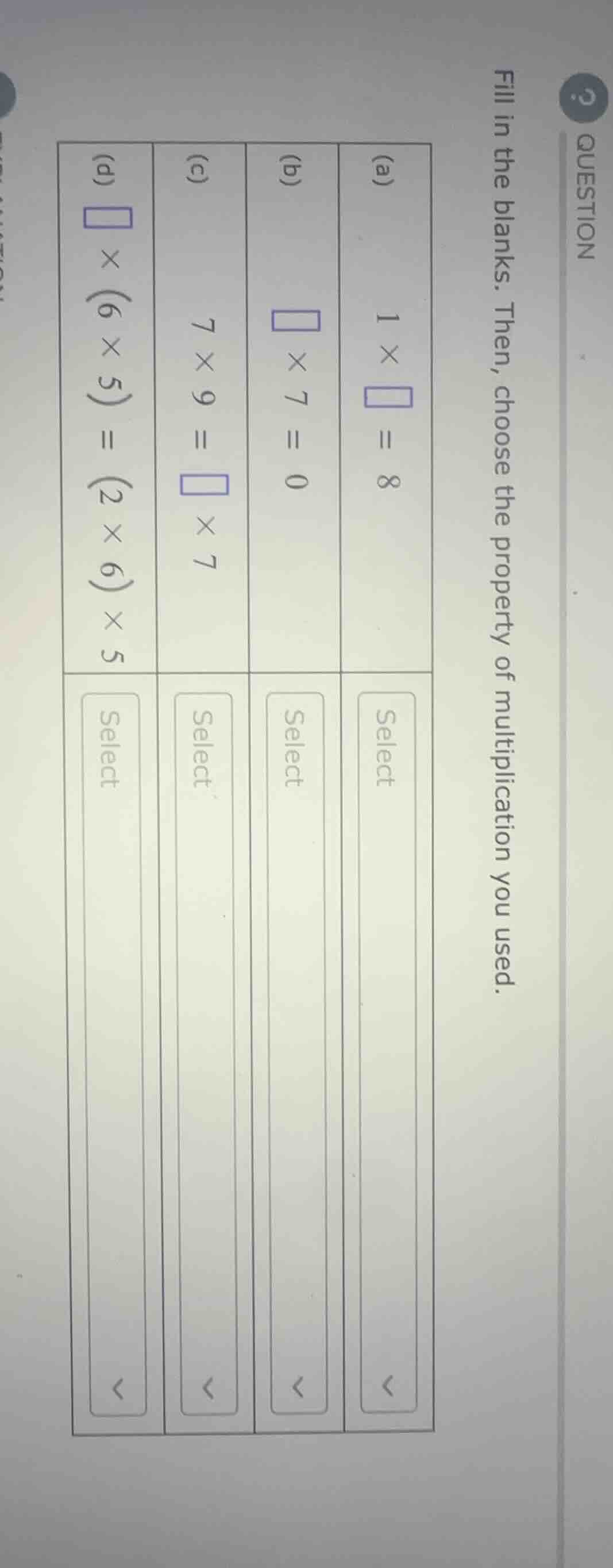
fill in the blanks. then, choose the property of multiplication you used.
(a) ( 1 \times square = 8 )
(b) ( square \times 7 = 0 )
(c) ( 7 \times 9 = square \times 7 )
(d) ( square \times (6 \times 5) = (2 \times 6) \times 5 )
Part (a)
Step1: Recall multiplicative identity
The multiplicative identity property states that \(1\times a = a\times1 = a\). Here, we need \(1\times\square = 8\), so the missing number should be 8.
\(1\times8 = 8\)
Step2: Identify the property
The property used is the Multiplicative Identity Property (since multiplying by 1 doesn't change the number).
Part (b)
Step1: Recall zero property of multiplication
The zero property of multiplication states that \(a\times0 = 0\times a = 0\). Here, we need \(\square\times7 = 0\), so the missing number is 0.
\(0\times7 = 0\)
Step2: Identify the property
The property used is the Zero Property of Multiplication (any number multiplied by 0 is 0).
Part (c)
Step1: Recall commutative property of multiplication
The commutative property of multiplication states that \(a\times b = b\times a\). Here, \(7\times9=\square\times7\), so by commutativity, \(\square = 9\) (since \(7\times9 = 9\times7\)).
\(7\times9 = 9\times7\)
Step2: Identify the property
The property used is the Commutative Property of Multiplication (order of multiplication doesn't matter).
Part (d)

Snap & solve any problem in the app
Get step-by-step solutions on Sovi AI
Photo-based solutions with guided steps
Explore more problems and detailed explanations
s:
(a) The blank is 8. Property: Multiplicative Identity Property.
(b) The blank is 0. Property: Zero Property of Multiplication.
(c) The blank is 9. Property: Commutative Property of Multiplication.
(d) The blank is 2. Property: Associative Property of Multiplication.
For the fill - in - the - blanks part:
(a) \(1\times\boldsymbol{8}=8\)
(b) \(\boldsymbol{0}\times7 = 0\)
(c) \(7\times9=\boldsymbol{9}\times7\)
(d) \(\boldsymbol{2}\times(6\times5)=(2\times6)\times5\)