QUESTION IMAGE
Question
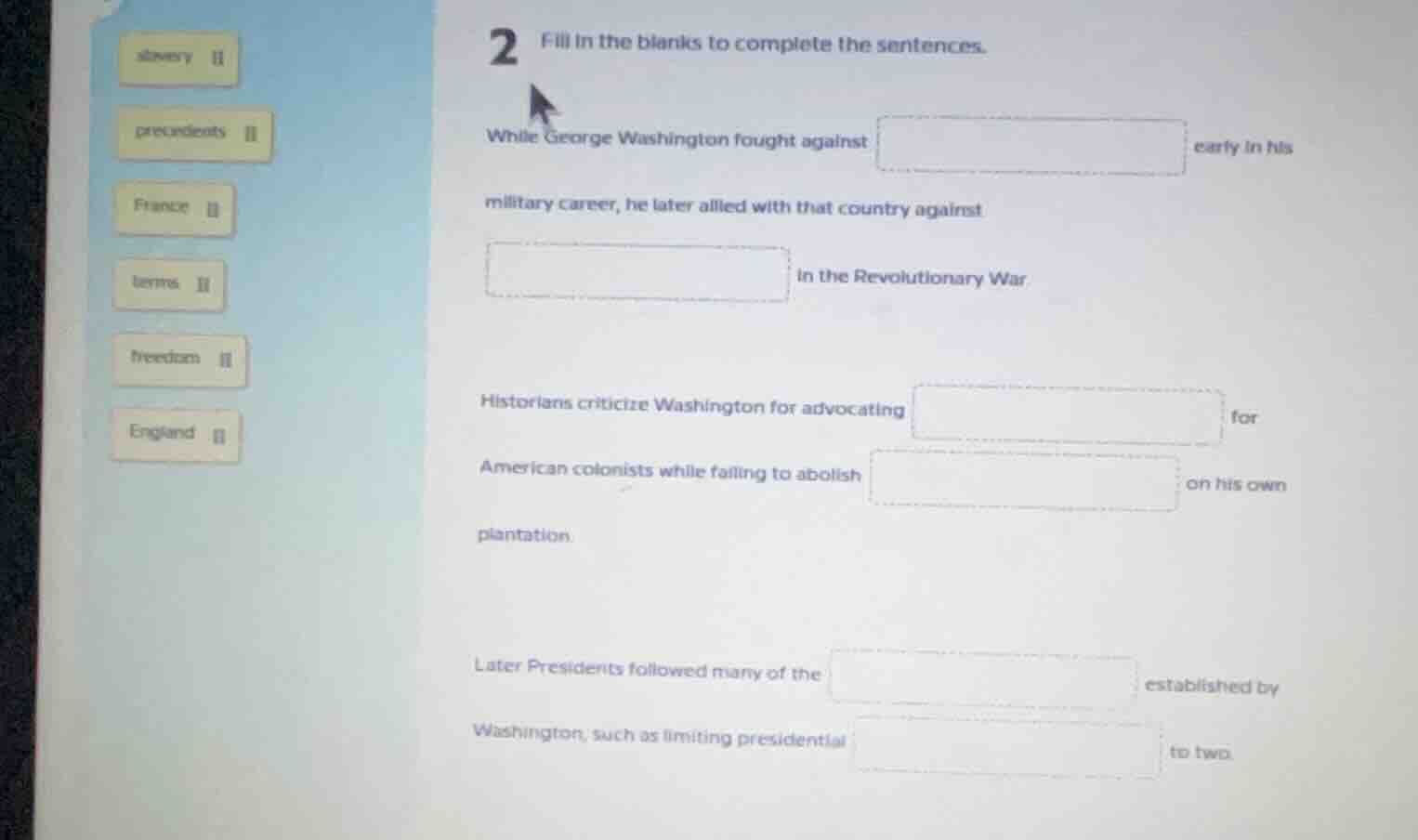
2 fill in the blanks to complete the sentences.
while george washington fought against
early in his
military career, he later allied with that country against
in the revolutionary war
historians criticize washington for advocating
for
american colonists while failing to abolish
on his own
plantation.
later presidents followed many of the
established by
washington, such as limiting presidential
to two.
First Sentence Blanks:
- First blank: In his early military career, George Washington fought in the French and Indian War against France? No, wait, the French and Indian War was Britain and its colonies (including Washington) against France and Native American allies. Wait, no, correction: The French and Indian War (part of the Seven Years' War) had British colonies (with Washington as a British colonial officer) fighting against France. Then, in the American Revolutionary War, the Americans (with Washington) allied with France against England (Britain). So first blank: France (he fought against France in French and Indian War early in career), second blank: England (allied with France against England in Revolutionary War).
Second Sentence Blanks:
- Washington advocated for freedom for American colonists (from British rule) but had slavery on his plantation. So first blank: freedom, second blank: slavery.
Third Sentence Blanks:
- Washington established precedents (customs/traditions) for the presidency, like limiting terms (he served two terms, setting a precedent) that later presidents followed. So first blank: precedents, second blank: terms.
Now filling the blanks:
- While George Washington fought against $\boldsymbol{\text{France}}$ early in his military career, he later allied with that country against $\boldsymbol{\text{England}}$ in the Revolutionary War.
- Historians criticize Washington for advocating $\boldsymbol{\text{freedom}}$ for American colonists while failing to abolish $\boldsymbol{\text{slavery}}$ on his own plantation.
- Later Presidents followed many of the $\boldsymbol{\text{precedents}}$ established by Washington, such as limiting presidential $\boldsymbol{\text{terms}}$ to two.
Final Answers (Filled Blanks):
- First sentence first blank: France
- First sentence second blank: England
- Second sentence first blank: freedom
- Second sentence second blank: slavery
- Third sentence first blank: precedents
- Third sentence second blank: terms
(If presenting as per the blanks in order: France, England, freedom, slavery, precedents, terms)

Snap & solve any problem in the app
Get step-by-step solutions on Sovi AI
Photo-based solutions with guided steps
Explore more problems and detailed explanations
First Sentence Blanks:
- First blank: In his early military career, George Washington fought in the French and Indian War against France? No, wait, the French and Indian War was Britain and its colonies (including Washington) against France and Native American allies. Wait, no, correction: The French and Indian War (part of the Seven Years' War) had British colonies (with Washington as a British colonial officer) fighting against France. Then, in the American Revolutionary War, the Americans (with Washington) allied with France against England (Britain). So first blank: France (he fought against France in French and Indian War early in career), second blank: England (allied with France against England in Revolutionary War).
Second Sentence Blanks:
- Washington advocated for freedom for American colonists (from British rule) but had slavery on his plantation. So first blank: freedom, second blank: slavery.
Third Sentence Blanks:
- Washington established precedents (customs/traditions) for the presidency, like limiting terms (he served two terms, setting a precedent) that later presidents followed. So first blank: precedents, second blank: terms.
Now filling the blanks:
- While George Washington fought against $\boldsymbol{\text{France}}$ early in his military career, he later allied with that country against $\boldsymbol{\text{England}}$ in the Revolutionary War.
- Historians criticize Washington for advocating $\boldsymbol{\text{freedom}}$ for American colonists while failing to abolish $\boldsymbol{\text{slavery}}$ on his own plantation.
- Later Presidents followed many of the $\boldsymbol{\text{precedents}}$ established by Washington, such as limiting presidential $\boldsymbol{\text{terms}}$ to two.
Final Answers (Filled Blanks):
- First sentence first blank: France
- First sentence second blank: England
- Second sentence first blank: freedom
- Second sentence second blank: slavery
- Third sentence first blank: precedents
- Third sentence second blank: terms
(If presenting as per the blanks in order: France, England, freedom, slavery, precedents, terms)