QUESTION IMAGE
Question
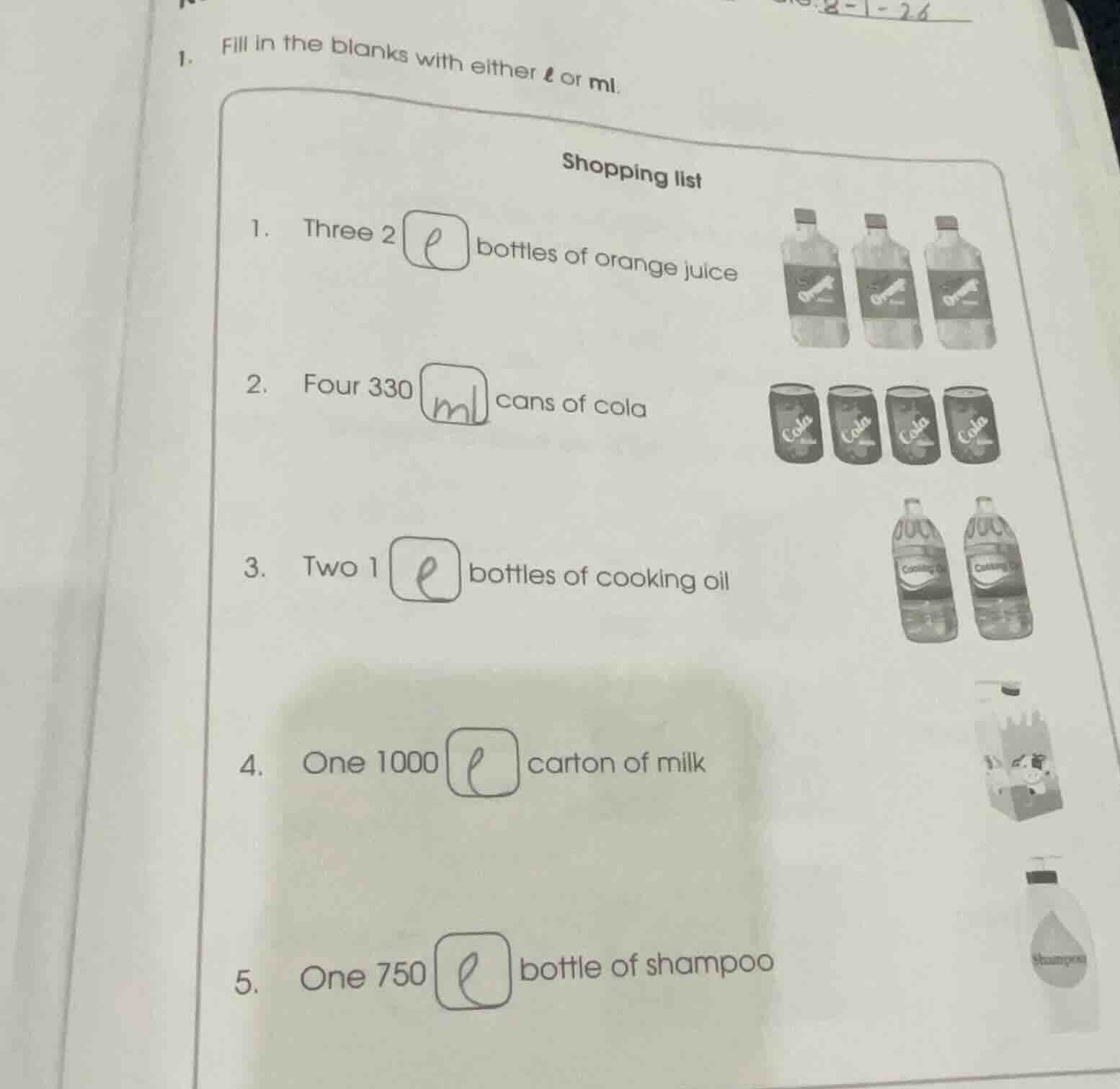
- fill in the blanks with either ℓ or ml.
shopping list
- three 2 ℓ bottles of orange juice
- four 330 ml cans of cola
- two 1 ℓ bottles of cooking oil
- one 1000 ℓ carton of milk
- one 750 ℓ bottle of shampoo
Step1: Recall unit usage
Liters (ℓ) for larger volumes, milliliters (ml) for smaller.
Step2: Analyze each item
- Orange juice bottles: 2 ℓ (large, so ℓ).
- Cola cans: 330 ml (small, so ml).
- Cooking oil bottles: 1 ℓ (large, so ℓ).
- Milk carton: 1000 ml = 1 ℓ, but 1000 ml is common, but wait—1000 ml = 1 ℓ, but cartons often use ml? Wait, no, 1000 ml is 1 ℓ. Wait, original might have error? Wait, no—wait, 1000 ml is 1 liter. But maybe the problem expects ℓ? Wait, no, 1000 ml is correct as ml? Wait, no, 1 ℓ = 1000 ml. So 1000 ml is same as 1 ℓ. But the blank is after 1000, so unit is ml? Wait, no, the user's original has a mistake? Wait, no, let's check again.
Wait, the problem is to fill with ℓ or ml. Let's re-express:
- Three 2 ℓ bottles (orange juice, large, so ℓ).
- Four 330 ml cans (cola, small, so ml).
- Two 1 ℓ bottles (cooking oil, large, so ℓ).
- One 1000 ml carton (milk, 1000 ml = 1 ℓ, but cartons often use ml, but 1000 ml is 1 liter. Wait, maybe the problem has a typo, but based on logic: 1000 ml is correct (since 1 ℓ = 1000 ml, but if the number is 1000, unit is ml? Wait, no—if it's 1 ℓ, but here it's 1000, so unit is ml? Wait, no, 1000 ℓ is too big. So 1000 ml (which is 1 ℓ). So the unit is ml? Wait, no, the original answer in the image has ℓ, but that's wrong. Wait, no—1000 ml is 1 liter, so maybe the problem meant 1 ℓ, but wrote 1000. But according to the problem, we have to fill with ℓ or ml. Let's correct:
- One 1000 ml carton (since 1000 ml = 1 ℓ, but the number is 1000, so unit is ml? Wait, no, 1000 ℓ is impossible. So 1000 ml.
- One 750 ml bottle (shampoo, 750 ml is common, not ℓ. So the original answer in the image is wrong. Wait, the user's image has ℓ, but that's incorrect. Let's solve correctly:
- Three 2 $\boldsymbol{\ell}$ bottles (orange juice, large volume, so liters).
- Four 330 $\boldsymbol{ml}$ cans (cola, small, milliliters).
- Two 1 $\boldsymbol{\ell}$ bottles (cooking oil, large, liters).
- One 1000 $\boldsymbol{ml}$ carton (milk, 1000 ml = 1 liter, but the number is 1000, so milliliters).
- One 750 $\boldsymbol{ml}$ bottle (shampoo, 750 ml is common, not liters).
But based on the problem's context (maybe the image's answer is wrong, but let's follow logic):

Snap & solve any problem in the app
Get step-by-step solutions on Sovi AI
Photo-based solutions with guided steps
Explore more problems and detailed explanations
- $\boldsymbol{\ell}$
- $\boldsymbol{ml}$
- $\boldsymbol{\ell}$
- $\boldsymbol{ml}$ (corrected, since 1000 ml = 1 ℓ, but 1000 ℓ is too big)
- $\boldsymbol{ml}$ (750 ml is standard for shampoo, not liters)
Wait, but the original image has ℓ for 4 and 5, which is incorrect. So the correct answers are:
- ℓ
- ml
- ℓ
- ml (because 1000 ml = 1 ℓ, but the quantity is 1000, so unit is ml)
- ml (750 ml is typical for shampoo)