QUESTION IMAGE
Question
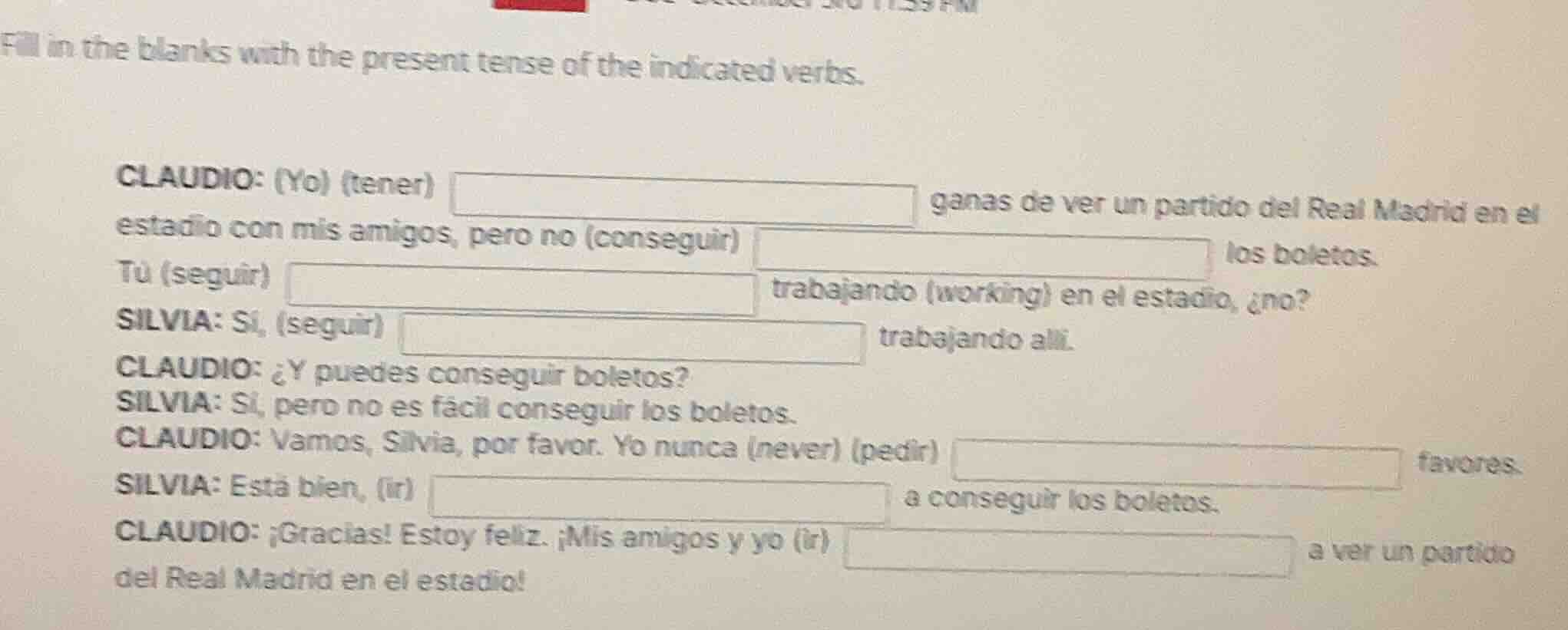
fill in the blanks with the present tense of the indicated verbs.
claudio: (yo) (tener) ganas de ver un partido del real madrid en el estadio con mis amigos, pero no (conseguir) los boletos.
tú (seguir) trabajando (working) en el estadio, ¿no?
silvia: sí, (seguir) trabajando allí.
claudio: ¿y puedes conseguir boletos?
silvia: sí, pero no es fácil conseguir los boletos.
claudio: vamos, silvia, por favor. yo nunca (never) (pedir) favores.
silvia: está bien, (ir) a conseguir los boletos.
claudio: ¡gracias! estoy feliz. ¡mis amigos y yo (ir) a ver un partido del real madrid en el estadio!
To solve this, we need to conjugate the verbs in the present tense for the appropriate subjects in Spanish. Let's go through each blank:
1. (Yo) (tener)
For the subject "yo" (I), the present tense conjugation of "tener" is "tengo".
2. no (conseguir)
The subject here is implied as "yo" (since it's Claudio speaking about himself), but in negative sentences with "no", for "conseguir" (to get), the conjugation for "yo" is "consigo", but wait, no—wait, "conseguir" in present tense: yo consigo, tú consigues, él/ella consigue, nosotros conseguimos, vosotros conseguís, ellos consiguen. Wait, but the sentence is "pero no (conseguir) los boletos"—the subject is "yo" (Claudio), so "yo no consigo los boletos". So "consigo".
Wait, maybe I made a mistake. Let's recall:
- Tener: yo tengo, tú tienes, él/ella tiene, nosotros tenemos, vosotros tenéis, ellos tienen.
- Conseguir: yo consigo, tú consigues, él/ella consigue, nosotros conseguimos, vosotros conseguís, ellos consiguen.
- Seguir: yo sigo, tú sigues, él/ella sigue, nosotros seguimos, vosotros seguís, ellos siguen.
- Pedir: yo pido, tú pides, él/ella pide, nosotros pedimos, vosotros pedís, ellos piden.
- Ir: yo voy, tú vas, él/ella va, nosotros vamos, vosotros vais, ellos van.
Let's re-examine each blank:
- (Yo) (tener): yo + tener → tengo.
- no (conseguir): subject is yo (Claudio), so yo no consigo → consigo.
- Tú (seguir): tú + seguir → sigues.
- (yo, but Silvia is speaking, so "yo" for Silvia? Wait, Silvia says "Sí, (seguir) trabajando allí." The subject is "yo" (Silvia), so yo + seguir → sigo.
- Yo nunca (pedir): yo + pedir → pido.
- Está bien, (ir) a conseguir: the subject is "yo" (Silvia), so yo + ir → voy.
- Mis amigos y yo (ir): "mis amigos y yo" is "nosotros", so nosotros + ir → vamos.
Wait, let's check each sentence:
- CLAUDIO: (Yo) (tener) ______ ganas... → yo tengo → tengo.
- pero no (conseguir) ______ los boletos. → yo no consigo → consigo.
- Tú (seguir) ______ trabajando... → tú sigues → sigues.
- SILVIA: Sí, (seguir) ______ trabajando allí. → yo sigo → sigo.
- CLAUDIO: Yo nunca (pedir) ______ favores. → yo pido → pido.
- SILVIA: Está bien, (ir) ______ a conseguir... → yo voy → voy.
- CLAUDIO: Mis amigos y yo (ir) ______ a ver... → nosotros vamos → vamos.
So the blanks should be filled as follows:
- tengo
- consigo
- sigues
- sigo
- pido
- voy
- vamos
Let's verify each conjugation:
- Tener (yo): tengo ✔️
- Conseguir (yo): consigo ✔️
- Seguir (tú): sigues ✔️
- Seguir (yo, Silvia): sigo ✔️
- Pedir (yo): pido ✔️
- Ir (yo, Silvia): voy ✔️
- Ir (nosotros, mis amigos y yo): vamos ✔️
Yes, these are the correct present tense conjugations for the respective subjects.

Snap & solve any problem in the app
Get step-by-step solutions on Sovi AI
Photo-based solutions with guided steps
Explore more problems and detailed explanations
To solve this, we need to conjugate the verbs in the present tense for the appropriate subjects in Spanish. Let's go through each blank:
1. (Yo) (tener)
For the subject "yo" (I), the present tense conjugation of "tener" is "tengo".
2. no (conseguir)
The subject here is implied as "yo" (since it's Claudio speaking about himself), but in negative sentences with "no", for "conseguir" (to get), the conjugation for "yo" is "consigo", but wait, no—wait, "conseguir" in present tense: yo consigo, tú consigues, él/ella consigue, nosotros conseguimos, vosotros conseguís, ellos consiguen. Wait, but the sentence is "pero no (conseguir) los boletos"—the subject is "yo" (Claudio), so "yo no consigo los boletos". So "consigo".
Wait, maybe I made a mistake. Let's recall:
- Tener: yo tengo, tú tienes, él/ella tiene, nosotros tenemos, vosotros tenéis, ellos tienen.
- Conseguir: yo consigo, tú consigues, él/ella consigue, nosotros conseguimos, vosotros conseguís, ellos consiguen.
- Seguir: yo sigo, tú sigues, él/ella sigue, nosotros seguimos, vosotros seguís, ellos siguen.
- Pedir: yo pido, tú pides, él/ella pide, nosotros pedimos, vosotros pedís, ellos piden.
- Ir: yo voy, tú vas, él/ella va, nosotros vamos, vosotros vais, ellos van.
Let's re-examine each blank:
- (Yo) (tener): yo + tener → tengo.
- no (conseguir): subject is yo (Claudio), so yo no consigo → consigo.
- Tú (seguir): tú + seguir → sigues.
- (yo, but Silvia is speaking, so "yo" for Silvia? Wait, Silvia says "Sí, (seguir) trabajando allí." The subject is "yo" (Silvia), so yo + seguir → sigo.
- Yo nunca (pedir): yo + pedir → pido.
- Está bien, (ir) a conseguir: the subject is "yo" (Silvia), so yo + ir → voy.
- Mis amigos y yo (ir): "mis amigos y yo" is "nosotros", so nosotros + ir → vamos.
Wait, let's check each sentence:
- CLAUDIO: (Yo) (tener) ______ ganas... → yo tengo → tengo.
- pero no (conseguir) ______ los boletos. → yo no consigo → consigo.
- Tú (seguir) ______ trabajando... → tú sigues → sigues.
- SILVIA: Sí, (seguir) ______ trabajando allí. → yo sigo → sigo.
- CLAUDIO: Yo nunca (pedir) ______ favores. → yo pido → pido.
- SILVIA: Está bien, (ir) ______ a conseguir... → yo voy → voy.
- CLAUDIO: Mis amigos y yo (ir) ______ a ver... → nosotros vamos → vamos.
So the blanks should be filled as follows:
- tengo
- consigo
- sigues
- sigo
- pido
- voy
- vamos
Let's verify each conjugation:
- Tener (yo): tengo ✔️
- Conseguir (yo): consigo ✔️
- Seguir (tú): sigues ✔️
- Seguir (yo, Silvia): sigo ✔️
- Pedir (yo): pido ✔️
- Ir (yo, Silvia): voy ✔️
- Ir (nosotros, mis amigos y yo): vamos ✔️
Yes, these are the correct present tense conjugations for the respective subjects.