QUESTION IMAGE
Question
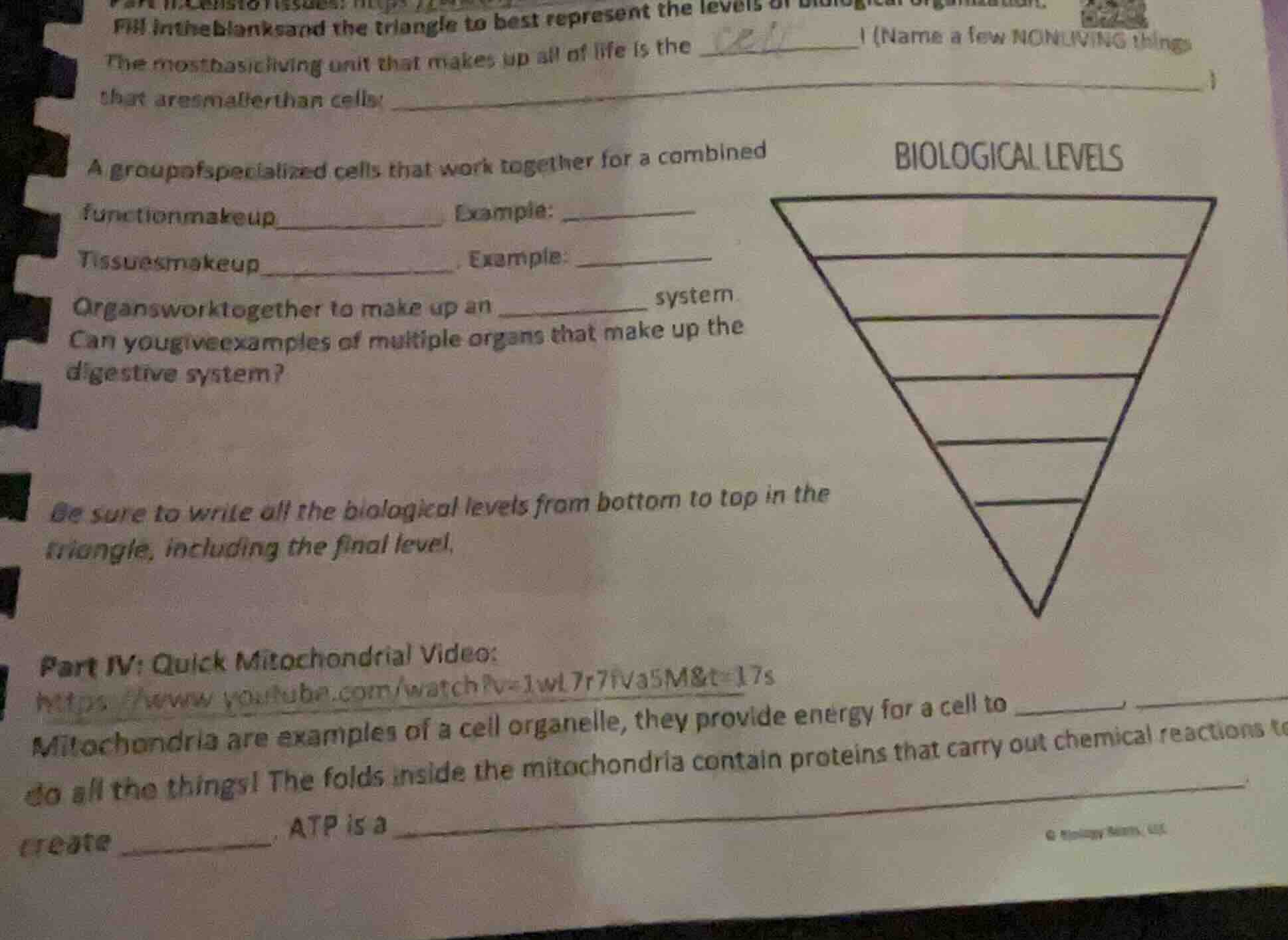
fill in the blanks and the triangle to best represent the levels of biological organization.
the most basic living unit that makes up all of life is the ____! (name a few nonliving things that are smaller than cells: ____)
a group of specialized cells that work together for a combined function makeup ____. example: ____
tissues makeup ____. example: ____
organs work together to make up an ______ system.
can you give examples of multiple organs that make up the digestive system?
be sure to write all the biological levels from bottom to top in the triangle, including the final level.
part iv: quick mitochondrial video:
https://www.youtube.com/watch?v=1wl7r7fva5m&t=17s
mitochondria are examples of a cell organelle, they provide energy for a cell to ____, __ do all the things! the folds inside the mitochondria contain proteins that carry out chemical reactions to create __. atp is a ____.
Filling the Blanks for Biological Organization Levels:
1. The most basic living unit...
- The most basic living unit that makes up all of life is the cell.
- Non - living things smaller than cells: Molecules (e.g., water molecules, glucose molecules), atoms (e.g., carbon atoms, oxygen atoms).
2. A group of specialized cells...
- A group of specialized cells that work together for a combined function make up a tissue.
- Example: Muscle tissue (muscle cells work together to enable movement), or Epithelial tissue (covers body surfaces and lines cavities).
3. Tissues make up...
- Tissues make up an organ.
- Example: The heart (made of cardiac muscle tissue, connective tissue, etc., to pump blood), or the stomach (made of muscle tissue, epithelial tissue, etc., to digest food).
4. Organs work together...
- Organs work together to make up an organ system.
- Examples of organs in the digestive system: Stomach (digests food), small intestine (absorbs nutrients), large intestine (absorbs water and forms feces), esophagus (transports food to the stomach), liver (produces bile for fat digestion), pancreas (produces digestive enzymes).
Filling the Blanks for Mitochondria Section:
- Mitochondria are examples of a cell organelle, they provide energy for a cell to grow, reproduce, move, (and other cellular activities).
- The folds inside the mitochondria contain proteins that carry out chemical reactions to create ATP (Adenosine Triphosphate).
- ATP is a molecule that stores and transfers energy within cells (it's the energy currency of the cell).
Filling the Triangle (Biological Levels from bottom to top):
From the most basic (bottom) to the most complex (top), the biological levels are:
- Cell (bottom)
- Tissue
- Organ
- Organ System
- Organism (top, representing a complete living entity made of organ systems working together)
Final Answers (Key Blanks):
- Most basic living unit: $\boldsymbol{\text{cell}}$
- Non - living things smaller than cells: $\boldsymbol{\text{Molecules (e.g., H}_2\text{O), Atoms (e.g., C)}}$ (examples)
- Group of specialized cells: $\boldsymbol{\text{tissue}}$; Example: $\boldsymbol{\text{Muscle tissue}}$
- Tissues make up: $\boldsymbol{\text{organ}}$; Example: $\boldsymbol{\text{Heart}}$
- Organs make up: $\boldsymbol{\text{organ system}}$; Digestive system organs: $\boldsymbol{\text{Stomach, Small Intestine, etc.}}$
- Mitochondria energy for cell: $\boldsymbol{\text{grow, reproduce}}$ (examples)
- Mitochondria create: $\boldsymbol{\text{ATP}}$
- ATP is a: $\boldsymbol{\text{energy - carrying molecule}}$
(Note: Some answers have examples, and the exact wording can vary based on standard biological definitions and classroom context.)

Snap & solve any problem in the app
Get step-by-step solutions on Sovi AI
Photo-based solutions with guided steps
Explore more problems and detailed explanations
Filling the Blanks for Biological Organization Levels:
1. The most basic living unit...
- The most basic living unit that makes up all of life is the cell.
- Non - living things smaller than cells: Molecules (e.g., water molecules, glucose molecules), atoms (e.g., carbon atoms, oxygen atoms).
2. A group of specialized cells...
- A group of specialized cells that work together for a combined function make up a tissue.
- Example: Muscle tissue (muscle cells work together to enable movement), or Epithelial tissue (covers body surfaces and lines cavities).
3. Tissues make up...
- Tissues make up an organ.
- Example: The heart (made of cardiac muscle tissue, connective tissue, etc., to pump blood), or the stomach (made of muscle tissue, epithelial tissue, etc., to digest food).
4. Organs work together...
- Organs work together to make up an organ system.
- Examples of organs in the digestive system: Stomach (digests food), small intestine (absorbs nutrients), large intestine (absorbs water and forms feces), esophagus (transports food to the stomach), liver (produces bile for fat digestion), pancreas (produces digestive enzymes).
Filling the Blanks for Mitochondria Section:
- Mitochondria are examples of a cell organelle, they provide energy for a cell to grow, reproduce, move, (and other cellular activities).
- The folds inside the mitochondria contain proteins that carry out chemical reactions to create ATP (Adenosine Triphosphate).
- ATP is a molecule that stores and transfers energy within cells (it's the energy currency of the cell).
Filling the Triangle (Biological Levels from bottom to top):
From the most basic (bottom) to the most complex (top), the biological levels are:
- Cell (bottom)
- Tissue
- Organ
- Organ System
- Organism (top, representing a complete living entity made of organ systems working together)
Final Answers (Key Blanks):
- Most basic living unit: $\boldsymbol{\text{cell}}$
- Non - living things smaller than cells: $\boldsymbol{\text{Molecules (e.g., H}_2\text{O), Atoms (e.g., C)}}$ (examples)
- Group of specialized cells: $\boldsymbol{\text{tissue}}$; Example: $\boldsymbol{\text{Muscle tissue}}$
- Tissues make up: $\boldsymbol{\text{organ}}$; Example: $\boldsymbol{\text{Heart}}$
- Organs make up: $\boldsymbol{\text{organ system}}$; Digestive system organs: $\boldsymbol{\text{Stomach, Small Intestine, etc.}}$
- Mitochondria energy for cell: $\boldsymbol{\text{grow, reproduce}}$ (examples)
- Mitochondria create: $\boldsymbol{\text{ATP}}$
- ATP is a: $\boldsymbol{\text{energy - carrying molecule}}$
(Note: Some answers have examples, and the exact wording can vary based on standard biological definitions and classroom context.)