QUESTION IMAGE
Question
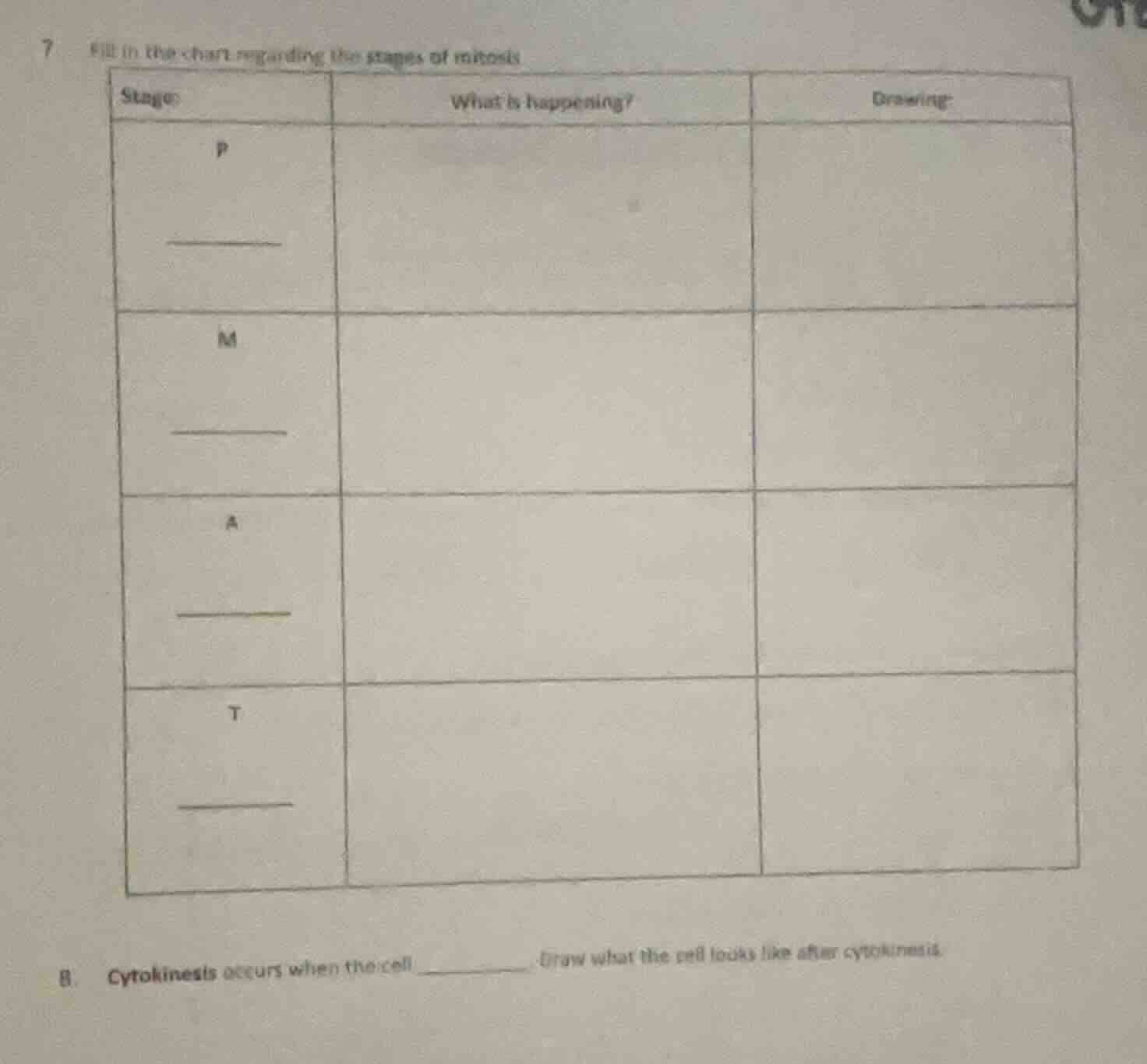
7 fill in the chart regarding the stages of mitosis
stage | what is happening? | drawing
p
______ | |
m
______ | |
a
______ | |
t
______ | |
- cytokinesis occurs when the cell ______. draw what the cell looks like after cytokinesis.
Question 7 (Filling the Mitosis Stages Chart)
- Stage P (Prophase): Chromosomes condense, nuclear envelope breaks down, spindle fibers form.
- Stage M (Metaphase): Chromosomes align at the cell's equatorial plate (metaphase plate).
- Stage A (Anaphase): Sister chromatids separate and move to opposite poles of the cell.
- Stage T (Telophase): Chromosomes decondense, nuclear envelopes reform around each set of chromosomes, spindle fibers break down.
Filled Chart:
| Stage | What is happening? | Drawing (Description) |
|---|---|---|
| M (Metaphase) | Chromosomes align at the metaphase plate (equator of the cell). | Chromosomes lined up in the middle of the cell, spindle fibers attached to centromeres |
| A (Anaphase) | Sister chromatids separate and move to opposite cell poles. | Chromatids moving towards opposite ends, cell elongating |
| T (Telophase) | Chromosomes decondense, nuclear envelopes reform, spindle fibers break down. | Two sets of chromosomes with new nuclear envelopes, cell ready to divide (cytokinesis) |
Question 8 (Cytokinesis)
Cytokinesis is the process where the cytoplasm of a parental cell divides into two daughter cells. In animal cells, a cleavage furrow forms and pinches the cell into two. In plant cells, a cell plate forms that eventually becomes the new cell wall. After cytokinesis, there are two separate daughter cells, each with its own nucleus and organelles, identical to the parent cell (in mitosis).

Snap & solve any problem in the app
Get step-by-step solutions on Sovi AI
Photo-based solutions with guided steps
Explore more problems and detailed explanations
Cytokinesis occurs when the cell divides its cytoplasm to form two daughter cells.
Drawing Description (After Cytokinesis):
- For an animal cell: Two separate round cells, each with a nucleus, cytoplasm, and cell membrane. The cleavage furrow has completed the division.
- For a plant cell: Two adjacent rectangular cells, each with a cell wall, cell membrane, nucleus, and cytoplasm. A new cell wall (from the cell plate) separates them.