QUESTION IMAGE
Question
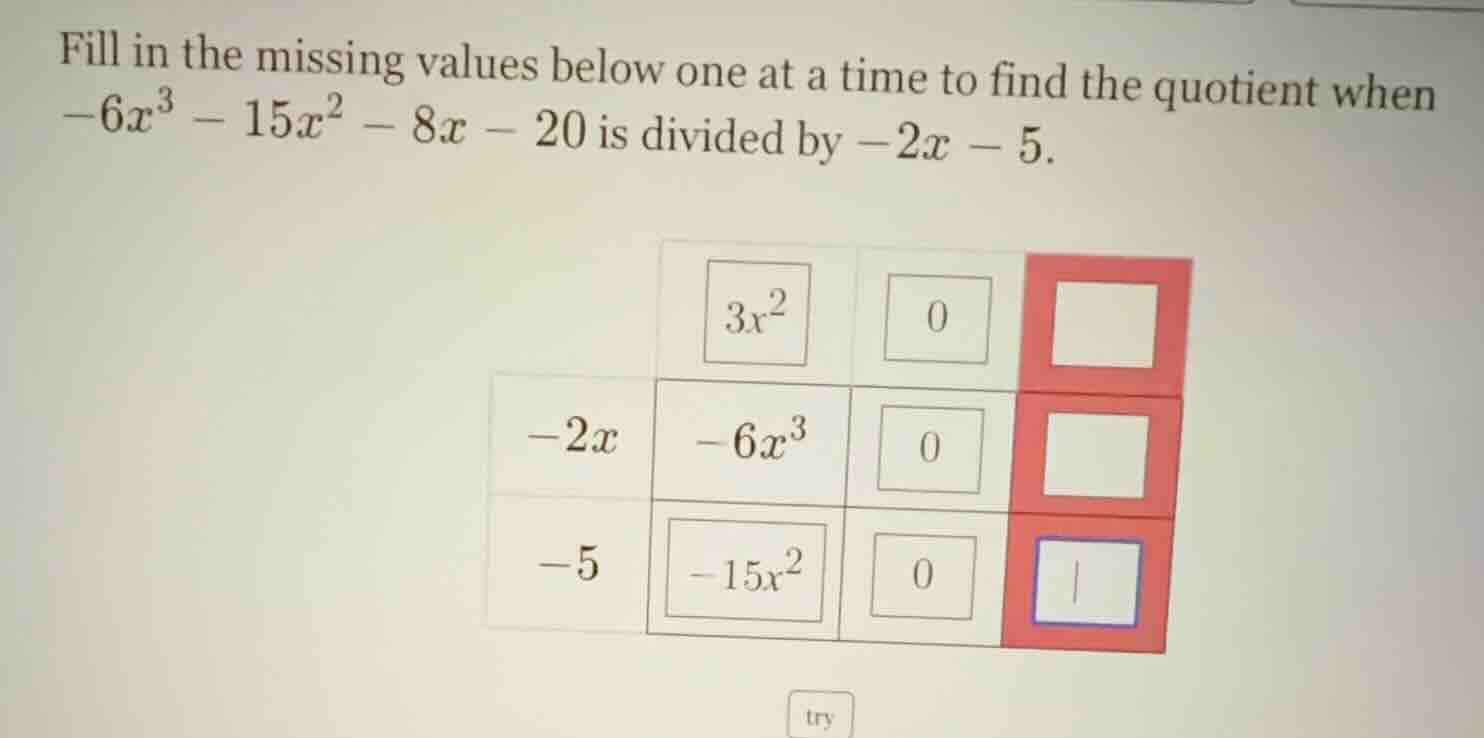
fill in the missing values below one at a time to find the quotient when $-6x^{3}-15x^{2}-8x - 20$ is divided by $-2x - 5$.
Step1: Analyze the division structure
We are dividing \(-6x^3 - 15x^2 - 8x - 20\) by \(-2x - 5\) using a box (area) method. The top row and left column are the terms of the quotient and divisor respectively. The product of the terms in the top row and left column should add up to the dividend.
First, let's find the last term of the quotient. We know that the last term of the dividend is \(-20\) and the last term of the divisor is \(-5\). Let the last term of the quotient be \(a\). Then, the product of \(-5\) (from the divisor) and \(a\) (from the quotient) plus the product of \(-2x\) (from the divisor) and the middle term of the quotient (which is \(0\)) should give the last two terms of the dividend \(-8x - 20\). Wait, maybe a better way: the total dividend is the sum of the products of each row and column.
The dividend is \(-6x^3 - 15x^2 - 8x - 20\). We already have \(-6x^3\) (from \(-2x\times3x^2\)), \(-15x^2\) (from \(-5\times3x^2\)), then we need to find the terms for the last column (the constant term and the linear term).
Let the last term of the quotient be \(k\). Then, the product of \(-2x\) and \(k\) is \(-2xk\), and the product of \(-5\) and \(k\) is \(-5k\). The sum of the linear terms should be \(-8x\), and the sum of the constant terms should be \(-20\).
We know that the middle term of the quotient is \(0\) (from the second column, \(-2x\times0 = 0\) and \(-5\times0 = 0\)). So now, for the linear term: \(-2xk=-8x\), solving for \(k\): divide both sides by \(-2x\) (assuming \(x
eq0\)), we get \(k = \frac{-8x}{-2x}=4\). Wait, but let's check the constant term: \(-5k=-20\), so \(k = \frac{-20}{-5}=4\). So the last term of the quotient is \(4\)? Wait, no, wait the blue box is the constant term from \(-5\times k\), which is \(-5k=-20\), so \(k = 4\)? But the blue box is currently \(1\), which is wrong. Wait, maybe I misread. Wait the problem is to fill in the missing values. Let's re-examine the table.
The table has rows: \(-2x\) and \(-5\) (divisor terms), columns: \(3x^2\), \(0\), and \(k\) (quotient terms). The product of each row and column:
- First row (\(-2x\)): \(-2x\times3x^2=-6x^3\) (first cell), \(-2x\times0 = 0\) (second cell), \(-2x\times k=-2xk\) (third cell, red bottom left? Wait no, the columns are \(3x^2\), \(0\), \(k\); rows are \(-2x\), \(-5\).
So the cells are:
- \(-2x\times3x^2=-6x^3\) (top left)
- \(-2x\times0 = 0\) (middle left)
- \(-2x\times k=-2xk\) (bottom left, red)
- \(-5\times3x^2=-15x^2\) (top middle)
- \(-5\times0 = 0\) (middle middle)
- \(-5\times k=-5k\) (bottom middle, blue)
- Then the sum of each column: first column: \(-6x^3 -15x^2\) (matches the first two terms of dividend), second column: \(0 + 0 = 0\) (middle term of dividend? Wait the dividend has no \(x\) term in the middle? Wait the dividend is \(-6x^3 -15x^2 -8x -20\), so the middle term (the \(x\) term) is \(-8x\), and the constant term is \(-20\). So the sum of the third column (the last column) should be \(-8x -20\). The third column has two cells: \(-2xk\) (from \(-2x\) row) and \(-5k\) (from \(-5\) row). So \(-2xk -5k=-8x -20\). Factor out \(k\): \(k(-2x -5)=-8x -20\). Notice that \(-8x -20 = 4(-2x -5)\), so \(k = 4\). Therefore, the last term of the quotient (top right cell) is \(4\), the middle red cell (from \(-2x\) row, last column) is \(-2x\times4=-8x\), and the blue cell (from \(-5\) row, last column) is \(-5\times4=-20\).
Wait the blue cell is currently \(1\), which is incorrect. So let's fill in the missing values:
- Top right cell (quotient's last term): \(4\) (since \(-2x\times4=-8x\) and \(-5\times4=-20\…

Snap & solve any problem in the app
Get step-by-step solutions on Sovi AI
Photo-based solutions with guided steps
Explore more problems and detailed explanations
- Top right cell (quotient's last term): \(4\)
- Middle red cell (from \(-2x\) row, last column): \(-8x\)
- Blue cell (from \(-5\) row, last column): \(-20\)