QUESTION IMAGE
Question
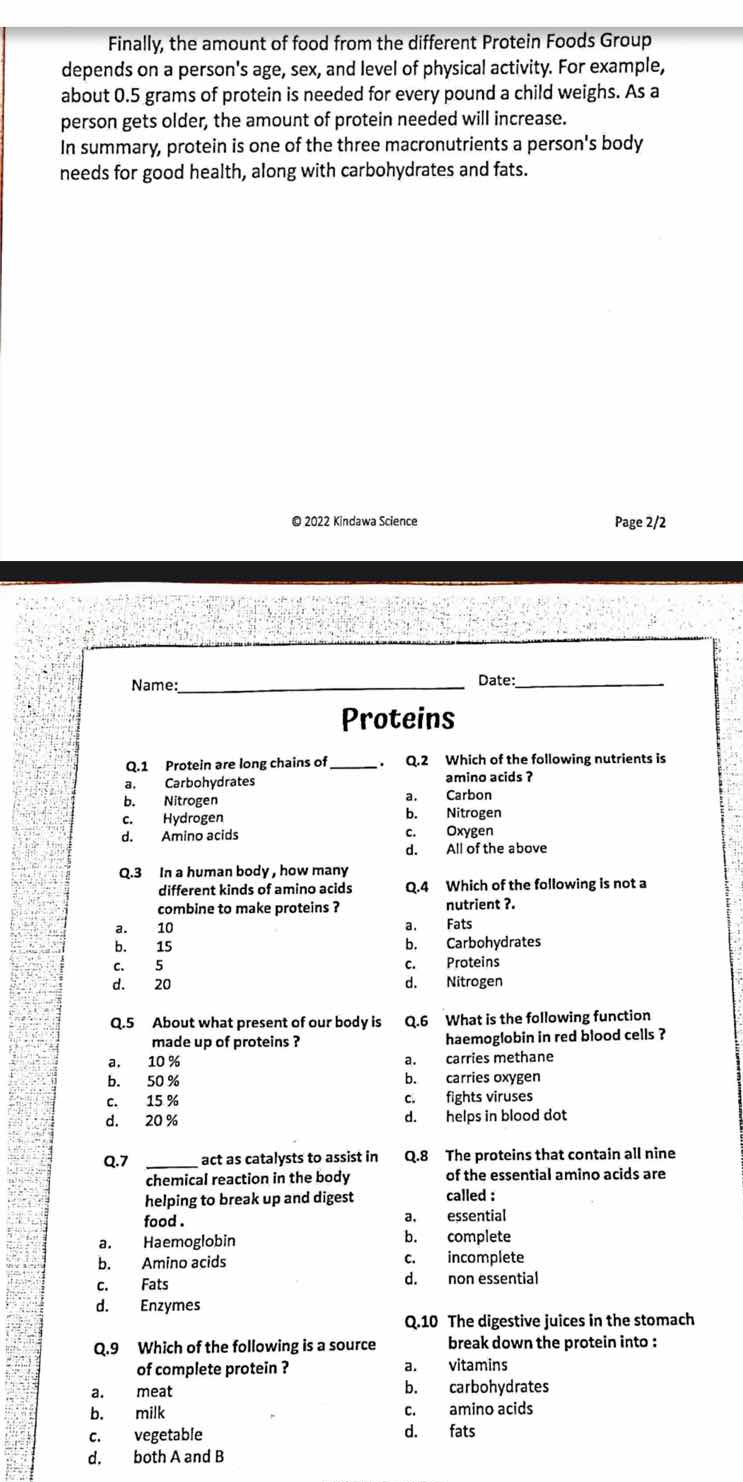
finally, the amount of food from the different protein foods group depends on a persons age, sex, and level of physical activity. for example, about 0.5 grams of protein is needed for every pound a child weighs. as a person gets older, the amount of protein needed will increase.in summary, protein is one of the three macronutrients a persons body needs for good health, along with carbohydrates and fats.© 2022 kindawa sciencepage 2/2name:_________ date:_______proteinsq.1 protein are long chains of __.a. carbohydratesb. nitrogenc. hydrogend. amino acidsq.2 which of the following nutrients is amino acids?a. carbonb. nitrogenc. oxygend. all of the aboveq.3 in a human body, how many different kinds of amino acids combine to make proteins?a. 10b. 15c. 5d. 20q.4 which of the following is not a nutrient?.a. fatsb. carbohydratesc. proteinsd. nitrogenq.5 about what present of our body is made up of proteins?a. 10 %b. 50 %c. 15 %d. 20 %q.6 what is the following function haemoglobin in red blood cells?a. carries methaneb. carries oxygenc. fights virusesd. helps in blood dotq.7 ____ act as catalysts to assist in chemical reaction in the body helping to break up and digest food.a. haemoglobinb. amino acidsc. fatsd. enzymesq.8 the proteins that contain all nine of the essential amino acids are called :a. essentialb. completec. incompleted. non essentialq.9 which of the following is a source of complete protein?a. meatb. milkc. vegetabled. both a and bq.10 the digestive juices in the stomach break down the protein into :a. vitaminsb. carbohydratesc. amino acidsd. fats
- Q.1: Proteins are polymers composed of amino acid monomers linked by peptide bonds.
- Q.2: Amino acids contain a carboxyl group (has carbon and oxygen) and an amino group (has nitrogen), so they contain all three elements.
- Q.3: There are 20 standard amino acids that are used by the human body to synthesize proteins.
- Q.4: Macronutrients are carbohydrates, fats, and proteins; nitrogen is an element, not a nutrient category.
- Q.5: Approximately 20% of the human body's mass is made up of proteins.
- Q.6: Haemoglobin in red blood cells binds to oxygen in the lungs and transports it to body tissues.
- Q.7: Enzymes are protein-based catalysts that speed up chemical reactions, including digestion of food.
- Q.8: Complete proteins contain all nine essential amino acids that the body cannot produce on its own.
- Q.9: Animal products like meat and milk are sources of complete proteins, providing all essential amino acids.
- Q.10: Stomach digestive juices (like pepsin) break down proteins into smaller amino acid units.

Snap & solve any problem in the app
Get step-by-step solutions on Sovi AI
Photo-based solutions with guided steps
Explore more problems and detailed explanations
Q.1 d. Amino acids
Q.2 d. All of the above
Q.3 d. 20
Q.4 d. Nitrogen
Q.5 d. 20 %
Q.6 b. carries oxygen
Q.7 d. Enzymes
Q.8 b. complete
Q.9 d. both A and B
Q.10 c. amino acids