QUESTION IMAGE
Question
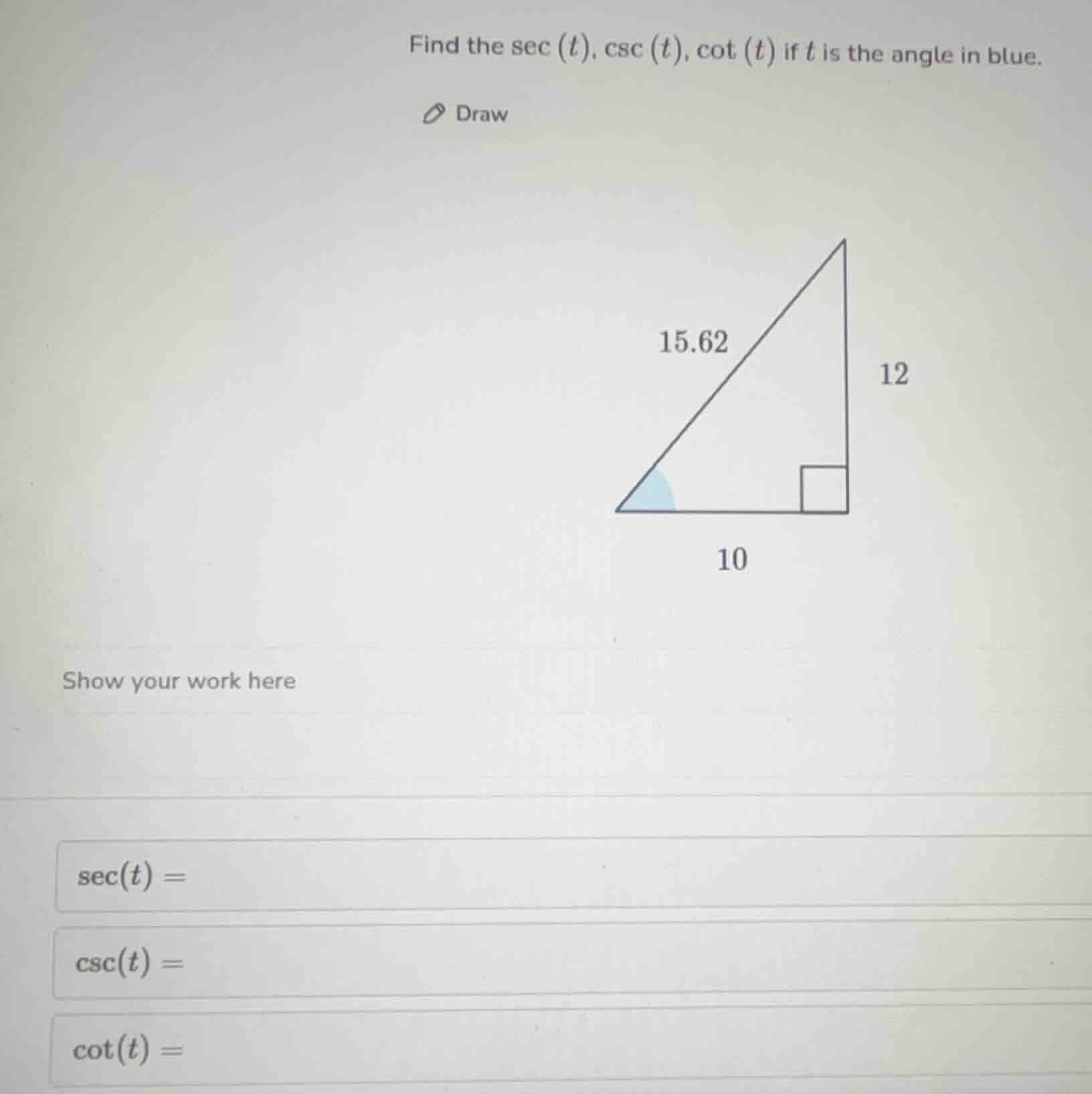
find the \\(\sec(t)\\), \\(\csc(t)\\), \\(\cot(t)\\) if \\(t\\) is the angle in blue.
draw
show your work here
\\(\sec(t) =\\)
\\(\csc(t) =\\)
\\(\cot(t) =\\)
Step1: Recall trigonometric identities
We know that for a right triangle, \(\sec(t)=\frac{1}{\cos(t)}\), \(\csc(t)=\frac{1}{\sin(t)}\), \(\cot(t)=\frac{1}{\tan(t)}\). Also, \(\cos(t)=\frac{\text{adjacent}}{\text{hypotenuse}}\), \(\sin(t)=\frac{\text{opposite}}{\text{hypotenuse}}\), \(\tan(t)=\frac{\text{opposite}}{\text{adjacent}}\).
For angle \(t\):
- Adjacent side (to \(t\)): \(10\)
- Opposite side (to \(t\)): \(12\)
- Hypotenuse: \(15.62\) (given)
Step2: Calculate \(\sec(t)\)
\(\cos(t)=\frac{\text{adjacent}}{\text{hypotenuse}}=\frac{10}{15.62}\)
So, \(\sec(t)=\frac{1}{\cos(t)}=\frac{15.62}{10} = 1.562\)
Step3: Calculate \(\csc(t)\)
\(\sin(t)=\frac{\text{opposite}}{\text{hypotenuse}}=\frac{12}{15.62}\)
So, \(\csc(t)=\frac{1}{\sin(t)}=\frac{15.62}{12}\approx1.3017\) (or keep as \(\frac{15.62}{12}\), but let's compute the decimal: \(15.62\div12\approx1.3017\))
Step4: Calculate \(\cot(t)\)
\(\tan(t)=\frac{\text{opposite}}{\text{adjacent}}=\frac{12}{10} = 1.2\)
So, \(\cot(t)=\frac{1}{\tan(t)}=\frac{10}{12}=\frac{5}{6}\approx0.8333\)

Snap & solve any problem in the app
Get step-by-step solutions on Sovi AI
Photo-based solutions with guided steps
Explore more problems and detailed explanations
s:
\(\sec(t)=\boldsymbol{1.562}\)
\(\csc(t)=\boldsymbol{\frac{15.62}{12}\approx1.302}\) (or \(\frac{781}{600}\) if we use exact fraction, but decimal is fine here)
\(\cot(t)=\boldsymbol{\frac{5}{6}\approx0.833}\)
(Note: If we check the Pythagorean theorem: \(10^2 + 12^2=100 + 144 = 244\), and \(15.62^2\approx244\) (since \(15.62\times15.62 = (15 + 0.62)^2=15^2+2\times15\times0.62 + 0.62^2=225+18.6 + 0.3844 = 243.9844\approx244\)), so the triangle is valid.)