QUESTION IMAGE
Question
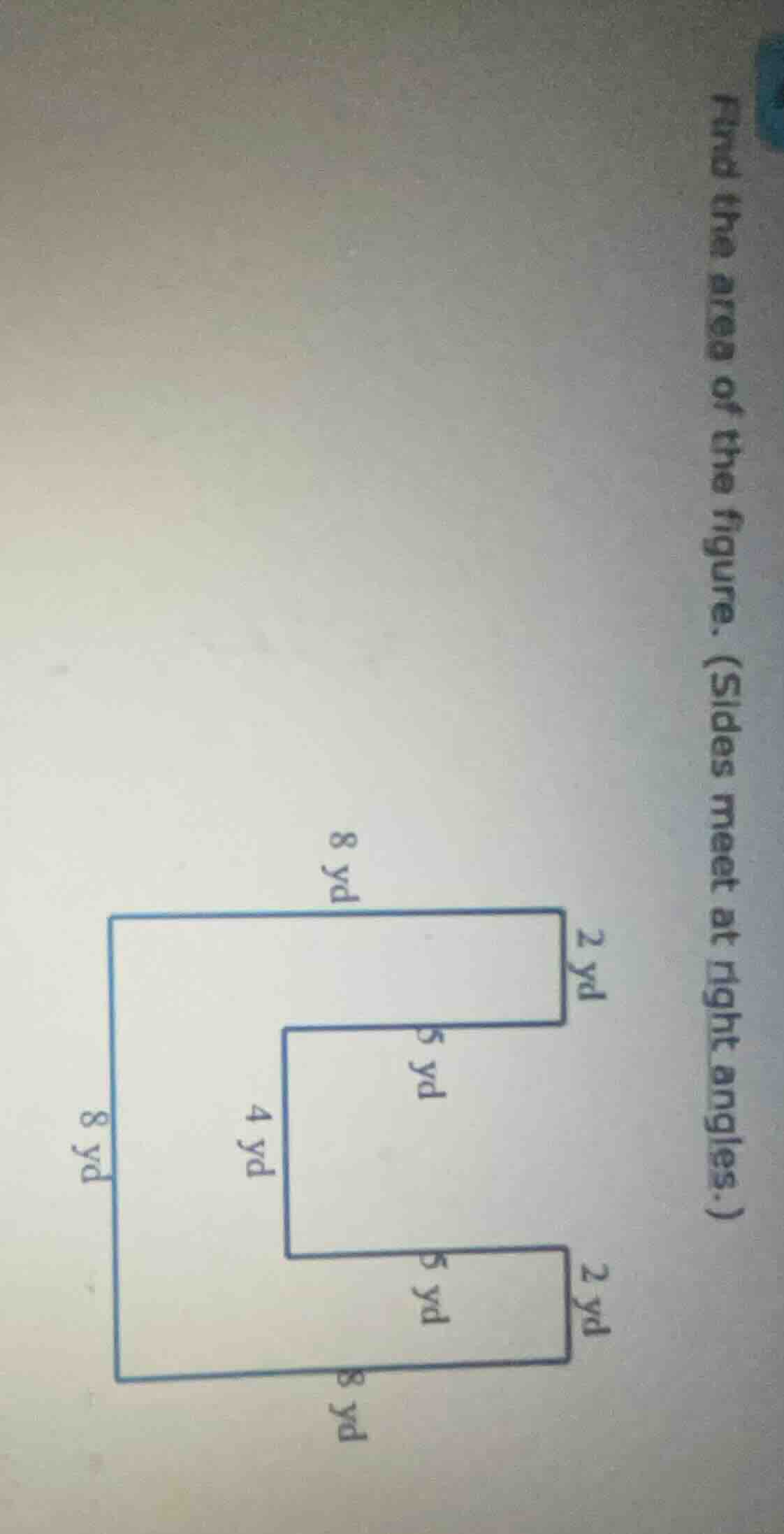
find the area of the figure. (sides meet at right angles.)
Step1: Calculate the area of the large square
The side length of the large square is 8 yd. The area of a square is given by \( A = s^2 \), where \( s \) is the side length. So the area of the large square is \( 8\times8 = 64 \) square yards.
Step2: Calculate the area of the missing rectangle
The missing rectangle has a height of 4 yd and a width of 5 yd (since the total height of the two small rectangles on the top and bottom is \( 2 + 2 = 4 \) yd? Wait, no, looking at the figure, the missing part is a rectangle with length 5 yd and width 4 yd. Wait, actually, the horizontal length of the missing part: the total length of the large square is 8 yd, and the two side parts? Wait, no, let's re - examine. The figure can be thought of as a large square with a rectangle cut out from the middle. The large square has side 8 yd. The cut - out rectangle has a height of 4 yd (because the vertical sides: 8 - 2 - 2 = 4 yd) and a width of 5 yd (given as 5 yd). So the area of the cut - out rectangle is \( 5\times4=20 \) square yards.
Step3: Calculate the area of the figure
To find the area of the given figure, we subtract the area of the cut - out rectangle from the area of the large square. So the area \( A=64 - 20=44 \) square yards. Wait, no, maybe another approach. Let's divide the figure into three rectangles. The top rectangle: length 8 yd, width 2 yd, area \( 8\times2 = 16 \) square yards. The bottom rectangle: length 8 yd, width 2 yd, area \( 8\times2=16 \) square yards. The middle rectangle: length \( 8 - 5=3 \) yd? Wait, no, I think I made a mistake earlier. Let's look at the horizontal dimensions. The total width of the figure is 8 yd. The middle part that is cut out has a width of 5 yd? Wait, no, the vertical sides: the height of the top and bottom rectangles is 2 yd each, and the middle part (the part that is not cut out) has a height of 4 yd (8 - 2 - 2). The horizontal length of the middle non - cut - out part: the total length is 8 yd, and the cut - out part has a length of 5 yd, so the non - cut - out middle part has a length of \( 8 - 5 = 3 \) yd? No, this is getting confusing. Let's use the correct method: the figure is a composite figure. Let's consider the large square of side 8, area 64. The missing rectangle: the vertical side of the missing rectangle is \( 8-(2 + 2)=4 \) yd (since the top and bottom rectangles have height 2 yd each), and the horizontal side is 5 yd. So area of missing rectangle is \( 5\times4 = 20 \). Then the area of the figure is \( 64-20 = 44 \)? Wait, no, let's check with the three - rectangle method. Top rectangle: 8x2 = 16. Bottom rectangle: 8x2 = 16. Middle rectangle: the middle part (the vertical part in the middle) has a height of 4 yd (8 - 2 - 2) and a width of \( 8 - 5=3 \) yd? No, that doesn't make sense. Wait, the correct way: the figure can be divided into three rectangles. The left - most part: no, maybe the figure is a square with side 8, minus a rectangle of 5x4. Wait, 8x8=64, 5x4 = 20, 64 - 20 = 44. But let's verify with another division. The top rectangle: length 8, width 2: area 16. The bottom rectangle: length 8, width 2: area 16. The middle rectangle: length (8 - 5)=3, width 4: area 3x4 = 12. Then total area is 16+16 + 12=44. Yes, that works. So the area is 44 square yards.

Snap & solve any problem in the app
Get step-by-step solutions on Sovi AI
Photo-based solutions with guided steps
Explore more problems and detailed explanations
44 square yards