QUESTION IMAGE
Question
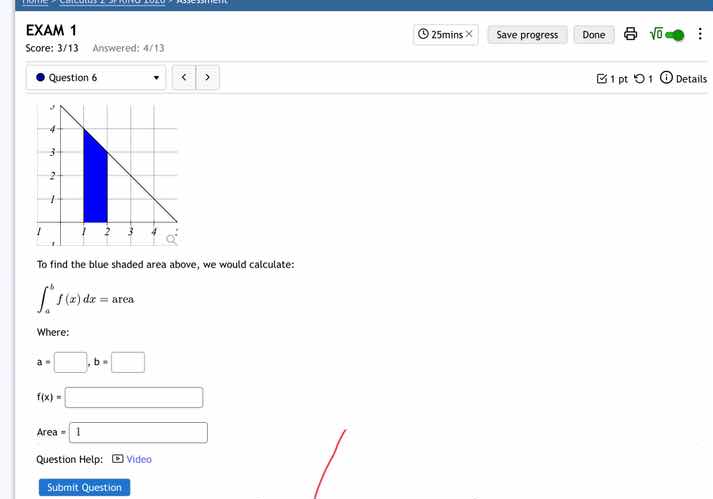
to find the blue shaded area above, we would calculate:
\\(\int_{a}^{b} f(x) dx = \text{area}\\)
where:
a = \\(\square\\), b = \\(\square\\)
f(x) = \\(\square\\)
area = \\(\square\\)
question help: \\(\square\\) video
submit question
Step1: Determine the limits of integration (a and b)
Looking at the graph, the blue shaded region starts at \( x = 1 \) and ends at \( x = 2 \). So, \( a = 1 \) and \( b = 2 \).
Step2: Find the function \( f(x) \)
The graph is a line. Let's find its equation. The line goes from \( (1, 4) \) to \( (5, 0) \) (since it hits the x - axis at \( x = 5 \)). The slope \( m \) of the line is \( \frac{0 - 4}{5 - 1}=\frac{- 4}{4}=-1 \). Using the point - slope form \( y - y_1=m(x - x_1) \) with the point \( (1, 4) \), we have \( y-4=-1(x - 1) \), which simplifies to \( y=-x + 5 \). For the interval \( [1,2] \), \( f(x)=-x + 5 \).
Step3: Calculate the integral (area)
The area is given by \( \int_{a}^{b}f(x)dx=\int_{1}^{2}(-x + 5)dx \).
We know that the integral of \( -x \) is \( -\frac{x^{2}}{2} \) and the integral of 5 is \( 5x \).
Using the fundamental theorem of calculus \( \int_{a}^{b}F^\prime(x)dx=F(b)-F(a) \), where \( F(x)=-\frac{x^{2}}{2}+5x \).
\( F(2)=-\frac{2^{2}}{2}+5\times2=- 2 + 10 = 8 \)
\( F(1)=-\frac{1^{2}}{2}+5\times1=-\frac{1}{2}+5=\frac{9}{2} \)
\( \int_{1}^{2}(-x + 5)dx=F(2)-F(1)=8-\frac{9}{2}=\frac{16 - 9}{2}=\frac{7}{2}=3.5 \)
Alternatively, since the figure is a trapezoid (or we can use the formula for the area of a trapezoid). The two parallel sides (heights) are \( f(1)=-1 + 5 = 4 \) and \( f(2)=-2+5 = 3 \), and the width (the difference in x - values) is \( 2 - 1=1 \). The area of a trapezoid is \( \frac{(h_1 + h_2)}{2}\times w=\frac{(4 + 3)}{2}\times1=\frac{7}{2}=3.5 \)

Snap & solve any problem in the app
Get step-by-step solutions on Sovi AI
Photo-based solutions with guided steps
Explore more problems and detailed explanations
\( a = 1 \), \( b = 2 \), \( f(x)=-x + 5 \), Area \(=\frac{7}{2}\) (or \( 3.5 \))