QUESTION IMAGE
Question
find the domain and range of the function:
domain:
range:
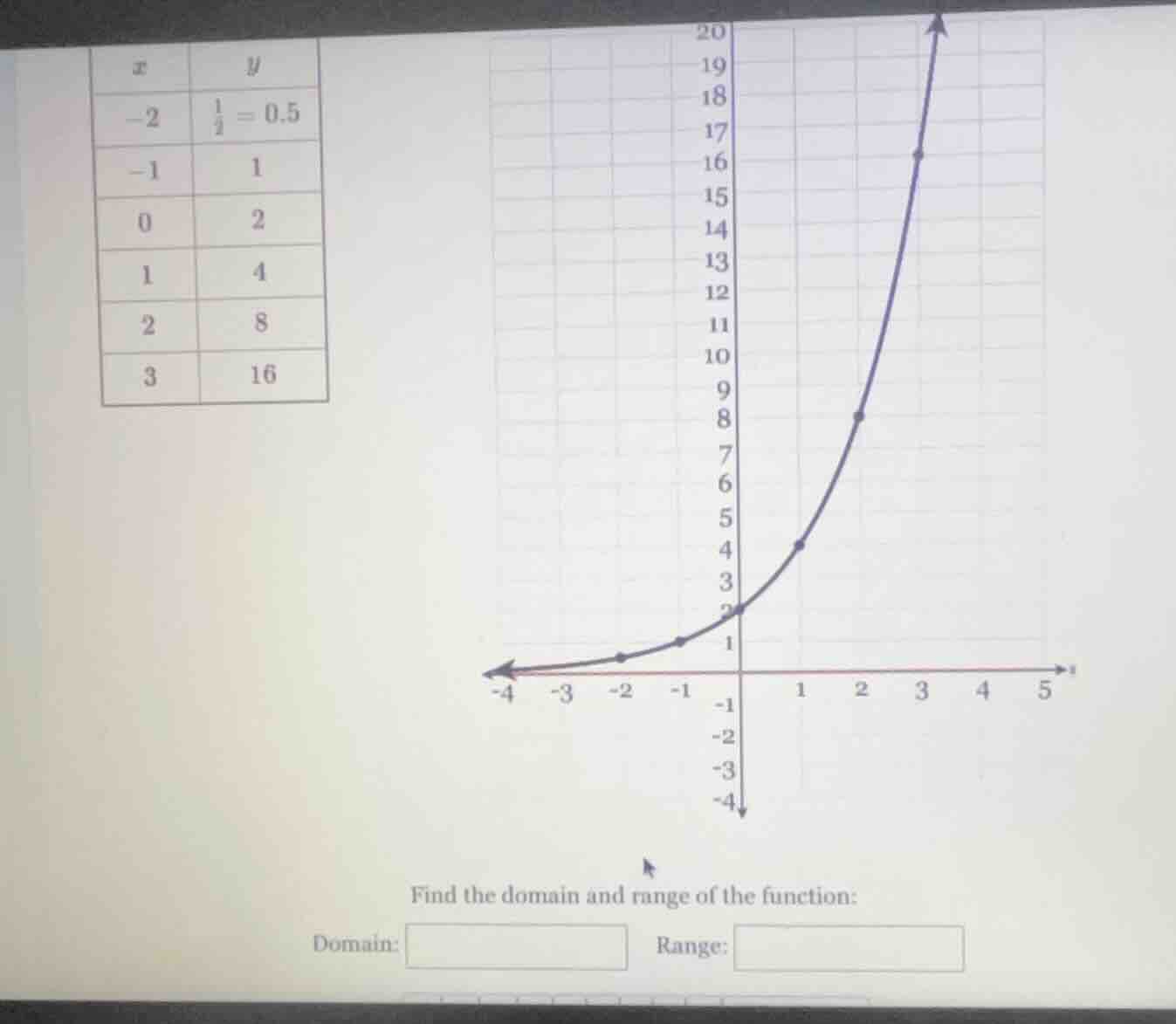
(the table has x values -2, -1, 0, 1, 2, 3 and corresponding y values 1/2=0.5, 1, 2, 4, 8, 16. there is also a graph of a curve.)
Step1: Determine the domain
The domain of a function is the set of all possible \( x \)-values. From the table, the \( x \)-values are \(-2, -1, 0, 1, 2, 3\), and from the graph, we can see that the function is defined for all real numbers (since the graph extends to the left and right without any breaks or restrictions on \( x \)). So the domain is all real numbers, which can be written as \( (-\infty, \infty) \) or \( \mathbb{R} \).
Step2: Determine the range
The range of a function is the set of all possible \( y \)-values. From the table, the \( y \)-values are \( 0.5, 1, 2, 4, 8, 16 \), and from the graph, we can see that the \( y \)-values start from \( 0 \) (approaching but never reaching \( 0 \) as \( x \) goes to \( -\infty \)) and increase to \( \infty \) as \( x \) increases. So the range is all positive real numbers, which can be written as \( (0, \infty) \) or \( y > 0 \).

Snap & solve any problem in the app
Get step-by-step solutions on Sovi AI
Photo-based solutions with guided steps
Explore more problems and detailed explanations
Domain: \( (-\infty, \infty) \) (or all real numbers)
Range: \( (0, \infty) \) (or all positive real numbers)