QUESTION IMAGE
Question
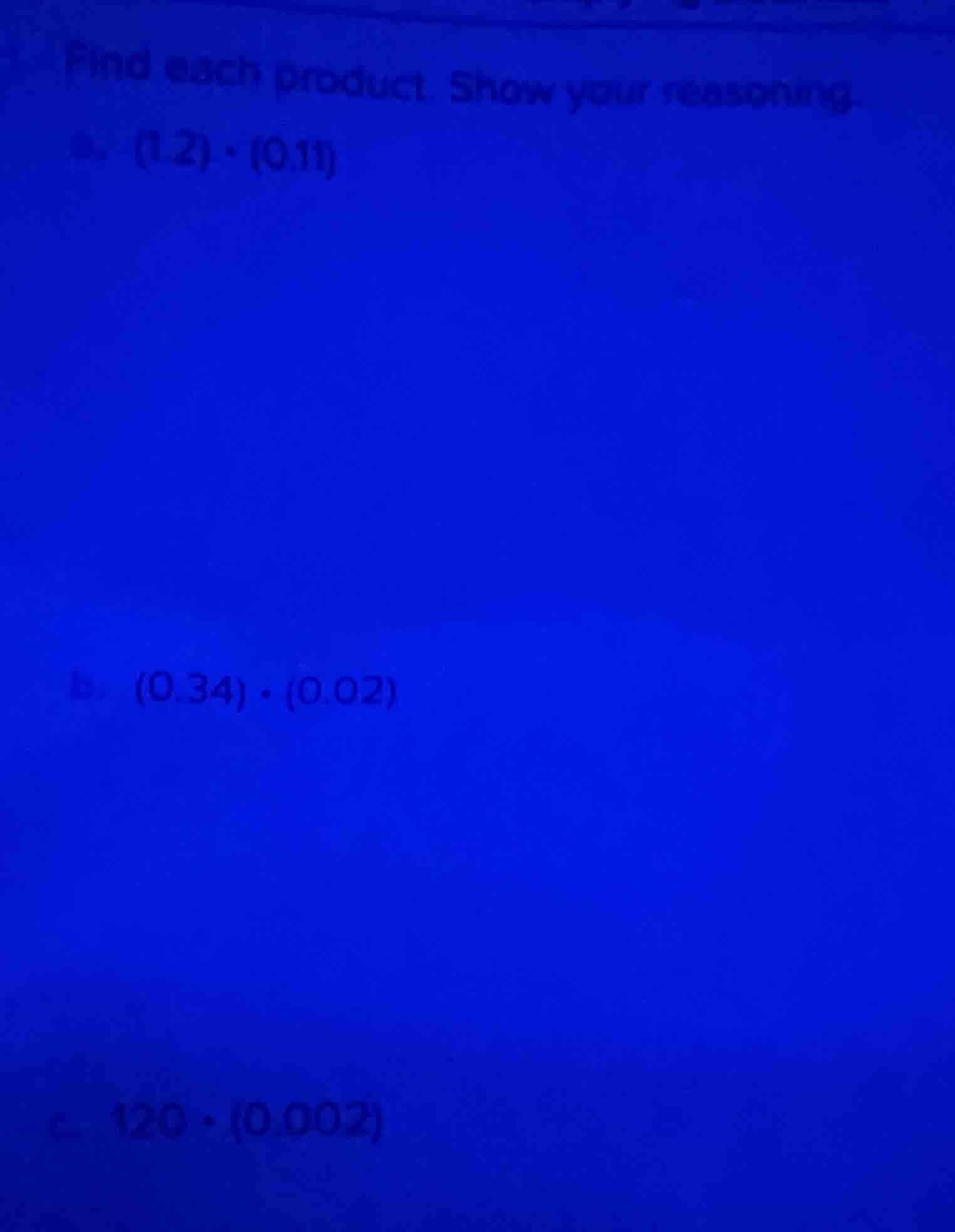
find each product. show your reasoning.
a. $(1.2) \cdot (0.11)$
b. $(0.34) \cdot (0.02)$
c. $120 \cdot (0.002)$
Part a: \((1.2) \cdot (0.11)\)
Step1: Multiply as integers
First, ignore the decimal points and multiply \(12\) and \(11\).
\(12 \times 11 = 132\)
Step2: Count decimal places
The number \(1.2\) has \(1\) decimal place, and \(0.11\) has \(2\) decimal places. So the total number of decimal places in the product is \(1 + 2 = 3\).
Step3: Place decimal in result
Starting from the right of \(132\), move the decimal point \(3\) places to the left.
\(132
ightarrow 0.132\) (we add a leading zero if necessary to have enough places)
Step1: Multiply as integers
Ignore the decimals and multiply \(34\) and \(2\).
\(34 \times 2 = 68\)
Step2: Count decimal places
\(0.34\) has \(2\) decimal places, \(0.02\) has \(2\) decimal places. Total decimal places: \(2 + 2 = 4\).
Step3: Place decimal in result
Move the decimal point \(4\) places left in \(68\). We need to add leading zeros: \(68
ightarrow 0.0068\) (since we need \(4\) decimal places, we have \(0.0068\) after moving the decimal)
Step1: Multiply as integers
Multiply \(120\) and \(2\) (ignoring the decimal in \(0.002\) for now).
\(120 \times 2 = 240\)
Step2: Count decimal places
\(0.002\) has \(3\) decimal places. So we need to move the decimal point \(3\) places left in the product.
\(240
ightarrow 0.240\) (which simplifies to \(0.24\) since the trailing zero after the decimal doesn't change the value)

Snap & solve any problem in the app
Get step-by-step solutions on Sovi AI
Photo-based solutions with guided steps
Explore more problems and detailed explanations
\(0.132\)