QUESTION IMAGE
Question
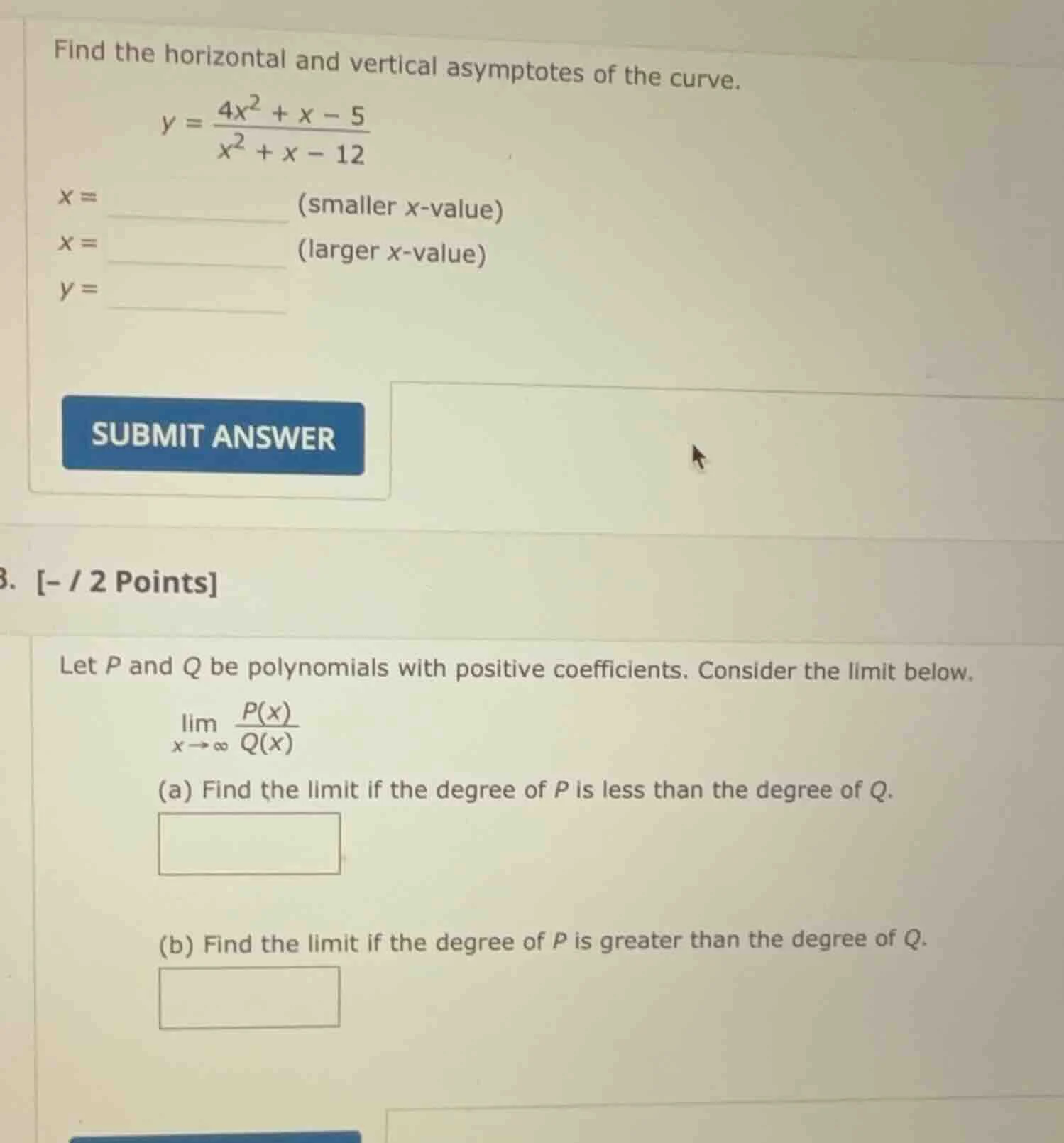
find the horizontal and vertical asymptotes of the curve.
$y = \frac{4x^2 + x - 5}{x^2 + x - 12}$
$x = $ (smaller $x$-value)
$x = $ (larger $x$-value)
$y = $
submit answer
- - / 2 points
let $p$ and $q$ be polynomials with positive coefficients. consider the limit below.
$\lim\limits_{x \to \infty} \frac{p(x)}{q(x)}$
(a) find the limit if the degree of $p$ is less than the degree of $q$.
(b) find the limit if the degree of $p$ is greater than the degree of $q$.
First Problem: Find Horizontal and Vertical Asymptotes of \( y = \frac{4x^2 + x - 5}{x^2 + x - 12} \)
Vertical Asymptotes (Step 1: Factor Denominator)
To find vertical asymptotes, we set the denominator equal to zero and solve for \( x \).
Denominator: \( x^2 + x - 12 \)
Factor: \( x^2 + x - 12 = (x + 4)(x - 3) \)
Set to zero: \( (x + 4)(x - 3) = 0 \)
Solutions: \( x = -4 \) (smaller), \( x = 3 \) (larger).
Horizontal Asymptote (Step 2: Compare Degrees)
For a rational function \( \frac{ax^n + \dots}{bx^m + \dots} \), if \( n = m \), the horizontal asymptote is \( y = \frac{a}{b} \).
Here, numerator degree \( n = 2 \), denominator degree \( m = 2 \), and leading coefficients \( a = 4 \), \( b = 1 \).
Thus, \( y = \frac{4}{1} = 4 \).
Second Problem: Limit of \( \lim_{x \to \infty} \frac{P(x)}{Q(x)} \)
Part (a): Degree of \( P \) < Degree of \( Q \)
For polynomials, if the degree of the numerator (\( P \)) is less than the degree of the denominator (\( Q \)), the limit as \( x \to \infty \) is \( 0 \). This is because the denominator grows faster than the numerator.
Part (b): Degree of \( P \) > Degree of \( Q \)
If the degree of the numerator (\( P \)) is greater than the degree of the denominator (\( Q \)), the limit as \( x \to \infty \) is \( \infty \) (or \( -\infty \), but since coefficients are positive, it is \( \infty \)). The numerator grows faster than the denominator.
Final Answers
Vertical Asymptotes:
\( x = -4 \) (smaller), \( x = 3 \) (larger)
Horizontal Asymptote:
\( y = 4 \)
Limit (a):
\( \boldsymbol{0} \)
Limit (b):
\( \boldsymbol{\infty} \) (or "infinity")

Snap & solve any problem in the app
Get step-by-step solutions on Sovi AI
Photo-based solutions with guided steps
Explore more problems and detailed explanations
First Problem: Find Horizontal and Vertical Asymptotes of \( y = \frac{4x^2 + x - 5}{x^2 + x - 12} \)
Vertical Asymptotes (Step 1: Factor Denominator)
To find vertical asymptotes, we set the denominator equal to zero and solve for \( x \).
Denominator: \( x^2 + x - 12 \)
Factor: \( x^2 + x - 12 = (x + 4)(x - 3) \)
Set to zero: \( (x + 4)(x - 3) = 0 \)
Solutions: \( x = -4 \) (smaller), \( x = 3 \) (larger).
Horizontal Asymptote (Step 2: Compare Degrees)
For a rational function \( \frac{ax^n + \dots}{bx^m + \dots} \), if \( n = m \), the horizontal asymptote is \( y = \frac{a}{b} \).
Here, numerator degree \( n = 2 \), denominator degree \( m = 2 \), and leading coefficients \( a = 4 \), \( b = 1 \).
Thus, \( y = \frac{4}{1} = 4 \).
Second Problem: Limit of \( \lim_{x \to \infty} \frac{P(x)}{Q(x)} \)
Part (a): Degree of \( P \) < Degree of \( Q \)
For polynomials, if the degree of the numerator (\( P \)) is less than the degree of the denominator (\( Q \)), the limit as \( x \to \infty \) is \( 0 \). This is because the denominator grows faster than the numerator.
Part (b): Degree of \( P \) > Degree of \( Q \)
If the degree of the numerator (\( P \)) is greater than the degree of the denominator (\( Q \)), the limit as \( x \to \infty \) is \( \infty \) (or \( -\infty \), but since coefficients are positive, it is \( \infty \)). The numerator grows faster than the denominator.
Final Answers
Vertical Asymptotes:
\( x = -4 \) (smaller), \( x = 3 \) (larger)
Horizontal Asymptote:
\( y = 4 \)
Limit (a):
\( \boldsymbol{0} \)
Limit (b):
\( \boldsymbol{\infty} \) (or "infinity")