QUESTION IMAGE
Question
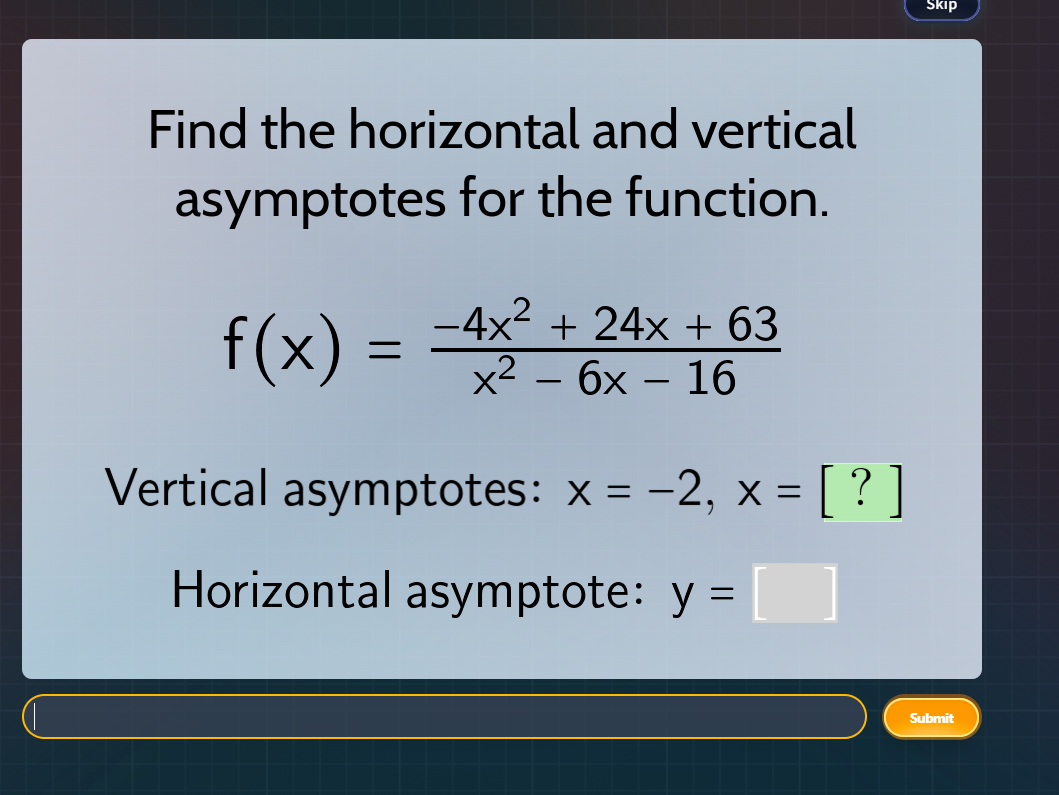
find the horizontal and vertical asymptotes for the function.
$f(x) = \frac{-4x^2 + 24x + 63}{x^2 - 6x - 16}$
vertical asymptotes: $x = -2$, $x = ?$
horizontal asymptote: $y = \square$
Step1: Find vertical asymptote (factor denominator)
Factor \(x^2 - 6x - 16\). We need two numbers that multiply to \(-16\) and add to \(-6\). Those numbers are \(-8\) and \(2\). So, \(x^2 - 6x - 16=(x - 8)(x + 2)\).
Set denominator equal to zero: \((x - 8)(x + 2)=0\). Solutions are \(x = 8\) and \(x=-2\). So the missing vertical asymptote is \(x = 8\).
Step2: Find horizontal asymptote (degree of numerator and denominator)
The degree of the numerator \(-4x^2 + 24x + 63\) is \(2\), and the degree of the denominator \(x^2 - 6x - 16\) is also \(2\). When degrees are equal, the horizontal asymptote is the ratio of the leading coefficients. Leading coefficient of numerator is \(-4\), leading coefficient of denominator is \(1\). So, \(y=\frac{-4}{1}=-4\).

Snap & solve any problem in the app
Get step-by-step solutions on Sovi AI
Photo-based solutions with guided steps
Explore more problems and detailed explanations
Vertical asymptote: \(x = 8\)
Horizontal asymptote: \(y = -4\)