QUESTION IMAGE
Question
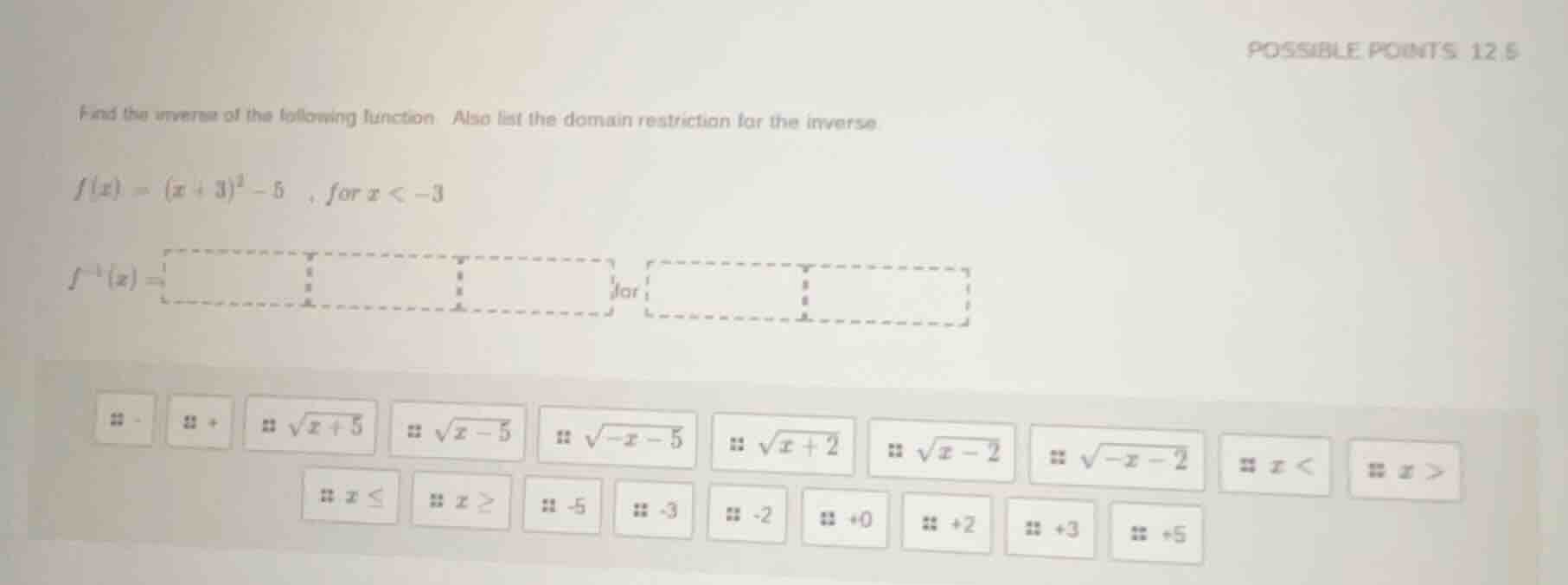
find the inverse of the following function. also list the domain restriction for the inverse
$f(x) = (x + 3)^2 - 5$, for $x < -3$
$f^{-1}(x) = \boxed{\quad}$ for $\boxed{\quad}$
Step1: Replace \( f(x) \) with \( y \)
We start with the function \( f(x) = (x + 3)^2 - 5 \) for \( x < -3 \). Replace \( f(x) \) with \( y \), so we have \( y=(x + 3)^2 - 5 \).
Step2: Swap \( x \) and \( y \)
To find the inverse, we swap \( x \) and \( y \). This gives us \( x=(y + 3)^2 - 5 \).
Step3: Solve for \( y \)
First, add 5 to both sides of the equation: \( x + 5=(y + 3)^2 \).
Then, take the square root of both sides. Since the original function has \( x < -3 \), the original function is decreasing (because the square function \( (x + 3)^2 \) is decreasing for \( x < -3 \)), so the inverse function should have a square root with a negative sign (to get the decreasing part inverse). So we have \( \sqrt{x + 5}=-(y + 3) \) (we take the negative square root because the original function's domain is \( x < -3 \), so the range of the original function will be the domain of the inverse, and we need to get the correct inverse).
Now, solve for \( y \):
First, multiply both sides by -1: \( -\sqrt{x + 5}=y + 3 \).
Then, subtract 3 from both sides: \( y=-\sqrt{x + 5}- 3 \)? Wait, no, wait. Wait, original function: \( y=(x + 3)^2 - 5 \), \( x < -3 \). Let's re - do the solving.
Starting from \( x=(y + 3)^2 - 5 \)
Add 5: \( x + 5=(y + 3)^2 \)
Take square roots: \( y + 3=\pm\sqrt{x + 5} \)
Now, the original function has \( x < -3 \), so \( x+3 < 0 \), and \( y=(x + 3)^2 - 5 \). When \( x < -3 \), as \( x\) decreases, \( (x + 3)^2 \) increases, so \( y\) increases? Wait, no, \( (x + 3)^2 \) is a parabola opening upwards with vertex at \( x=-3 \). For \( x < -3 \), the function \( (x + 3)^2 \) is decreasing (since the vertex is at \( x = - 3\) and for \( x < -3\), moving left from \( x=-3\), the value of \( (x + 3)^2\) decreases? Wait, no, if \( x=-4\), \( (x + 3)^2=(-1)^2 = 1\); if \( x=-5\), \( (x + 3)^2=(-2)^2 = 4\). Wait, that's increasing. So when \( x < -3\), \( (x + 3)^2\) is increasing (because as \( x\) becomes more negative, \( x + 3\) becomes more negative, and squaring a more negative number gives a larger positive number). So the original function \( y=(x + 3)^2-5\) for \( x < -3\) is increasing. So when we find the inverse, we should take the negative square root? Wait, no, let's think about the domain and range.
Original function: \( f(x)=(x + 3)^2-5\), \( x < -3\). The range of \( f(x)\): when \( x < -3\), \( (x + 3)^2>0\) (since \( x
eq - 3\)), so \( (x + 3)^2-5>-5\). So the range of \( f(x)\) is \( y > - 5\). So the domain of the inverse function \( f^{-1}(x)\) is \( x > - 5\).
Now, going back to \( x=(y + 3)^2-5\), solve for \( y\):
\( (y + 3)^2=x + 5\)
Since the original function is increasing (for \( x < -3\)), the inverse function should be such that when we solve for \( y\), we take the negative square root? Wait, no, let's do the algebra again.
\( (y + 3)^2=x + 5\)
Take square roots: \( y + 3=\pm\sqrt{x + 5}\)
Now, in the original function, \( x < -3\), so \( y + 3=x + 3\) (wait, no, \( y=(x + 3)^2-5\), so \( y + 5=(x + 3)^2\), so \( x + 3=-\sqrt{y + 5}\) (because \( x < -3\), so \( x + 3 < 0\)). So when we swap \( x\) and \( y\), we have \( y + 3=-\sqrt{x + 5}\) (because in the original function, \( x + 3\) is negative, so in the inverse, \( y + 3\) should be negative).
So \( y+3 =-\sqrt{x + 5}\)
Subtract 3 from both sides: \( y=-\sqrt{x + 5}-3\)? Wait, no, that doesn't seem right. Wait, let's check with an example. Let's take \( x=-4\) (which is less than -3). Then \( f(-4)=(-4 + 3)^2-5=(-1)^2-5=1 - 5=-4\). So the point \((-4,-4)\) is on the original function. Now, for the inverse function, when \( x=-4\…

Snap & solve any problem in the app
Get step-by-step solutions on Sovi AI
Photo-based solutions with guided steps
Explore more problems and detailed explanations
The inverse function \( f^{-1}(x)=-\sqrt{x + 5}-3\) (which is composed of the minus sign, \( \sqrt{x + 5}\), and -3 from the options) and the domain restriction is \( x > - 5\) (using \( x > \) and -5 from the options). So filling in the blanks:
\( f^{-1}(x)=\boldsymbol{-\sqrt{x + 5}-3}\) (using the minus sign, \( \sqrt{x + 5}\), and -3) for \( \boldsymbol{x > - 5}\) (using \( x > \) and -5).