QUESTION IMAGE
Question
9.
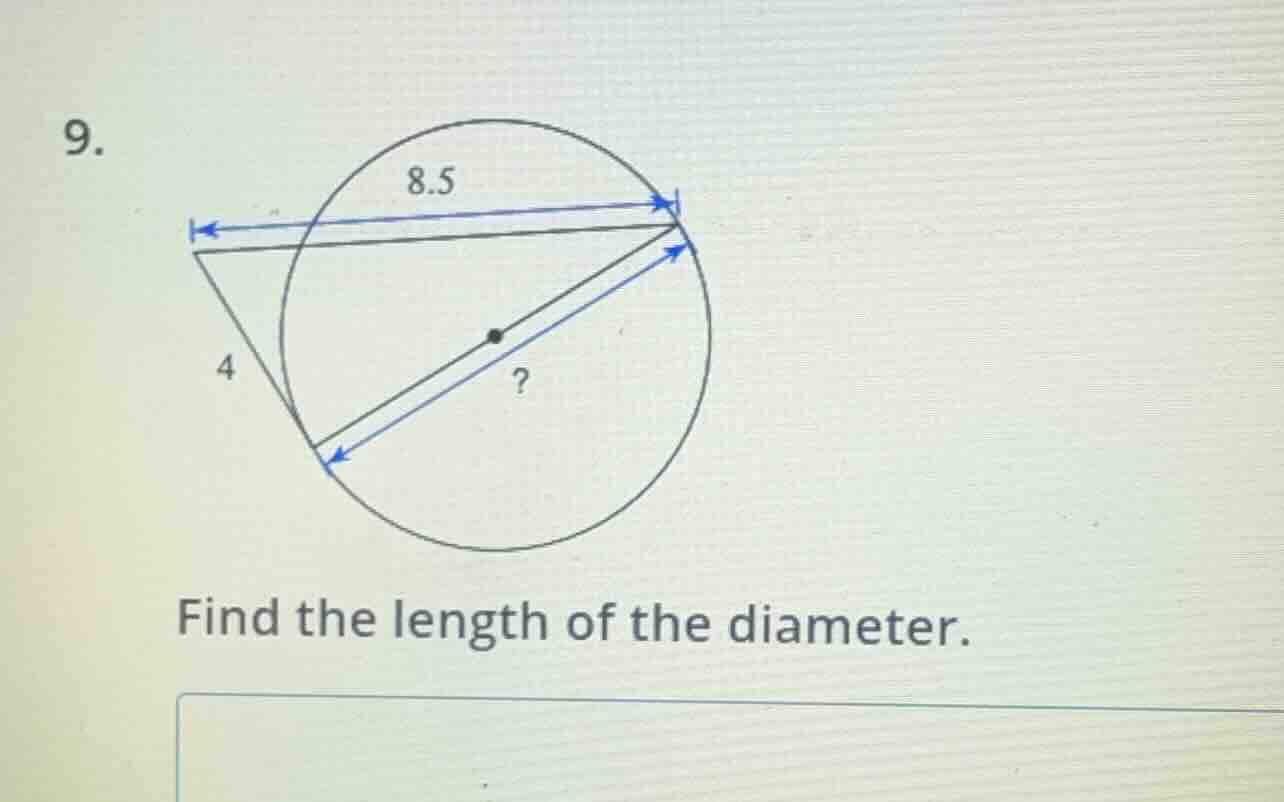
find the length of the diameter.
Step1: Identify the theorem
We use the Pythagorean theorem here. Let the diameter be \( d \), the tangent segment be \( 4 \), the secant segment (outside part) be \( 8.5 \), and the whole secant (including the part inside the circle) be \( 8.5 + x \), but actually, since the triangle is right - angled (tangent is perpendicular to the radius at the point of contact, and if we consider the triangle formed by the tangent, the chord, and the diameter, we can use the geometric mean theorem (or Pythagorean theorem). Let the length of the tangent be \( a = 4 \), the length of the chord be \( b = 8.5 \), and the diameter be \( d \). The triangle formed is a right - triangle where \( a^{2}+b^{2}=d^{2}\)? Wait, no, actually, the tangent to a circle is perpendicular to the radius at the point of contact. If we have a tangent from an external point to the circle, and a secant from the same external point passing through the circle, the square of the tangent is equal to the product of the entire secant and its external part. But in this case, the triangle formed by the tangent, the chord, and the diameter: Let's assume that the triangle is a right - triangle with legs \( 4 \) and \( 8.5 \), and hypotenuse equal to the diameter. Wait, let's calculate:
Let the diameter be \( d \). The triangle is right - angled, so by Pythagorean theorem: \( 4^{2}+8.5^{2}=d^{2}\)? Wait, no, wait. Wait, the tangent is perpendicular to the radius, so if the diameter is the hypotenuse, and the two legs are the tangent (length \( 4 \)) and the chord (length \( 8.5 \))? Wait, no, let's re - examine.
Wait, the tangent from the external point to the circle has length \( 4 \), and the chord inside the circle has length \( 8.5 \), and the line from the external point to the other end of the diameter forms a right - triangle. Wait, actually, the correct approach is: Let the external point be \( P \), the point of tangency be \( A \), the intersection of the secant with the circle be \( B \) and \( C \) (where \( B \) is closer to \( P \) and \( C \) is the other end). Then \( PA^{2}=PB\times PC \). But in our case, if the secant is a chord that is not passing through the external point? Wait, no, the figure shows a tangent (length \( 4 \)) and a chord (length \( 8.5 \)) and the diameter. Wait, maybe the triangle is right - angled with legs \( 4 \) and \( 8.5 \), and hypotenuse is the diameter. Wait, let's calculate \( 4^{2}+8.5^{2}=16 + 72.25=88.25 \), but that's not a perfect square. Wait, maybe I made a mistake. Wait, another approach: The tangent is perpendicular to the radius, so if we have a right - triangle where one leg is the tangent (\( 4 \)), one leg is the length of the chord (\( 8.5 \)), and the hypotenuse is the diameter? Wait, no, maybe the triangle is right - angled, and we can use \( a^{2}+b^{2}=c^{2} \), but let's check the numbers. Wait, \( 4^{2}+8.5^{2}=16 + 72.25 = 88.25\), and \( \sqrt{88.25}\approx9.4 \), but that doesn't seem right. Wait, maybe the triangle is such that the tangent is \( 4 \), and the other leg is the length of the diameter minus something? No, wait, maybe the correct formula is that in a right - triangle formed by a tangent, a chord, and the diameter, the Pythagorean theorem applies. Wait, let's recast: Let the diameter be \( d \), the tangent length \( t = 4 \), the chord length \( c = 8.5 \). Then \( t^{2}+c^{2}=d^{2}\)? Wait, no, that's not the correct theorem. Wait, the correct theorem is the geometric mean theorem: If a tangent from an external point \( P \) touches the circle at \( A \), and a secant from \( P \) passes thr…

Snap & solve any problem in the app
Get step-by-step solutions on Sovi AI
Photo-based solutions with guided steps
Explore more problems and detailed explanations
\( 7.5 \)