QUESTION IMAGE
Question
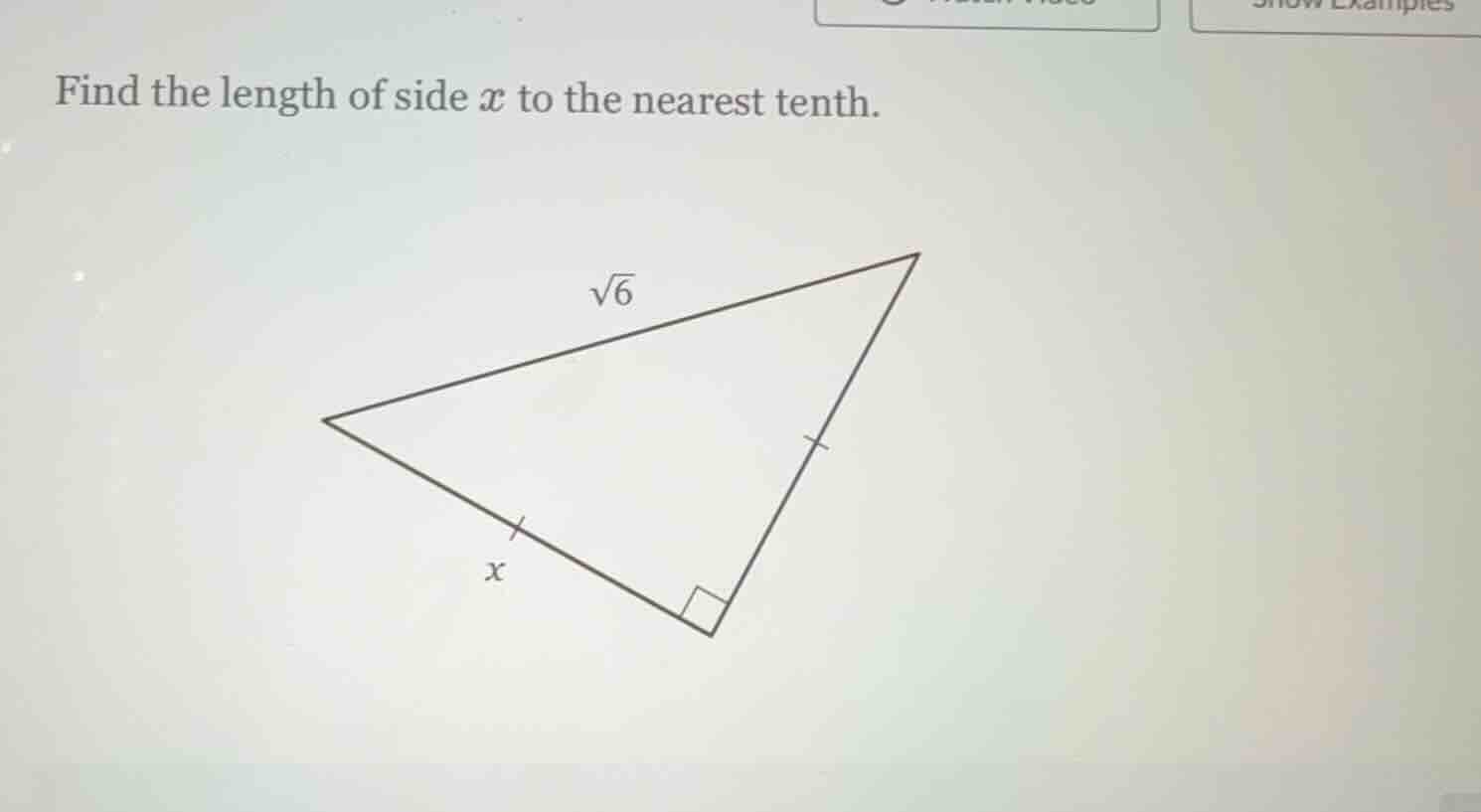
find the length of side ( x ) to the nearest tenth.
Step1: Identify triangle type
The triangle is isosceles right - triangle (two legs equal, right angle), so legs are \(x\) and the other leg (equal to \(x\)), hypotenuse is \(\sqrt{6}\).
Using Pythagorean theorem: \(a^{2}+b^{2}=c^{2}\), here \(a = x\), \(b = x\), \(c=\sqrt{6}\). So \(x^{2}+x^{2}=(\sqrt{6})^{2}\).
Step2: Simplify the equation
\(2x^{2}=6\), divide both sides by 2: \(x^{2}=\frac{6}{2}=3\).
Step3: Solve for x
Take square root: \(x = \sqrt{3}\approx1.732\).
Step4: Round to nearest tenth
\(1.732\approx1.7\) (wait, no, \(\sqrt{3}\approx1.732\), to nearest tenth is \(1.7\)? Wait, no, wait, let's check again. Wait, if the hypotenuse is \(\sqrt{6}\approx2.449\). Wait, maybe I made a mistake in identifying legs and hypotenuse. Wait, the right angle is at the vertex where the two legs with ticks meet. So the legs are \(x\) and the other leg (length \(x\)), hypotenuse is \(\sqrt{6}\). So Pythagorean theorem: \(x^{2}+x^{2}=(\sqrt{6})^{2}\Rightarrow2x^{2}=6\Rightarrow x^{2}=3\Rightarrow x = \sqrt{3}\approx1.7\)? Wait, no, \(\sqrt{3}\approx1.732\), to the nearest tenth is \(1.7\)? Wait, no, 1.732 rounded to nearest tenth: look at the hundredth place, 3, which is less than 5, so we keep the tenth place as is. So 1.7. But wait, let's calculate \(\sqrt{3}\approx1.7\) (to nearest tenth).

Snap & solve any problem in the app
Get step-by-step solutions on Sovi AI
Photo-based solutions with guided steps
Explore more problems and detailed explanations
\(1.7\)