QUESTION IMAGE
Question
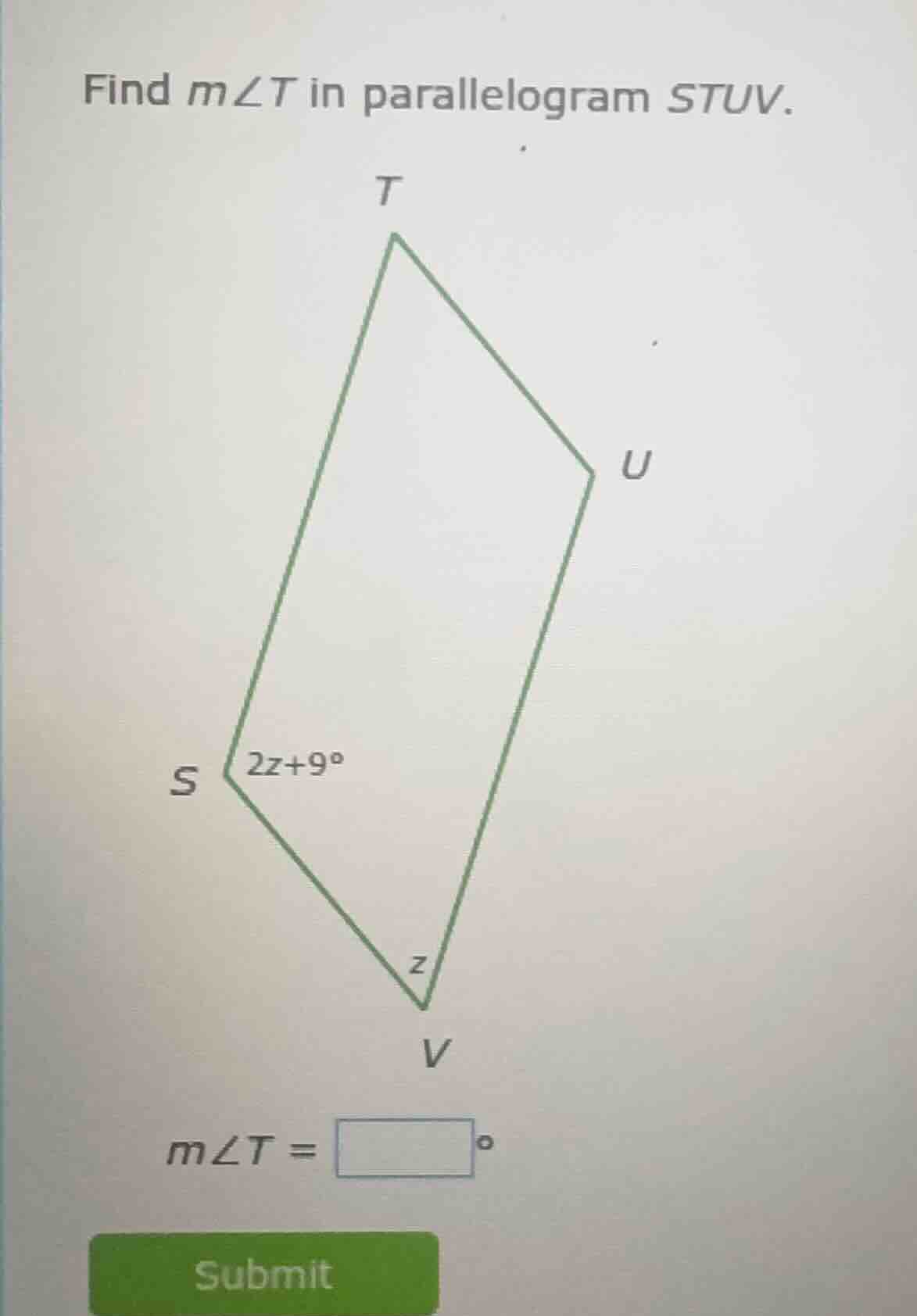
find ( mangle t ) in parallelogram ( stuv ).( s ) angle is ( 2z + 9^circ ), ( v ) angle is ( z ). ( mangle t = square^circ )
Step1: Recall parallelogram angle property
In a parallelogram, consecutive angles are supplementary, and opposite angles are equal. Also, angle \( S \) and angle \( V \) are not consecutive, wait, actually in parallelogram \( STUV \), angle \( S \) and angle \( T \) are consecutive? Wait no, let's see the vertices: \( S, T, U, V \) in order. So \( ST \parallel UV \) and \( SV \parallel TU \). So angle \( S \) and angle \( T \) are consecutive? Wait no, angle at \( S \) and angle at \( V \): wait, the given angle at \( S \) is \( 2z + 9 \) degrees, and angle at \( V \) is \( z \) degrees. Wait, in a parallelogram, consecutive angles are supplementary, but opposite angles are equal? Wait no, actually, in a parallelogram, opposite angles are equal, and consecutive angles are supplementary. Wait, angle \( S \) and angle \( U \) are opposite? No, let's list the angles: angle at \( S \), angle at \( T \), angle at \( U \), angle at \( V \). So \( \angle S = \angle U \), \( \angle T = \angle V \)? Wait no, that's not right. Wait, in a parallelogram, opposite angles are equal. So \( \angle S = \angle U \), \( \angle T = \angle V \)? Wait no, let's think again. If \( STUV \) is a parallelogram, then \( ST \parallel UV \) and \( SV \parallel TU \). So the consecutive angles: \( \angle S \) and \( \angle T \) are consecutive (since \( S \) to \( T \) to \( U \) to \( V \) to \( S \)), so \( \angle S + \angle T = 180^\circ \)? Wait no, no: in a parallelogram, consecutive angles (adjacent angles) are supplementary. Wait, but also, \( \angle S \) and \( \angle V \): are they opposite? Wait, the vertices are \( S, T, U, V \), so the sides are \( ST, TU, UV, VS \). So the angles: \( \angle S \) is between \( VS \) and \( ST \), \( \angle T \) is between \( ST \) and \( TU \), \( \angle U \) is between \( TU \) and \( UV \), \( \angle V \) is between \( UV \) and \( VS \). So \( \angle S \) and \( \angle U \) are opposite, \( \angle T \) and \( \angle V \) are opposite? Wait no, that can't be. Wait, no, in a parallelogram, opposite angles are equal. So \( \angle S = \angle U \), \( \angle T = \angle V \). Wait, but the given angles are \( \angle S = 2z + 9 \) and \( \angle V = z \). Wait, that would mean \( \angle S \) and \( \angle V \) are not opposite. Wait, maybe I got the vertices wrong. Wait, the diagram: \( S \) is at the bottom left, \( T \) at the top, \( U \) at the top right, \( V \) at the bottom right? Wait, no, the diagram shows \( S \), \( T \), \( U \), \( V \) with \( S \) connected to \( T \) and \( V \), \( T \) connected to \( U \), \( U \) connected to \( V \). So \( STUV \) is a parallelogram, so \( ST \parallel UV \) and \( SV \parallel TU \). Therefore, \( \angle S \) and \( \angle T \) are consecutive (since \( ST \) is a side, so \( \angle S \) and \( \angle T \) are adjacent), so they should be supplementary? Wait no, consecutive angles in a parallelogram are supplementary. Wait, but also, \( \angle S \) and \( \angle V \): are they opposite? Wait, no, \( \angle S \) and \( \angle U \) are opposite, \( \angle T \) and \( \angle V \) are opposite. Wait, but the problem gives \( \angle S = 2z + 9 \) and \( \angle V = z \). Wait, maybe \( \angle S \) and \( \angle V \) are consecutive? Wait, no, let's look at the sides: \( S \) is connected to \( T \) and \( V \), \( T \) is connected to \( U \), \( U \) is connected to \( V \). So the sides are \( ST, TU, UV, VS \). So the angles: \( \angle S \) (between \( VS \) and \( ST \)), \( \angle T \) (between \( ST \) and \( TU \)), \( \angle U \) (between \( TU \) and \( UV \)),…

Snap & solve any problem in the app
Get step-by-step solutions on Sovi AI
Photo-based solutions with guided steps
Explore more problems and detailed explanations
\( 57 \)