QUESTION IMAGE
Question
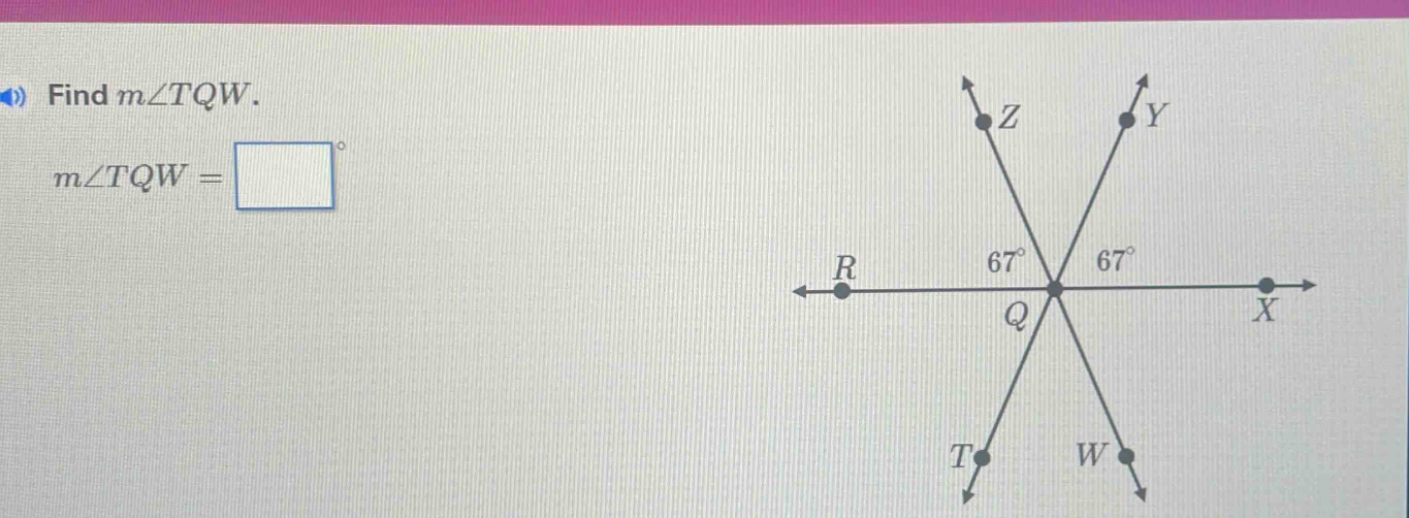
find ( mangle tqw ).( mangle tqw = square^circ )
Step1: Identify straight line angle
A straight line forms a \(180^\circ\) angle. The angles around point \(Q\) on line \(RX\) should sum to \(180^\circ\).
Step2: Calculate remaining angle for \( \angle TQW \)
We know two angles are \(67^\circ\) each. Let the measure of \( \angle TQW \) be \(x\). So, \(67^\circ + 67^\circ + x= 180^\circ\). First, sum the known angles: \(67 + 67 = 134\). Then, \(x = 180 - 134 = 46\)? Wait, no, maybe vertical angles or linear pair. Wait, actually, looking at the diagram, \( \angle TQW \) and the angle opposite or maybe the straight line. Wait, another approach: the angles on a straight line sum to \(180^\circ\). The two \(67^\circ\) angles and \( \angle TQW \) and its adjacent? Wait, no, maybe \( \angle TQW \) is equal to the angle between the two lines? Wait, no, let's re-examine. The line \(RX\) is straight, so the sum of angles on one side is \(180^\circ\). The angles given are \(67^\circ\) (between \(RZ\) and \(RQ\)) and \(67^\circ\) (between \(XY\) and \(XQ\)). Then the remaining angle between \(TQ\) and \(WQ\) (i.e., \( \angle TQW \)) and the other two angles (but actually, \( \angle TQW \) and the angle between \(ZQ\) and \(YQ\) might be vertical or something? Wait, no, maybe \( \angle TQW \) is a straight line complement. Wait, no, the correct way: since \( \angle RQZ = 67^\circ \) and \( \angle XQY = 67^\circ \), and \(RX\) is a straight line, the angle \( \angle TQW \) should be equal to \(180^\circ - 67^\circ - 67^\circ = 46^\circ\)? Wait, no, that can't be. Wait, maybe I made a mistake. Wait, actually, looking at the diagram, \(TQ\) and \(WQ\) are forming a vertical angle or maybe the angle \( \angle TQW \) is equal to \(180 - 67 - 67 = 46\)? Wait, no, wait, maybe the angles \( \angle RQT \) and \( \angle XQW \) are equal? No, maybe the correct answer is \(46^\circ\)? Wait, no, let's think again. The sum of angles on a straight line is \(180^\circ\). So \( \angle RQZ + \angle ZQY + \angle YQX + \angle XQW + \angle WQT + \angle TQR = 360^\circ \), but we are dealing with a straight line, so half is \(180^\circ\). Wait, maybe the two \(67^\circ\) angles and \( \angle TQW \) are on a straight line? No, the straight line is \(RX\), so from \(R\) to \(Q\) to \(X\). So the angles at \(Q\) on line \(RX\) are \( \angle RQT \), \( \angle TQW \), \( \angle WQX \), and also \( \angle RQZ \), \( \angle ZQY \), \( \angle YQX \). Wait, maybe \( \angle TQW \) is equal to \(180 - 67 - 67 = 46\)? Wait, no, that seems wrong. Wait, maybe the diagram has \(TQ\) and \(WQ\) forming a vertical angle with \(ZQ\) and \(YQ\)? No, maybe I messed up. Wait, another way: the angle \( \angle TQW \) is a straight angle minus the two \(67^\circ\) angles. So \(180 - 67 - 67 = 46\). Wait, but maybe the answer is \(46\)? Wait, no, wait, maybe the angle is \(180 - 2\times67 = 180 - 134 = 46\). Yes, that makes sense. So \(m\angle TQW = 46^\circ\)? Wait, no, wait, maybe I made a mistake. Wait, let's check again. The line \(RX\) is straight, so the sum of angles on one side (say, the lower side) is \(180^\circ\). The angles are \( \angle RQT \), \( \angle TQW \), \( \angle WQX \). But also, \( \angle RQZ = 67^\circ \) (upper left), \( \angle XQY = 67^\circ \) (upper right). So the upper angles sum to \(67 + 67 + \angle ZQY = 180\), so \( \angle ZQY = 46\). Then \( \angle TQW \) is vertical to \( \angle ZQY \), so \( \angle TQW = 46^\circ \). Yes, that's it. So vertical angles are equal, so \( \angle TQW = \angle ZQY = 46^\circ \). Wait, no, maybe \( \angle ZQY \) is \(180 - 67 - 67 = 46\), and \( \angle TQW \) is equal to \(…

Snap & solve any problem in the app
Get step-by-step solutions on Sovi AI
Photo-based solutions with guided steps
Explore more problems and detailed explanations
\(46\)