QUESTION IMAGE
Question
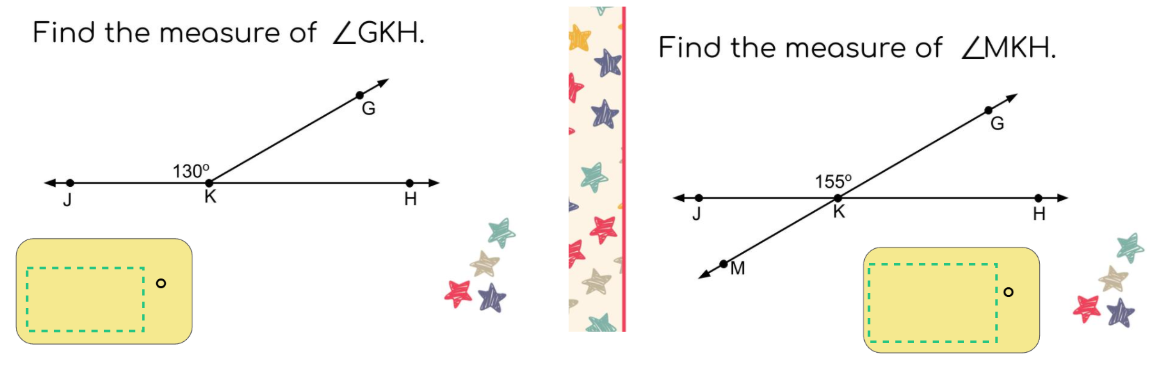
find the measure of ∠gkh.
find the measure of ∠mkh.
First Sub - question: Find the measure of $\angle GKH$
Step 1: Recall the property of supplementary angles
Angles on a straight line (supplementary angles) add up to $180^{\circ}$. We know that $\angle JK G = 130^{\circ}$ and $\angle JK G$ and $\angle GKH$ are supplementary (they form a linear pair).
Step 2: Calculate the measure of $\angle GKH$
Let the measure of $\angle GKH$ be $x$. Then we have the equation $130^{\circ}+x = 180^{\circ}$. Solving for $x$, we subtract $130^{\circ}$ from both sides of the equation: $x=180^{\circ}- 130^{\circ}=50^{\circ}$.
Step 1: Recall the property of vertical angles or supplementary angles (also, note the linear pair and vertical angle relationships)
First, we know that $\angle JK G = 155^{\circ}$, and $\angle JK M$ and $\angle JK G$ are supplementary? Wait, no. Actually, $\angle MK H$ and $\angle JK G$ are vertical angles? Wait, no. Let's look at the lines. $JH$ is a straight line and $MG$ is a straight line intersecting at $K$. So $\angle MK H$ and $\angle JK G$ are supplementary? Wait, no. Wait, $\angle JK M$ and $\angle GKH$? Wait, no. Let's use the fact that $\angle MK H$ and $\angle JK M$ are supplementary, and $\angle JK M$ and $\angle JK G$ (which is $155^{\circ}$) are vertical angles? Wait, no. Wait, $\angle JK G$ and $\angle MK H$: since $JH$ and $MG$ are straight lines, $\angle MK H$ and $\angle JK G$ are supplementary? Wait, no. Wait, the sum of angles on a straight line is $180^{\circ}$. Let's see, $\angle JK M$ and $\angle MK H$ form a linear pair. And $\angle JK M$ is equal to $\angle GKH$? No, wait, $\angle JK G$ is $155^{\circ}$, so $\angle GKH$ would be $180 - 155=25^{\circ}$? No, wait, no. Wait, for the second diagram, $JH$ is a straight line, $MG$ is a straight line intersecting at $K$. So $\angle MK H$ and $\angle JK G$ are vertical angles? No, $\angle MK H$ and $\angle JK M$ are supplementary. And $\angle JK M$ is equal to $\angle GKH$? Wait, no. Wait, let's start over. The angle $\angle JK G = 155^{\circ}$, and $\angle MK H$ and $\angle JK G$: since $JH$ is a straight line, and $MG$ is a straight line, the angle $\angle MK H$ and $\angle JK M$ are supplementary. And $\angle JK M$ is vertical to $\angle GKH$? No, $\angle JK M$ and $\angle GKH$ are vertical angles? Wait, no. Wait, $\angle JK G$ and $\angle MK H$: actually, $\angle MK H$ is equal to $\angle JK G$? No, that can't be. Wait, no, let's use the linear pair. The angle adjacent to $\angle JK G$ (which is $155^{\circ}$) on the straight line $JH$ is $180 - 155 = 25^{\circ}$, but that's $\angle GKH$. Wait, no, for the second diagram, we need to find $\angle MK H$. Wait, $\angle MK H$: since $MG$ and $JH$ intersect at $K$, $\angle MK H$ and $\angle JK M$ are supplementary, and $\angle JK M$ is equal to $\angle GKH$? No, wait, $\angle JK G$ is $155^{\circ}$, so $\angle MK H$ is equal to $\angle JK G$? No, that's not right. Wait, no, vertical angles are equal. $\angle JK G$ and $\angle MK H$: are they vertical angles? Let's see, the intersection of $JH$ and $MG$ at $K$. So the vertical angle of $\angle JK G$ is $\angle MK H$? Yes! Because when two lines intersect, vertical angles are equal. Wait, no, if $JH$ and $MG$ are two intersecting lines, then $\angle JK G$ and $\angle MK H$ are vertical angles? Wait, no, $\angle JK G$ and $\angle MK H$: let's label the angles. Let's say line $JH$ is horizontal, line $MG$ is slanting. So at point $K$, the angles: $\angle JK G$ (top - left), $\angle GKH$ (top - right), $\angle MK H$ (bottom - right), $\angle JK M$ (bottom - left). So $\angle JK G$ and $\angle MK H$ are vertical angles? No, $\angle JK G$ and $\angle MK H$: $\angle JK G$ is top - left, $\angle MK H$ is bottom - right. So they are vertical angles? Yes! Because vertical angles are opposite each other when two lines intersect. So if two lines intersect, vertical angles are equal. Wait, no, vertical angles are opposite angles formed by two intersecting lines. So $\angle JK G$ and $\angle MK H$ are vertical angles? Wait, no, $\angle JK G$ and $\angle MK H$: let's check the vertices. The lines are $JH$ (from $J$ to $H$) and $MG$ (from $M$ to $G$). The intersection is at $K$.…

Snap & solve any problem in the app
Get step-by-step solutions on Sovi AI
Photo-based solutions with guided steps
Explore more problems and detailed explanations
The measure of $\angle GKH$ is $50^{\circ}$.