QUESTION IMAGE
Question
find the measure of the missing angles.
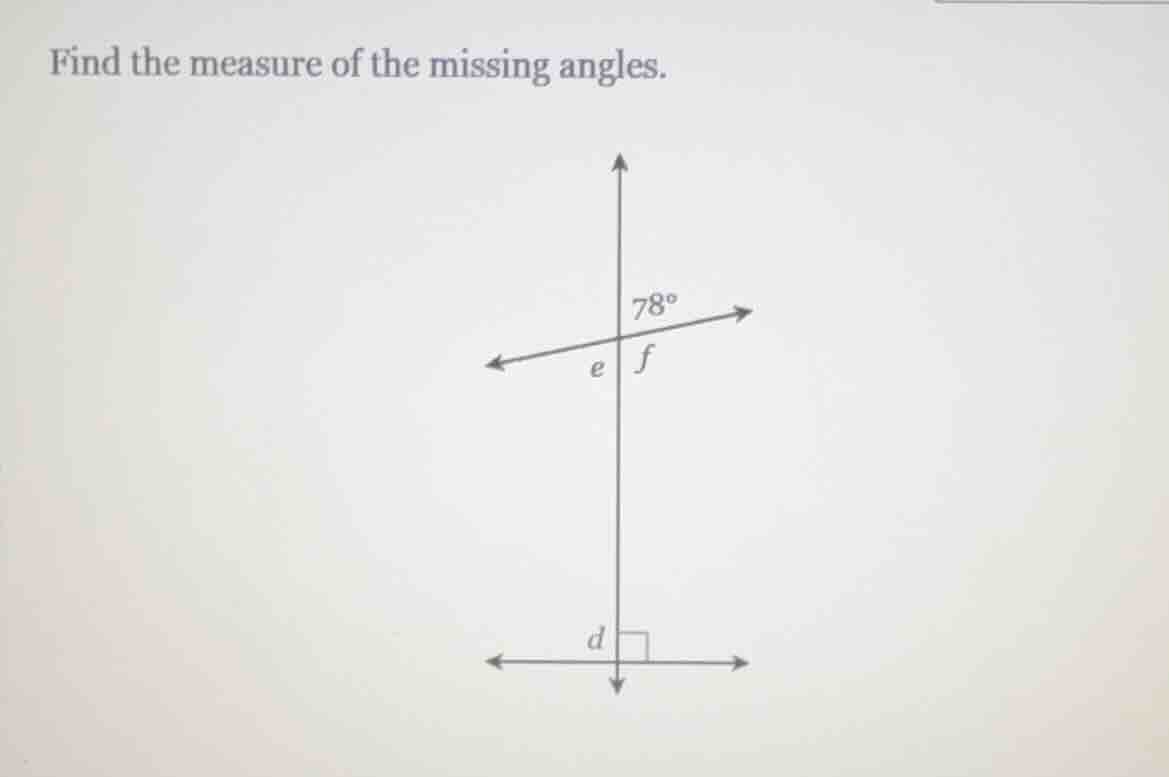
Step 1: Find angle \( d \)
Angle \( d \) is a right angle (indicated by the square symbol), so \( d = 90^\circ \).
Step 2: Find angle \( f \)
Angle \( f \) and the \( 78^\circ \) angle are supplementary (they form a linear pair), so \( f = 180^\circ - 78^\circ = 102^\circ \)? Wait, no, wait. Wait, the vertical line and the horizontal line (with the right angle) – actually, the angle \( f \) and the \( 78^\circ \) angle: Wait, no, the angle between the vertical line and the slanted line: Wait, the angle \( e \) and the \( 78^\circ \) angle are vertical angles? Wait, no, let's re-examine.
Wait, the vertical line and the slanted line intersect, so angle \( e \) and the \( 78^\circ \) angle are vertical angles? No, wait, the angle labeled \( 78^\circ \) and angle \( e \): Wait, actually, the angle between the vertical line and the slanted line: Let's see, the vertical line is straight, so the angle adjacent to \( 78^\circ \) (angle \( f \)): Wait, no, the right angle at \( d \) means the horizontal and vertical lines are perpendicular, so \( d = 90^\circ \).
For angle \( e \): Angle \( e \) and the \( 78^\circ \) angle are vertical angles? Wait, no, the slanted line intersects the vertical line, so the angle \( e \) and the \( 78^\circ \) angle are equal? Wait, no, vertical angles are equal. Wait, the \( 78^\circ \) angle and angle \( e \): Wait, maybe I made a mistake. Let's correct:
Wait, the angle between the vertical line and the slanted line: the \( 78^\circ \) angle and angle \( e \) – actually, angle \( e \) is equal to \( 78^\circ \) because they are vertical angles? No, wait, no. Wait, the vertical line is straight, so the angle adjacent to \( 78^\circ \) (angle \( f \)): Wait, no, the angle \( f \) and the \( 78^\circ \) angle are supplementary? Wait, no, the vertical line is a straight line, so the sum of \( 78^\circ \) and angle \( f \) is \( 180^\circ \)? No, that can't be. Wait, no, the slanted line intersects the vertical line, so the angle \( 78^\circ \) and angle \( e \) are vertical angles? Wait, no, the \( 78^\circ \) angle is between the vertical line and the slanted line (going right), and angle \( e \) is between the vertical line and the slanted line (going left). So they are vertical angles, so \( e = 78^\circ \). Then angle \( f \) is supplementary to \( 78^\circ \), so \( f = 180^\circ - 78^\circ = 102^\circ \)? Wait, no, that's not right. Wait, no, the vertical line is a straight line, so the angle on one side of the slanted line is \( 78^\circ \), so the angle on the other side (angle \( f \)) is \( 180^\circ - 78^\circ = 102^\circ \)? Wait, no, maybe I confused the angles.
Wait, let's start over:
- Angle \( d \): The square symbol means it's a right angle, so \( d = 90^\circ \).
- Angle \( e \): Angle \( e \) and the \( 78^\circ \) angle are vertical angles (opposite angles formed by intersecting lines), so \( e = 78^\circ \).
- Angle \( f \): Angle \( f \) and the \( 78^\circ \) angle are supplementary (they form a linear pair, so their sum is \( 180^\circ \)), so \( f = 180^\circ - 78^\circ = 102^\circ \). Wait, but also, angle \( f \) and the angle adjacent to \( d \): Wait, no, \( d \) is \( 90^\circ \), so the vertical line is perpendicular to the horizontal line (with \( d \)).
Wait, maybe the problem is to find \( d \), \( e \), \( f \). Let's confirm:
- \( d \): Right angle, so \( 90^\circ \).
- \( e \): Vertical angle with \( 78^\circ \), so \( e = 78^\circ \).
- \( f \): Supplementary to \( 78^\circ \), so \( f = 180^\circ - 78^\circ = 102^\circ \).
Wait, but maybe the angle \( f \…

Snap & solve any problem in the app
Get step-by-step solutions on Sovi AI
Photo-based solutions with guided steps
Explore more problems and detailed explanations
- \( d = 90^\circ \)
- \( e = 78^\circ \)
- \( f = 102^\circ \)