QUESTION IMAGE
Question
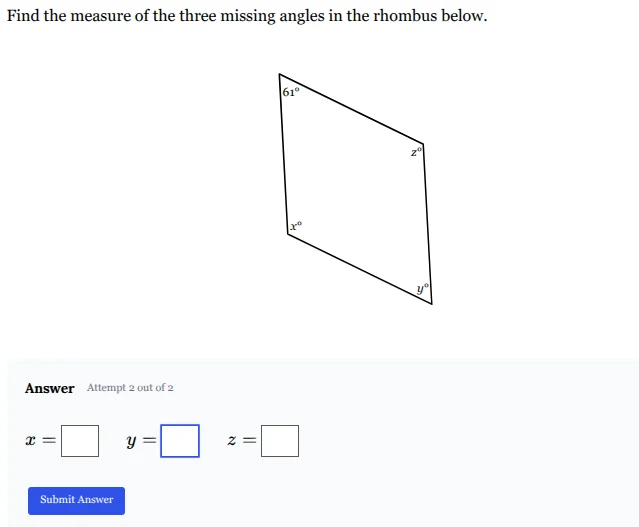
find the measure of the three missing angles in the rhombus below.
answer attempt 2 out of 2
x = \square \space \space y = \square \space \space z = \square
submit answer
Step1: Recall properties of a rhombus
In a rhombus, opposite angles are equal, and adjacent angles are supplementary (their sum is \(180^\circ\)).
Step2: Find angle \(x\)
The given angle is \(64^\circ\). Angle \(x\) is adjacent to the \(64^\circ\) angle? No, wait, in a rhombus, consecutive angles are supplementary. Wait, actually, in a rhombus, opposite angles are equal. Wait, let's correct: In a rhombus, opposite angles are equal, and consecutive angles are supplementary (sum to \(180^\circ\)). So if one angle is \(64^\circ\), its opposite angle is also \(64^\circ\), and the other two angles (which are equal to each other) are \(180 - 64 = 116^\circ\). Wait, let's check the diagram. The angle given is \(64^\circ\), then angle \(x\) is adjacent? Wait, no, looking at the rhombus, the angle at the top left is \(64^\circ\), then the bottom left is \(x\), top right is \(z\), bottom right is \(y\). In a rhombus, opposite angles are equal. So top left (\(64^\circ\)) and bottom right (\(y\)) are opposite? Wait, no, maybe I got the labeling wrong. Wait, in a rhombus, opposite angles are equal. So if the top angle is \(64^\circ\), then the angle opposite to it (bottom angle) is also \(64^\circ\)? No, that can't be, because consecutive angles are supplementary. Wait, no, let's recall: In a parallelogram (and a rhombus is a parallelogram), opposite angles are equal, consecutive angles are supplementary. So if angle \(A = 64^\circ\), then angle \(C = 64^\circ\) (opposite), and angles \(B\) and \(D = 180 - 64 = 116^\circ\) (opposite to each other). So in the diagram, let's assume the given angle is \(64^\circ\), then the angle opposite to it (say \(y\))? Wait, no, maybe the given angle is \(64^\circ\), then \(x\) is adjacent. Wait, the diagram: top left is \(64^\circ\), bottom left is \(x\), top right is \(z\), bottom right is \(y\). So top left and bottom right are opposite? No, top left and top right are adjacent? Wait, no, in a rhombus, sides are parallel. So top side and bottom side are parallel, left and right sides are parallel. So consecutive angles (e.g., top left and bottom left) are same - side interior angles, so supplementary. Wait, no, same - side interior angles between parallel lines are supplementary. So if top left is \(64^\circ\), then bottom left (x) is supplementary? Wait, no, that would be if the sides are horizontal and vertical, but in a rhombus, the sides are slanting. Wait, no, in a parallelogram (rhombus is a parallelogram), consecutive angles are supplementary. So angle at top left (\(64^\circ\)) and angle at bottom left (\(x\)): are they consecutive? Yes, because they share a side. So they should be supplementary? Wait, no, that's not right. Wait, in a parallelogram, consecutive angles are supplementary. So if angle \(A = 64^\circ\), angle \(B = 180 - 64 = 116^\circ\), angle \(C = 64^\circ\), angle \(D = 116^\circ\). So opposite angles: \(A = C\), \(B = D\). So in the diagram, let's say the top left is \(A = 64^\circ\), bottom left is \(B = x\), top right is \(C = z\), bottom right is \(D = y\). Then \(A = C\) (opposite), so \(z = 64^\circ\)? No, wait, no, \(A\) and \(C\) are opposite, so \(A = C = 64^\circ\), and \(B = D = x = y\), and \(A + B = 180^\circ\), so \(B = 180 - 64 = 116^\circ\). So \(x = 116^\circ\), \(y = 64^\circ\) (since \(y\) is opposite to \(A\)), and \(z = 116^\circ\) (opposite to \(x\))? Wait, no, maybe I mixed up. Wait, let's re - label:
In a rhombus, let's denote the angles as follows:
- Angle 1: top - left \(= 64^\circ\)
- Angle 2: bottom - left \(= x\)
- Angle 3: top - right \(= z\)…

Snap & solve any problem in the app
Get step-by-step solutions on Sovi AI
Photo-based solutions with guided steps
Explore more problems and detailed explanations
\(x = \boldsymbol{116}\), \(y=\boldsymbol{64}\), \(z = \boldsymbol{116}\)