QUESTION IMAGE
Question
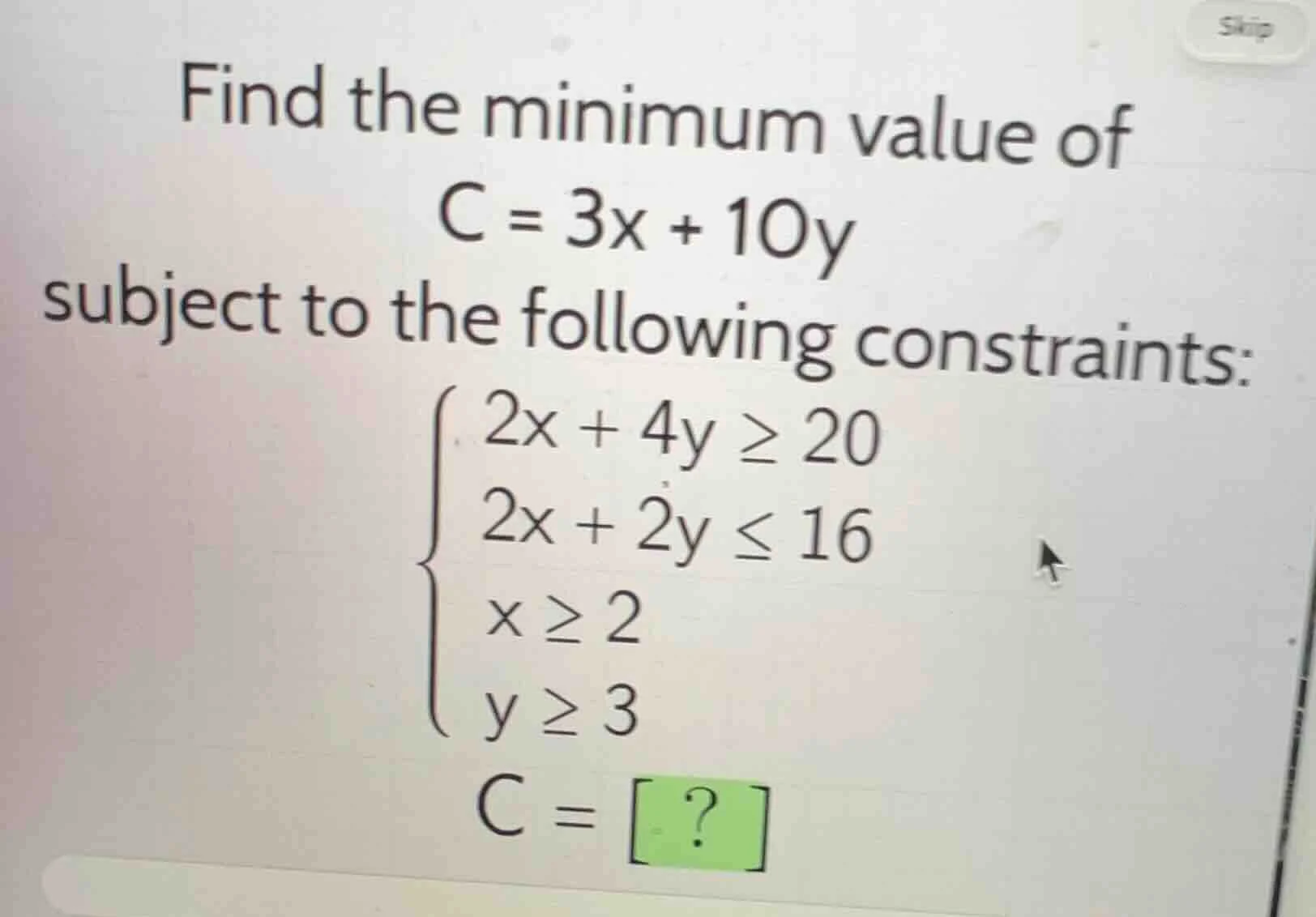
find the minimum value of
$c = 3x + 10y$
subject to the following constraints:
\
$c = ?$
Step1: Simplify constraints
First, simplify the inequalities. For \(2x + 4y \geq 20\), divide by 2: \(x + 2y \geq 10\). For \(2x + 2y \leq 16\), divide by 2: \(x + y \leq 8\). We also have \(x \geq 2\) and \(y \geq 3\).
Step2: Find intersection points
- Intersection of \(x + 2y = 10\) and \(x + y = 8\):
Subtract the second equation from the first: \((x + 2y) - (x + y) = 10 - 8\) → \(y = 2\). But \(y \geq 3\), so this point is invalid.
- Intersection of \(x + 2y = 10\) and \(y = 3\):
Substitute \(y = 3\) into \(x + 2y = 10\): \(x + 6 = 10\) → \(x = 4\). So point \((4, 3)\).
- Intersection of \(x + y = 8\) and \(y = 3\):
Substitute \(y = 3\) into \(x + y = 8\): \(x + 3 = 8\) → \(x = 5\). But check \(x + 2y = 5 + 6 = 11 \geq 10\) (satisfies). Wait, but also check \(x \geq 2\). Now, check intersection of \(x = 2\) and \(y = 3\): \(x=2,y=3\). Check \(x + 2y = 2 + 6 = 8 < 10\) (doesn't satisfy \(x + 2y \geq 10\)). So invalid.
- Intersection of \(x + 2y = 10\) and \(x = 2\):
Substitute \(x = 2\) into \(x + 2y = 10\): \(2 + 2y = 10\) → \(2y = 8\) → \(y = 4\). Check \(x + y = 6 \leq 8\) (satisfies) and \(y \geq 3\) (satisfies). So point \((2, 4)\).
- Intersection of \(x + y = 8\) and \(x = 2\):
Substitute \(x = 2\) into \(x + y = 8\): \(y = 6\). Check \(x + 2y = 2 + 12 = 14 \geq 10\) (satisfies) and \(y \geq 3\) (satisfies). So point \((2, 6)\). But let's check feasible points.
Feasible points must satisfy all constraints:
- From \(x + 2y \geq 10\), \(x + y \leq 8\), \(x \geq 2\), \(y \geq 3\).
Let's list possible points:
- When \(y = 3\): \(x + 6 \geq 10\) → \(x \geq 4\); and \(x + 3 \leq 8\) → \(x \leq 5\). So \(x = 4,5\). But \(x=5,y=3\): check \(2x + 4y = 10 + 12 = 22 \geq 20\), \(2x + 2y = 10 + 6 = 16 \leq 16\), \(x \geq 2\), \(y \geq 3\). Valid. \(x=4,y=3\): \(2x + 4y = 8 + 12 = 20 \geq 20\), \(2x + 2y = 8 + 6 = 14 \leq 16\), valid.
- When \(y = 4\): \(x + 8 \geq 10\) → \(x \geq 2\); \(x + 4 \leq 8\) → \(x \leq 4\). So \(x=2,3,4\). \(x=2,y=4\): \(2x + 4y = 4 + 16 = 20 \geq 20\), \(2x + 2y = 4 + 8 = 12 \leq 16\), valid. \(x=4,y=4\): \(x + y = 8 \leq 8\), \(x + 2y = 4 + 8 = 12 \geq 10\), valid. But let's check \(C = 3x + 10y\). We need to find the minimum, so check points with smaller \(y\) first (since \(y\) has a coefficient of 10, which is larger than 3 for \(x\), so minimizing \(y\) will help).
Check points:
- \((4, 3)\): \(C = 3(4) + 10(3) = 12 + 30 = 42\)
- \((5, 3)\): \(C = 3(5) + 10(3) = 15 + 30 = 45\) (larger than 42)
- \((2, 4)\): \(C = 3(2) + 10(4) = 6 + 40 = 46\) (larger than 42)
- Wait, is there a point with \(y=3\) and \(x=4\) valid? Let's recheck constraints:
\(2x + 4y = 8 + 12 = 20 \geq 20\) (ok), \(2x + 2y = 8 + 6 = 14 \leq 16\) (ok), \(x=4 \geq 2\) (ok), \(y=3 \geq 3\) (ok). So valid.
Wait, but also check intersection of \(x + 2y = 10\) and \(y=3\) is \(x=4\), and \(x + y = 8\) and \(y=3\) is \(x=5\). But between \(x=4\) and \(x=5\), \(y=3\), both satisfy. But \(x=4\) gives lower \(C\) than \(x=5\).
Wait, another point: \(x=2,y=4\): \(C=46\), \(x=4,y=3\): \(C=42\), \(x=4,y=4\): \(C=3(4)+10(4)=12+40=52\) (larger). So the minimum so far is 42. Wait, but let's check if there's a point with \(y=3\) and \(x\) between 4 and 5? No, because \(x + y \leq 8\) and \(x + 2y \geq 10\). When \(y=3\), \(x \leq 5\) and \(x \geq 4\), so \(x=4,5\).
Wait, is there a mistake? Let's re-express the constraints:
Original constraints:
- \(2x + 4y \geq 20\) → \(x + 2y \geq 10\)
- \(2x + 2y \leq 16\) → \(x + y \leq 8\)
- \(x \geq 2\)
- \(y \geq 3\)
Let's graph the feasible region:
- \(x + 2y \geq 10\): line \(x + 2y = 10\),…

Snap & solve any problem in the app
Get step-by-step solutions on Sovi AI
Photo-based solutions with guided steps
Explore more problems and detailed explanations
42