QUESTION IMAGE
Question
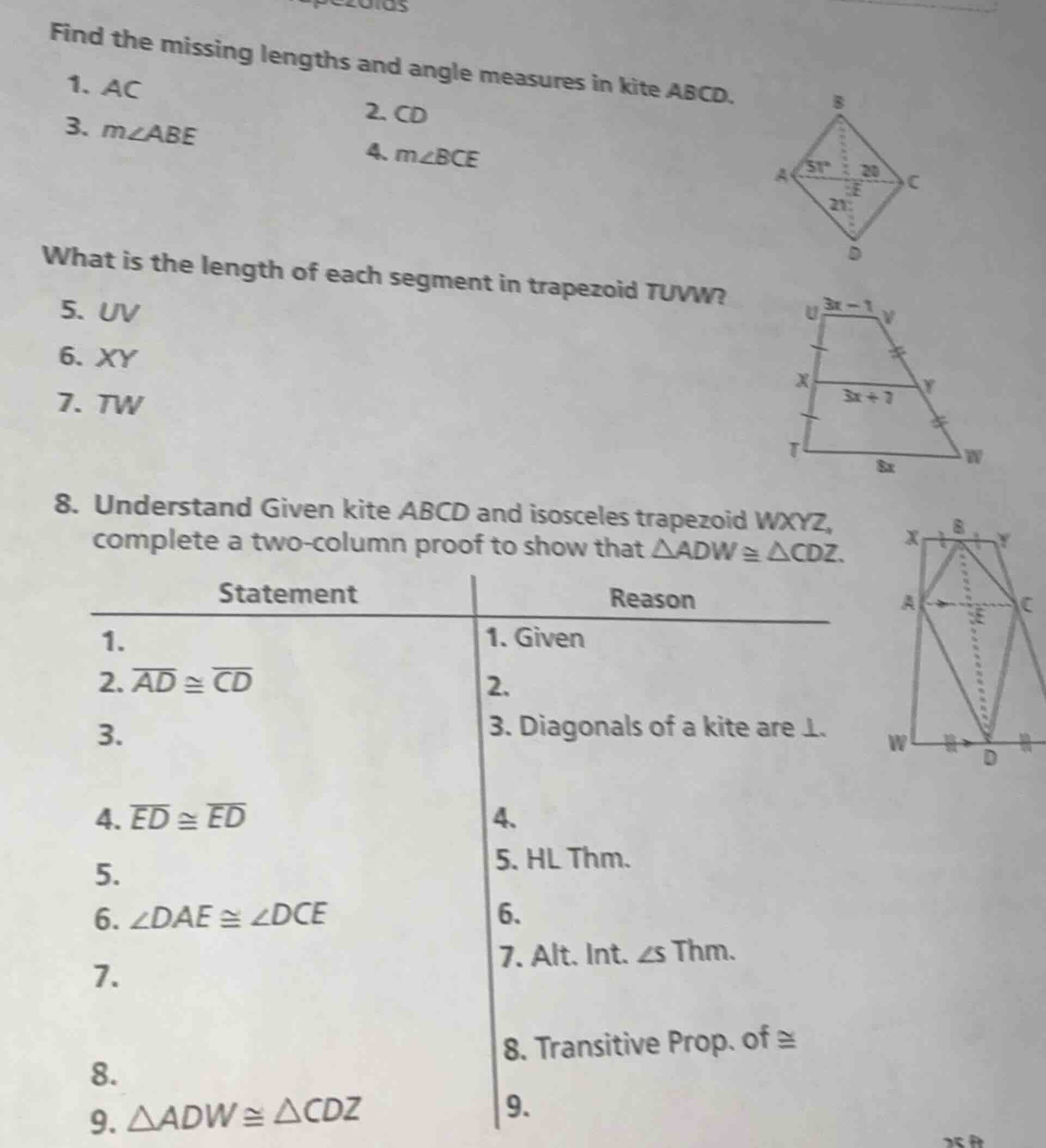
find the missing lengths and angle measures in kite abcd.
- ac
- cd
- ( mangle abe )
- ( mangle bce )
what is the length of each segment in trapezoid tuvw?
- uv
- xy
- tw
- understand given kite abcd and isosceles trapezoid wxyz, complete a two - column proof to show that ( \triangle adwcong\triangle cdz ).
statement \t\t\t\t\t\treason
- \t\t\t\t\t\t1. given
- ( overline{ad}congoverline{cd} ) \t\t\t\t\t\t2.
- \t\t\t\t\t\t3. diagonals of a kite are ( perp ).
- ( overline{ed}congoverline{ed} ) \t\t\t\t\t\t4.
- \t\t\t\t\t\t5. hl thm.
- ( angle daecongangle dce ) \t\t\t\t\t\t6.
- \t\t\t\t\t\t7. alt. int. ( angle s ) thm.
- \t\t\t\t\t\t8. transitive prop. of ( cong )
- ( \triangle adwcong\triangle cdz ) \t\t\t\t\t\t9.
Problem 1: Kite \(ABCD\) (Finding \(AC\))
Step 1: Analyze the kite's diagonal property
In a kite, one diagonal is bisected by the other. From the diagram, \(AC\) is a diagonal, and we can see that the segment from \(A\) to \(E\) and \(E\) to \(C\) – wait, actually, looking at the diagram, the length from \(A\) to \(C\) is given as two equal parts? Wait, no, the diagram shows \(AC\) with a segment of length 20? Wait, no, let's re - examine. Wait, the kite \(ABCD\) has diagonal \(AC\), and from the diagram, the length of \(AC\) – wait, maybe I misread. Wait, the diagram for kite \(ABCD\) has \(AC\) as a horizontal diagonal, and the length from \(A\) to \(C\) – looking at the numbers, maybe \(AC\) is composed of two equal parts? Wait, no, actually, in the kite, the diagonal \(AC\) – wait, the diagram shows that the segment from \(A\) to \(C\) is \(20 + 20\)? No, wait, maybe the given length is that \(AE = 20\) and \(EC = 20\)? Wait, no, the diagram has \(AC\) with a label of 20? Wait, no, let's think again. In a kite, one diagonal is bisected. Wait, maybe the length of \(AC\) is \(40\)? Wait, no, maybe the diagram shows that \(AC\) is \(2\times20=40\)? Wait, no, perhaps I made a mistake. Wait, the problem says "Find the missing lengths and angle measures in kite \(ABCD\)". For \(AC\), looking at the diagram, the horizontal diagonal \(AC\) has a segment of length 20 from \(A\) to \(E\) and 20 from \(E\) to \(C\), so \(AC=AE + EC=20 + 20 = 40\).
Step 2: Confirm the calculation
Since \(E\) is the mid - point of \(AC\) (because in a kite, one diagonal is bisected by the other), and \(AE = 20\), then \(AC=2\times AE=2\times20 = 40\).
Step 1: Use the Pythagorean theorem in \(\triangle CDE\)
In kite \(ABCD\), triangle \(CDE\) is a right triangle (because the diagonals of a kite are perpendicular). We know that \(EC = 20\) and \(ED = 21\). By the Pythagorean theorem, for a right triangle with legs \(a\) and \(b\) and hypotenuse \(c\), \(c=\sqrt{a^{2}+b^{2}}\). Here, \(a = EC = 20\) and \(b = ED = 21\), and \(c = CD\).
Step 2: Calculate \(CD\)
\[CD=\sqrt{EC^{2}+ED^{2}}=\sqrt{20^{2}+21^{2}}=\sqrt{400 + 441}=\sqrt{841}=29\]
Step 1: Analyze the angles in \(\triangle ABE\)
In \(\triangle ABE\), we know that the diagonals of a kite are perpendicular, so \(\angle AEB = 90^{\circ}\). We are given that \(\angle BAE=51^{\circ}\). The sum of the interior angles of a triangle is \(180^{\circ}\). So, in \(\triangle ABE\), \(m\angle ABE+ m\angle BAE+m\angle AEB = 180^{\circ}\).
Step 2: Solve for \(m\angle ABE\)
Substitute \(m\angle BAE = 51^{\circ}\) and \(m\angle AEB = 90^{\circ}\) into the angle - sum formula:
\[m\angle ABE=180^{\circ}-m\angle BAE - m\angle AEB=180^{\circ}-51^{\circ}-90^{\circ}=39^{\circ}\]

Snap & solve any problem in the app
Get step-by-step solutions on Sovi AI
Photo-based solutions with guided steps
Explore more problems and detailed explanations
The length of \(AC\) is \(\boldsymbol{40}\).