QUESTION IMAGE
Question
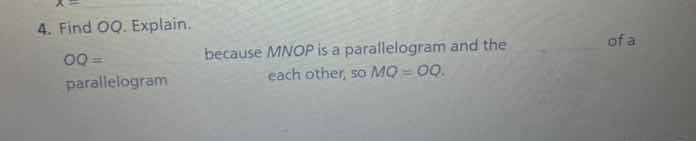
- find oq. explain.
oq = ____ because mnop is a parallelogram and the __ of a parallelogram ____ each other, so mq = oq.
Step1: Recall parallelogram diagonals property
In a parallelogram, the diagonals bisect each other. That means the point where the diagonals intersect (let's say \( Q \) here, assuming \( Q \) is the midpoint of diagonal \( MO \)) divides each diagonal into two equal parts. So if \( MQ \) and \( OQ \) are segments of diagonal \( MO \), then \( MQ = OQ \) because diagonals of a parallelogram bisect each other. But we need to know the length of \( MQ \) (or some related length) to find \( OQ \). Wait, maybe there was a diagram or more information? Wait, the original problem might have a diagram where, for example, if \( MQ \) is given as a length, say if \( MQ = 5 \), then \( OQ = 5 \) because diagonals bisect each other. But since the problem is about parallelogram diagonals, the key property is that diagonals bisect each other, so \( OQ = MQ \) (if \( Q \) is the midpoint). Let's assume that maybe in the diagram, \( MQ \) has a known length, but since it's not provided here, maybe the general property is that diagonals of a parallelogram bisect each other, so \( OQ = MQ \) (or whatever the length of \( MQ \) is, \( OQ \) is equal to it). But to fill in the blanks:
First blank (OQ = ): Let's say if \( MQ \) is, for example, 4 (but since it's not given, maybe the answer is based on the property. Wait, the problem says "Explain. OQ = __ because MNOP is a parallelogram and the of a parallelogram __ each other, so \( MQ = OQ \)."
So the correct terms: The diagonals of a parallelogram bisect each other. So the first blank (OQ = ) would be equal to \( MQ \) (assuming \( Q \) is the midpoint of \( MO \)), and the second blank is "diagonals", third blank is "bisect".
Wait, let's structure it:
OQ = \( MQ \) (or whatever the length of \( MQ \) is, but since it's a fill - in - the - blank with the property) because MNOP is a parallelogram and the diagonals of a parallelogram bisect each other, so \( MQ = OQ \).
But maybe in the original problem (with a diagram), if \( MQ \) is, say, 6, then \( OQ = 6 \). But since the problem is about the property, the key is that diagonals bisect each other, so \( OQ \) is equal to \( MQ \) (the segment from \( M \) to \( Q \)), and the reason is that diagonals of a parallelogram bisect each other.

Snap & solve any problem in the app
Get step-by-step solutions on Sovi AI
Photo-based solutions with guided steps
Explore more problems and detailed explanations
Assuming that in the context (diagram or previous info) \( MQ \) has a length (say \( l \)), then \( OQ = l \) (because diagonals of a parallelogram bisect each other, so \( MQ = OQ \)). The blanks are filled as: \( OQ=\boldsymbol{MQ} \) (or the length of \( MQ \)) because MNOP is a parallelogram and the \(\boldsymbol{\text{diagonals}}\) of a parallelogram \(\boldsymbol{\text{bisect}}\) each other, so \( MQ = OQ \).
(Note: If there was a specific length given for \( MQ \) in the original problem's diagram or context, substitute that length for \( MQ \) in the answer. For example, if \( MQ = 3 \), then \( OQ = 3 \) because diagonals of a parallelogram bisect each other.)