QUESTION IMAGE
Question
find the perimeter. simplify your answer.
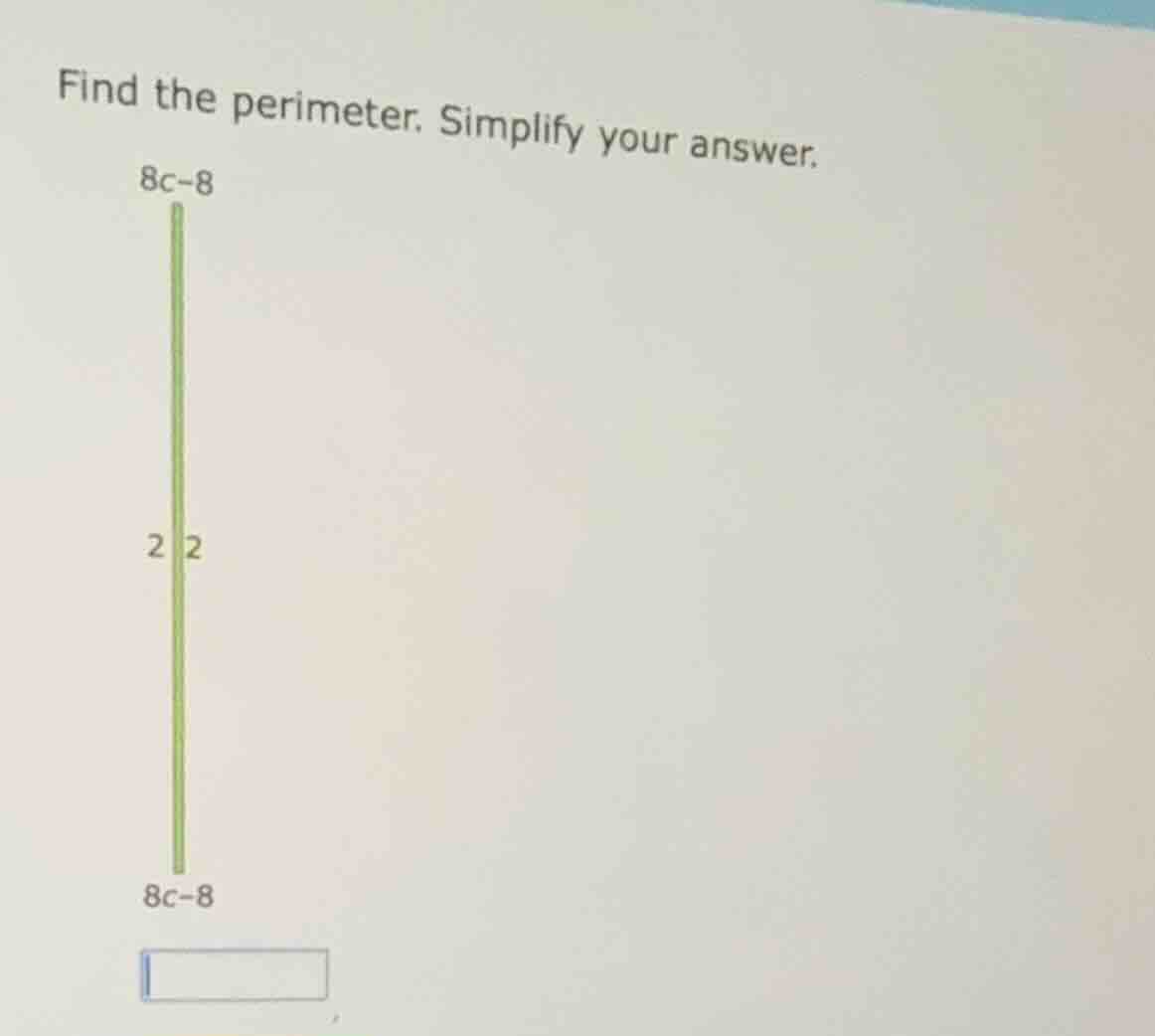
8c - 8
2 2
8c - 8
Step1: Identify the shape and sides
The figure appears to be a rectangle (or a parallelogram with two pairs of equal sides). The vertical sides are \(8c - 8\) each, and the horizontal sides are \(2\) each.
Step2: Recall the perimeter formula for a rectangle
The perimeter \(P\) of a rectangle is given by \(P = 2\times(\text{length}+\text{width})\). Here, length \(= 8c - 8\) and width \(= 2\).
Step3: Substitute into the formula
\(P = 2\times((8c - 8)+ 2)+2\times((8c - 8)+ 2)\) (or more simply, since there are two of each side: \(P = 2\times(8c - 8)+2\times2\))
First, calculate \(2\times(8c - 8)=16c - 16\) and \(2\times2 = 4\).
Step4: Combine like terms
\(P=(16c - 16)+4 + 16c - 16+4\) (wait, no, better to do it as \(2\times(8c - 8)+2\times2+2\times(8c - 8)+2\times2\) is incorrect. Wait, actually, for a rectangle, it's \(2\times(\text{vertical side}+\text{horizontal side})\). So vertical side is \(8c - 8\), horizontal is \(2\). So perimeter is \(2\times(8c - 8)+2\times2\). Wait, no, there are two vertical sides and two horizontal sides. So total perimeter: \(2\times(8c - 8)+2\times2\). Wait, no, the vertical sides are two of \(8c - 8\) and horizontal sides are two of \(2\). So:
\(P = 2\times(8c - 8)+2\times2\)
\(=16c - 16 + 4\)
Wait, no, that's wrong. Wait, the vertical sides: two sides of \(8c - 8\), so \(2\times(8c - 8)\), and horizontal sides: two sides of \(2\), so \(2\times2\). So total perimeter:
\(P = 2(8c - 8)+2(2)\)
\(=16c - 16 + 4\)
Wait, no, that's only one vertical and one horizontal. Wait, no, the formula for perimeter of a rectangle is \(2\times(\text{length}+\text{width})\), where length is the vertical side (\(8c - 8\)) and width is the horizontal side (\(2\)). So:
\(P = 2\times((8c - 8)+2)\)
\(=2\times(8c - 6)\)
\(=16c - 12\)
Wait, let's do it step by step. The two vertical sides: each is \(8c - 8\), so total for vertical: \(2\times(8c - 8)=16c - 16\). The two horizontal sides: each is \(2\), so total for horizontal: \(2\times2 = 4\). Now, add them together: \(16c - 16+4+16c - 16+4\) is wrong. Wait, no, the figure has two vertical sides (each \(8c - 8\)) and two horizontal sides (each \(2\)). So:
Vertical sides: \(2\times(8c - 8)=16c - 16\)
Horizontal sides: \(2\times2 = 4\)
Total perimeter: \(16c - 16 + 4=16c - 12\)? Wait, no, that's not right. Wait, no, the vertical sides are \(8c - 8\) (top and bottom? No, the figure shows vertical sides as \(8c - 8\) (left and right?) Wait, the diagram shows a vertical line with length \(8c - 8\) (top to middle) and middle to bottom also \(8c - 8\), and horizontal sides (left and right?) as \(2\). Wait, maybe it's a rectangle with length \(8c - 8\) (vertical) and width \(2\) (horizontal). So perimeter is \(2\times(\text{length}+\text{width})=2\times((8c - 8)+2)=2\times(8c - 6)=16c - 12\). Wait, but let's check again. If the vertical sides are each \(8c - 8\) (so two of them: \(2\times(8c - 8)\)) and horizontal sides are each \(2\) (two of them: \(2\times2\)), then total perimeter is \(2(8c - 8)+2(2)=16c - 16 + 4=16c - 12\). Yes, that's correct.
Wait, maybe the initial mistake was in the side identification. Let's re-express: the figure has two sides of length \(8c - 8\) and two sides of length \(2\). So perimeter is sum of all sides: \((8c - 8)+2+(8c - 8)+2\). Combine like terms: \(8c - 8+2+8c - 8+2=(8c + 8c)+(-8 - 8+2 + 2)=16c - 12\). Yes, that's simpler. So adding all four sides: \( (8c - 8)+2+(8c - 8)+2\). Combine the \(c\) terms: \(8c + 8c = 16c\). Combine the constant terms: \(-8 - 8+2 + 2=-12\). So perimeter is \(16c - 12\).

Snap & solve any problem in the app
Get step-by-step solutions on Sovi AI
Photo-based solutions with guided steps
Explore more problems and detailed explanations
\(16c - 12\)