QUESTION IMAGE
Question
find the perimeter.
write your answer as a fraction or as a whole or mixed number.
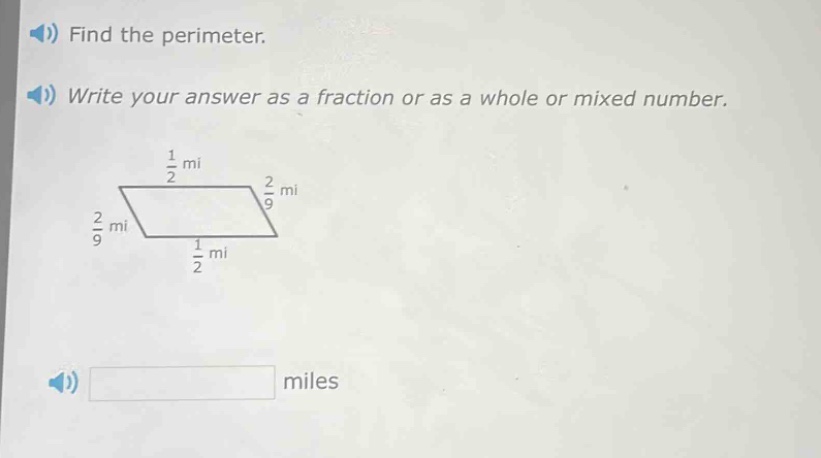
\\(\frac{1}{2}\\) mi
\\(\frac{2}{9}\\) mi
\\(\frac{2}{9}\\) mi
\\(\frac{1}{2}\\) mi
\\(\boxed{}\\) miles
Step1: Recall perimeter of parallelogram
A parallelogram has opposite sides equal. So perimeter \( P = 2\times(a + b) \), where \( a \) and \( b \) are adjacent sides. Here, \( a=\frac{1}{2} \) mi and \( b = \frac{2}{9} \) mi.
Step2: Calculate sum of adjacent sides
First, find \( \frac{1}{2}+\frac{2}{9} \). Find a common denominator, which is 18. So \( \frac{1}{2}=\frac{9}{18} \) and \( \frac{2}{9}=\frac{4}{18} \). Then \( \frac{9}{18}+\frac{4}{18}=\frac{13}{18} \).
Step3: Multiply by 2 for perimeter
Now, perimeter \( P = 2\times\frac{13}{18}=\frac{13}{9}=1\frac{4}{9} \)? Wait, no, wait. Wait, let's re - check. Wait, \( 2\times\frac{1}{2}+2\times\frac{2}{9} \). \( 2\times\frac{1}{2}=1 \), \( 2\times\frac{2}{9}=\frac{4}{9} \). Then total perimeter is \( 1+\frac{4}{9}=\frac{9 + 4}{9}=\frac{13}{9} \)? Wait, no, wait, no. Wait, the formula is \( 2(a + b) \), where \( a=\frac{1}{2} \) and \( b=\frac{2}{9} \). So \( a + b=\frac{1}{2}+\frac{2}{9}=\frac{9 + 4}{18}=\frac{13}{18} \). Then \( 2\times\frac{13}{18}=\frac{13}{9}=1\frac{4}{9} \)? Wait, no, that's wrong. Wait, \( \frac{1}{2}+\frac{1}{2}+\frac{2}{9}+\frac{2}{9} \). \( \frac{1}{2}+\frac{1}{2}=1 \), \( \frac{2}{9}+\frac{2}{9}=\frac{4}{9} \). Then \( 1+\frac{4}{9}=\frac{9 + 4}{9}=\frac{13}{9}=1\frac{4}{9} \)? Wait, no, wait, \( \frac{13}{9} \) is \( 1\frac{4}{9} \)? Wait, no, \( 9\times1 = 9 \), \( 13-9 = 4 \), so yes, \( 1\frac{4}{9} \)? Wait, no, wait, let's do the addition again. \( \frac{1}{2}+\frac{2}{9} \): common denominator 18. \( \frac{1}{2}=\frac{9}{18} \), \( \frac{2}{9}=\frac{4}{18} \), sum is \( \frac{13}{18} \). Then perimeter is \( 2\times\frac{13}{18}=\frac{13}{9}=1\frac{4}{9} \)? Wait, no, \( \frac{13}{9} \) is \( 1\frac{4}{9} \)? Wait, no, \( 9\times1 = 9 \), \( 13 - 9=4 \), so yes. Wait, but let's check with another approach. The sides are \( \frac{1}{2},\frac{2}{9},\frac{1}{2},\frac{2}{9} \). So adding them up: \( \frac{1}{2}+\frac{2}{9}+\frac{1}{2}+\frac{2}{9}=(\frac{1}{2}+\frac{1}{2})+(\frac{2}{9}+\frac{2}{9})=1+\frac{4}{9}=\frac{9 + 4}{9}=\frac{13}{9}=1\frac{4}{9} \). Wait, but \( \frac{13}{9} \) is \( 1\frac{4}{9} \)? Wait, no, \( 1\frac{4}{9}=\frac{13}{9} \), yes. Wait, but let's compute \( \frac{1}{2}+\frac{2}{9} \) again. \( \frac{1}{2}=0.5 \), \( \frac{2}{9}\approx0.222 \), sum is \( 0.722 \). Then multiply by 2: \( 1.444\approx\frac{13}{9}\approx1.444 \), which is \( 1\frac{4}{9} \) (since \( \frac{4}{9}\approx0.444 \)). So the perimeter is \( \frac{13}{9} \) or \( 1\frac{4}{9} \). Wait, but let's do the fraction addition properly. \( 2\times\frac{1}{2}=1 \), \( 2\times\frac{2}{9}=\frac{4}{9} \), so \( 1+\frac{4}{9}=\frac{9 + 4}{9}=\frac{13}{9}=1\frac{4}{9} \).

Snap & solve any problem in the app
Get step-by-step solutions on Sovi AI
Photo-based solutions with guided steps
Explore more problems and detailed explanations
\( \frac{13}{9} \) (or \( 1\frac{4}{9} \))