QUESTION IMAGE
Question
find s.
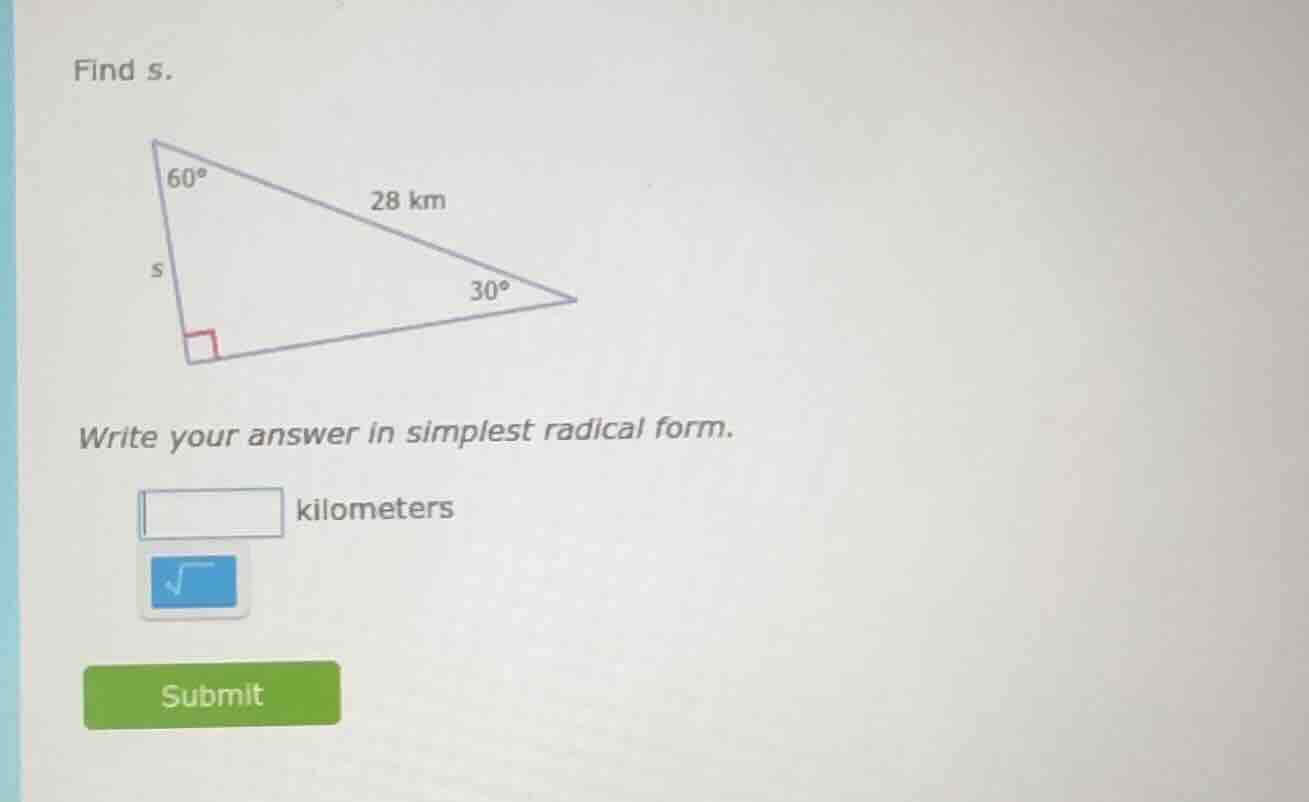
right triangle with angles 60°, 30°, right angle; hypotenuse 28 km, side s opposite 30°? wait no, s is one leg, hypotenuse 28 km. write your answer in simplest radical form. blank kilometers
Step1: Identify triangle type
This is a 30 - 60 - 90 right triangle. The hypotenuse is 28 km. In a 30 - 60 - 90 triangle, the side opposite 30° is half the hypotenuse, and the side opposite 60° is $\frac{\sqrt{3}}{2}$ times the hypotenuse. Here, \(s\) is opposite the 30° angle? Wait, no. Wait, the right angle, 60° and 30°. So the side \(s\) is adjacent to 60° and opposite to 30°? Wait, no. Let's label the triangle. The right angle, one angle 60°, one 30°. The hypotenuse is 28 km. The side \(s\): let's see, the angle of 30°: the side opposite 30° is the shorter leg. Wait, in a 30 - 60 - 90 triangle, the sides are in the ratio \(1:\sqrt{3}:2\), where 1 is the shorter leg (opposite 30°), \(\sqrt{3}\) is the longer leg (opposite 60°), and 2 is the hypotenuse. Wait, so if hypotenuse is 28 (which is 2 parts), then the shorter leg (opposite 30°) is \(28\div2 = 14\)? Wait, no, wait. Wait, the side \(s\): let's check the angles. The right angle, angle at the bottom left is right angle, top left is 60°, bottom right is 30°. So the side \(s\) is the side opposite the 30° angle? Wait, no. Wait, the side opposite 30°: in the triangle, the vertices: let's call the right angle vertex A, top left vertex B (60°), bottom right vertex C (30°). So side AB is \(s\), BC is the hypotenuse (28 km), and AC is the other leg. So angle at C is 30°, so side AB (opposite angle C) is the side opposite 30°, so length of AB (s) is \(\frac{1}{2}\) of hypotenuse? Wait, no, wait. Wait, in a right triangle, \(\sin(\theta)=\frac{\text{opposite}}{\text{hypotenuse}}\). So for angle C (30°), \(\sin(30^{\circ})=\frac{s}{28}\). Since \(\sin(30^{\circ})=\frac{1}{2}\), then \(s = 28\times\sin(30^{\circ})\).
Step2: Calculate \(s\)
We know that \(\sin(30^{\circ})=\frac{1}{2}\), so \(s = 28\times\frac{1}{2}=14\)? Wait, no, wait. Wait, maybe I mixed up. Wait, angle at B is 60°, angle at C is 30°, right angle at A. So side AB is \(s\) (from A to B), AC is the other leg (from A to C), and BC is hypotenuse (28) from B to C. So angle at C is 30°, so the side opposite angle C is AB (s), so \(\sin(30^{\circ})=\frac{AB}{BC}=\frac{s}{28}\). Since \(\sin(30^{\circ})=\frac{1}{2}\), then \(s = 28\times\frac{1}{2}=14\). Wait, but wait, maybe I made a mistake. Wait, or is \(s\) the side opposite 60°? Wait, no, let's check with cosine. For angle B (60°), \(\cos(60^{\circ})=\frac{AB}{BC}=\frac{s}{28}\). Since \(\cos(60^{\circ})=\frac{1}{2}\), so \(s = 28\times\frac{1}{2}=14\). Yes, that's correct. So \(s = 14\) km? Wait, but wait, the problem says "simplest radical form", but 14 is an integer. Wait, maybe I messed up the angle. Wait, let's re - examine. Wait, the triangle: right angle, 60°, 30°. The hypotenuse is 28. The side \(s\): if the angle adjacent to \(s\) is 60°, then \(\cos(60^{\circ})=\frac{s}{28}\), so \(s = 28\times\cos(60^{\circ})=28\times\frac{1}{2}=14\). Alternatively, if we consider the side opposite 30° is the shorter leg, which is half the hypotenuse, so that's 14, and the side opposite 60° is \(14\sqrt{3}\). Wait, maybe I had the angle wrong. Wait, the side \(s\): let's see the diagram again. The right angle is at the bottom left, so the vertical side is \(s\), horizontal side is the other leg, hypotenuse is 28. The angle at the top left is 60°, so the angle between \(s\) and the hypotenuse is 60°, so \(s\) is adjacent to 60°, so \(\cos(60^{\circ})=\frac{s}{28}\), so \(s = 28\times\frac{1}{2}=14\).

Snap & solve any problem in the app
Get step-by-step solutions on Sovi AI
Photo-based solutions with guided steps
Explore more problems and detailed explanations
14