QUESTION IMAGE
Question
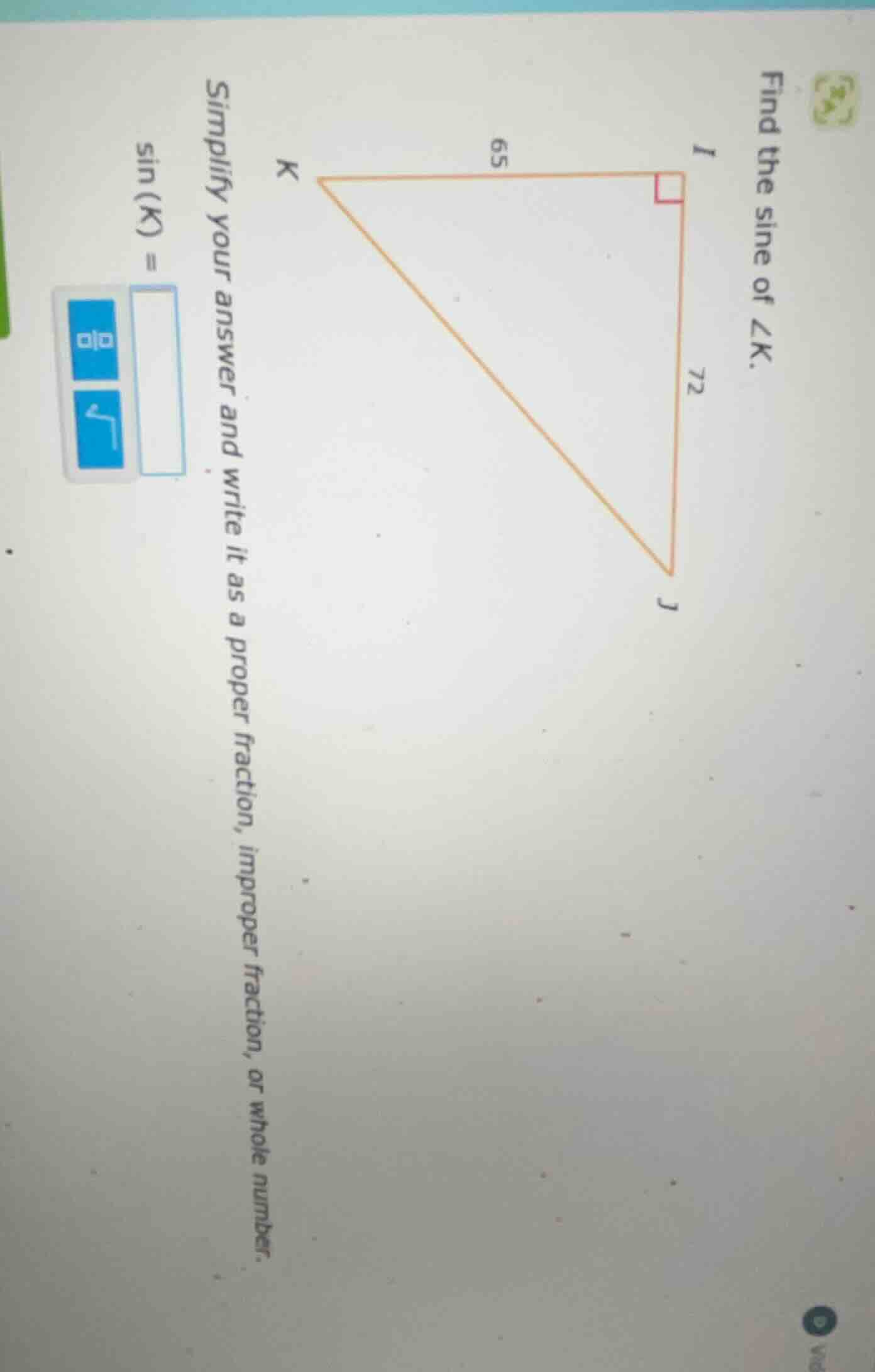
find the sine of ∠k. simplify your answer and write it as a proper fraction, improper fraction, or whole number. sin(k) =
Step1: Recall SOHCAHTOA for sine
In a right triangle, $\sin(\theta) = \frac{\text{opposite}}{\text{hypotenuse}}$. For $\angle K$, we need to identify the opposite side and the hypotenuse.
Step2: Identify sides relative to $\angle K$
- Opposite side to $\angle K$: $IJ = 72$ (since it's opposite angle $K$ in right triangle $IJK$ with right angle at $I$).
- Hypotenuse: $KJ$. First, find the length of $KJ$ using the Pythagorean theorem? Wait, no, wait. Wait, in right triangle $IJK$, right-angled at $I$, so legs are $II = 65$? Wait, no, the sides: $II$? Wait, the triangle has vertices $I$, $J$, $K$, right-angled at $I$. So $II$ is a typo? Wait, the sides: $IK = 65$, $IJ = 72$, and hypotenuse $KJ$. Wait, no, wait, let's check: in right triangle, right angle at $I$, so $IK$ and $IJ$ are legs, $KJ$ is hypotenuse. Wait, but to find $\sin(K)$, angle $K$: the opposite side to $K$ is $IJ$ (length 72), and the hypotenuse is $KJ$. Wait, but do we know $KJ$? Wait, no, wait, maybe I made a mistake. Wait, no, wait: in right triangle $IJK$, right-angled at $I$, so angle at $K$: the sides: adjacent to $K$ is $IK = 65$, opposite is $IJ = 72$, and hypotenuse is $KJ$. Wait, but we can find $KJ$ using Pythagoras: $KJ = \sqrt{IK^2 + IJ^2} = \sqrt{65^2 + 72^2}$. Wait, but wait, maybe I misread the triangle. Wait, the problem says "Find the sine of $\angle K$". Let's re-express: in right triangle $IJK$, right angle at $I$, so:
- $\angle I = 90^\circ$, $IK = 65$, $IJ = 72$, so hypotenuse $KJ = \sqrt{65^2 + 72^2}$. Let's calculate that: $65^2 = 4225$, $72^2 = 5184$, so $KJ = \sqrt{4225 + 5184} = \sqrt{9409} = 97$. Ah, so hypotenuse $KJ = 97$.
Now, $\sin(K)$: opposite side to $K$ is $IJ = 72$, hypotenuse is $KJ = 97$. So $\sin(K) = \frac{72}{97}$. Wait, but let's confirm: SOHCAHTOA: Sine is Opposite over Hypotenuse. So for angle $K$, the opposite side is $IJ$ (since from $K$, the side opposite is $IJ$), and hypotenuse is $KJ$. So yes, $\sin(K) = \frac{IJ}{KJ} = \frac{72}{97}$.
Wait, but let's check the steps again:
Step1: Identify the right triangle and angle
Right triangle $IJK$, right angle at $I$. Angle $K$: we need to find $\sin(K)$.
Step2: Recall sine definition
$\sin(\theta) = \frac{\text{opposite}}{\text{hypotenuse}}$.
Step3: Determine opposite and hypotenuse for $\angle K$
- Opposite side to $\angle K$: $IJ = 72$ (since it's across from angle $K$).
- Hypotenuse: $KJ$. Calculate $KJ$ using Pythagorean theorem: $KJ = \sqrt{IK^2 + IJ^2} = \sqrt{65^2 + 72^2} = \sqrt{4225 + 5184} = \sqrt{9409} = 97$.
Step4: Compute $\sin(K)$
$\sin(K) = \frac{\text{opposite}}{\text{hypotenuse}} = \frac{72}{97}$.

Snap & solve any problem in the app
Get step-by-step solutions on Sovi AI
Photo-based solutions with guided steps
Explore more problems and detailed explanations
$\frac{72}{97}$