QUESTION IMAGE
Question
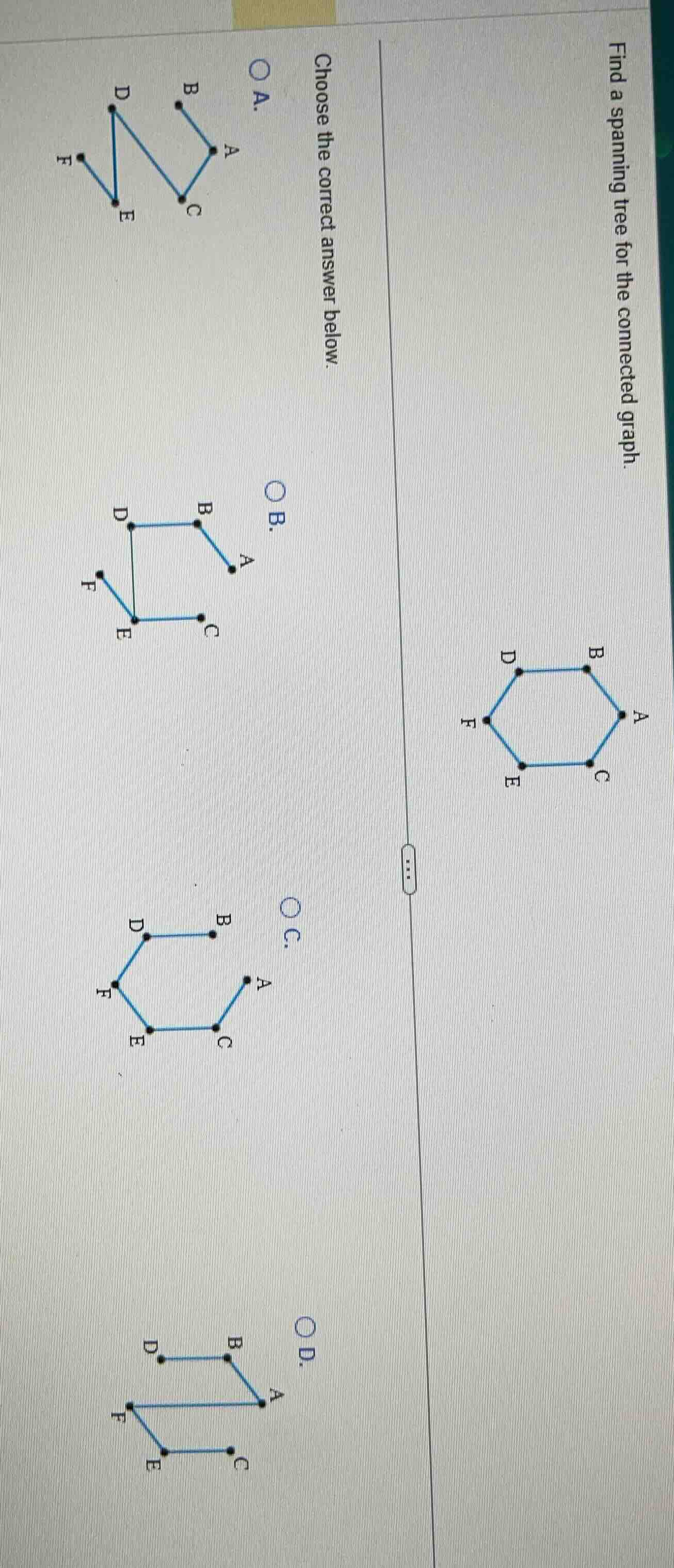
find a spanning tree for the connected graph. choose the correct answer below. a. graph a b. graph b c. graph c d. graph d
Step1: Recall Spanning Tree Properties
A spanning tree of a connected graph is a subgraph that includes all the vertices, is connected, and has no cycles (it has exactly \(n - 1\) edges where \(n\) is the number of vertices).
Step2: Analyze Each Option
- Option A: Check if it's connected, has all vertices, and no cycles. The graph in A connects all vertices (A, B, C, D, E, F) with edges that form a tree (no cycles, \(n - 1\) edges for \(n = 6\) vertices: \(6 - 1 = 5\) edges, and the structure has no cycles).
- Option B: Contains a cycle (e.g., B - D - E - C -...? Wait, looking at the diagram, B - D - E - C -... forms a cycle? Wait, no, let's count edges. Wait, the original graph (the hexagon) has 6 vertices. A spanning tree should have 5 edges. Option B's graph: Let's count vertices (A, B, D, E, F, C) – all 6. But does it have a cycle? Let's see the edges: A - B, B - D, D - E, E - C, E - F? Wait, no, the diagram for B: A - B, B - D, D - E, E - C, E - F? Wait, no, maybe I missee. Wait, the key is: a spanning tree must be acyclic. Option B: Let's check the structure. If there's a cycle (like a quadrilateral or something), but actually, looking at the options, Option A: the graph is a tree (no cycles, connected, all vertices). Option B: has a cycle? Wait, no, maybe I made a mistake. Wait, the original graph is a hexagon (6 vertices, 6 edges, so a cycle). A spanning tree must remove one edge to make it a tree (5 edges, acyclic, connected).
Wait, the original graph (the hexagon) has vertices A, B, C, D, E, F with edges AB, BC, CD, DE, EF, FA (forming a hexagon, a cycle). A spanning tree should be a subgraph with all 6 vertices, connected, 5 edges, no cycles.
Now, check Option A: The graph in A: A - B, B - C, C - D, D - E, E - F? Wait, no, the diagram for A: A connected to B, B connected to... Wait, the first option (A) has edges: A - B, B - C? No, wait the first diagram (A) shows: A connected to B, B connected to... Wait, maybe the correct way is: a spanning tree must be a tree (connected, acyclic, all vertices).
Option A: Let's count vertices: A, B, C, D, E, F – all 6. Edges: Let's see the diagram: A - B, B - C? No, wait the first option (A) has A, B, C, D, E, F with edges that form a tree (no cycles). Option B: The diagram for B has a cycle (e.g., B - D - E - C -...? No, maybe B's graph has a cycle. Wait, the key is: Option A is a tree (no cycles, connected, all vertices), while Option B, C, D have cycles or are disconnected? Wait, Option C: The graph is the original hexagon (6 edges, a cycle), so it's not a tree (has a cycle). Option D: Also has a cycle? Wait, no, let's re - check.
Wait, the correct spanning tree should be acyclic, connected, with all vertices. Option A: The structure is a tree (no cycles, connected, all vertices). So Option A is the correct spanning tree.

Snap & solve any problem in the app
Get step-by-step solutions on Sovi AI
Photo-based solutions with guided steps
Explore more problems and detailed explanations
A. The graph in Option A (with vertices A, B, C, D, E, F connected in a tree - like structure with no cycles)