QUESTION IMAGE
Question
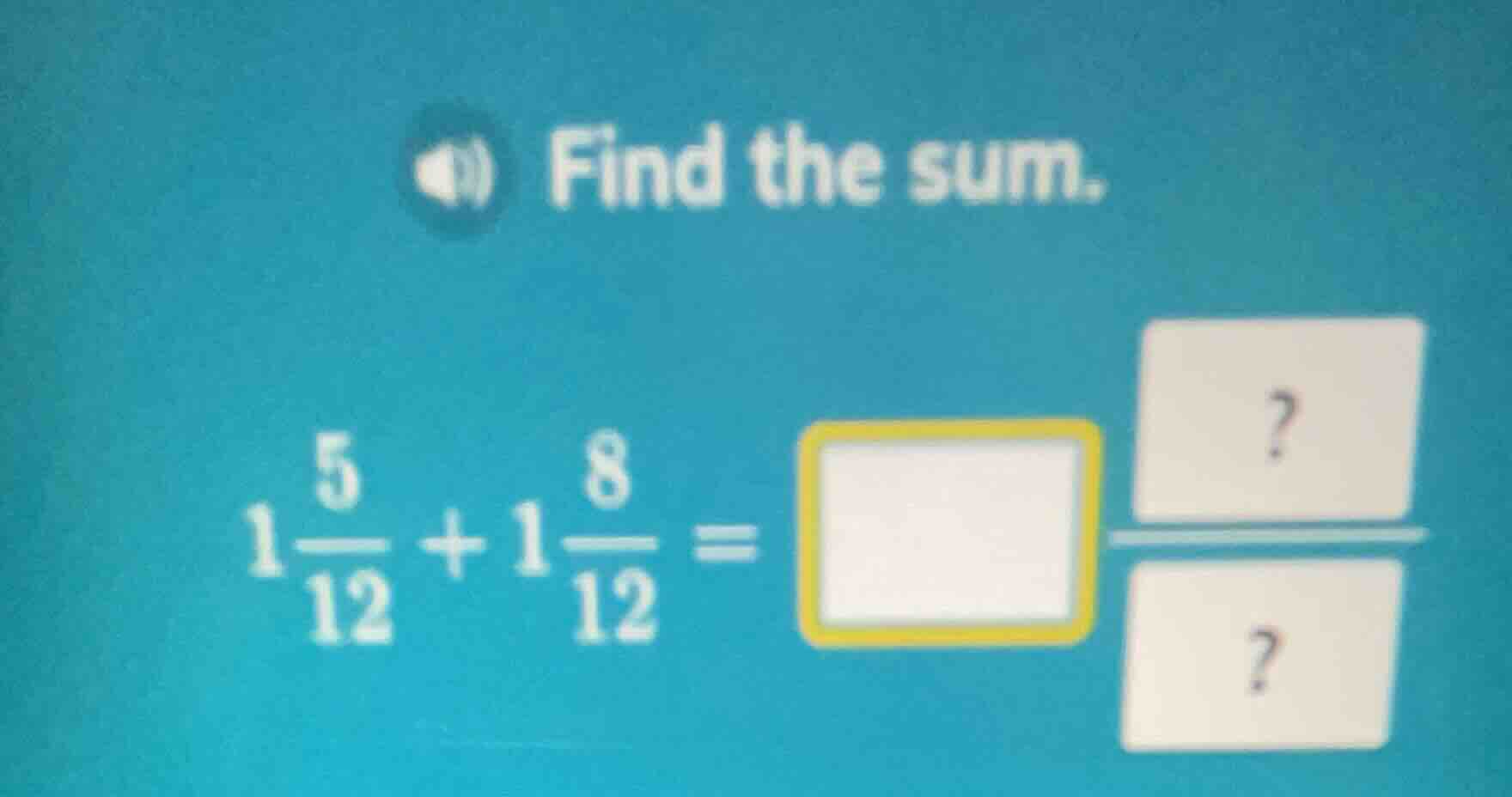
find the sum.
$1\frac{5}{12} + 1\frac{8}{12} = \square \frac{?}{?}$
Step1: Add the whole numbers
The whole numbers are 1 and 1. So, \(1 + 1 = 2\).
Step2: Add the fractions
The fractions are \(\frac{5}{12}\) and \(\frac{8}{12}\). Since they have the same denominator, we add the numerators: \(\frac{5 + 8}{12}=\frac{13}{12}\).
Step3: Combine the whole number and the fraction
We have \(2+\frac{13}{12}\). Convert \(2\) to twelfths: \(2=\frac{24}{12}\). Then \(\frac{24}{12}+\frac{13}{12}=\frac{37}{12}\). Now, convert \(\frac{37}{12}\) to a mixed number: \(37\div12 = 3\) with a remainder of \(1\), so \(\frac{37}{12}=3\frac{1}{12}\). Wait, no, wait. Wait, actually, when we add the mixed numbers, another way: add the whole parts and the fractional parts separately. So whole parts: \(1 + 1 = 2\), fractional parts: \(\frac{5}{12}+\frac{8}{12}=\frac{13}{12}=1\frac{1}{12}\). Then add the whole parts: \(2 + 1\frac{1}{12}=3\frac{1}{12}\). Wait, but let's check again. Wait, the original problem is \(1\frac{5}{12}+1\frac{8}{12}\). So adding the whole numbers: \(1 + 1 = 2\), adding the fractions: \(\frac{5}{12}+\frac{8}{12}=\frac{13}{12}=1\frac{1}{12}\). Then total is \(2 + 1\frac{1}{12}=3\frac{1}{12}\). So the mixed number is \(3\frac{1}{12}\), so the whole number part is 3, the numerator is 1, and the denominator is 12.
Wait, maybe I made a mistake earlier. Let's do it step by step correctly.
Alternative Step1: Add the mixed numbers by adding whole parts and fractional parts.
Whole parts: \(1 + 1 = 2\)
Fractional parts: \(\frac{5}{12}+\frac{8}{12}=\frac{13}{12}\)
Now, \(\frac{13}{12}=1\frac{1}{12}\)
Now, add the whole part from the fraction to the whole number: \(2 + 1\frac{1}{12}=3\frac{1}{12}\)
So the mixed number is \(3\frac{1}{12}\), so the first box (whole number) is 3, the numerator is 1, and the denominator is 12.
Wait, but let's check the addition again. \(1\frac{5}{12}\) is \(1 + \frac{5}{12}\), \(1\frac{8}{12}\) is \(1 + \frac{8}{12}\). So adding them together: \((1 + 1)+(\frac{5}{12}+\frac{8}{12}) = 2+\frac{13}{12}\). Now, \(\frac{13}{12}=1\frac{1}{12}\), so \(2 + 1\frac{1}{12}=3\frac{1}{12}\). So the mixed number is \(3\frac{1}{12}\), so the whole number part is 3, the numerator is 1, and the denominator is 12.
So the first box (the whole number in the mixed number) is 3, the numerator is 1, and the denominator is 12.
Wait, maybe the problem is expecting to add the mixed numbers and express the result as a mixed number, so the format is \(\text{whole number}\frac{\text{numerator}}{\text{denominator}}\). So let's do it again:
\(1\frac{5}{12}+1\frac{8}{12}\)
Add the whole numbers: \(1 + 1 = 2\)
Add the fractions: \(\frac{5}{12}+\frac{8}{12}=\frac{13}{12}\)
Now, \(\frac{13}{12}=1\frac{1}{12}\)
Now, add the 2 and \(1\frac{1}{12}\): \(2 + 1\frac{1}{12}=3\frac{1}{12}\)
So the mixed number is \(3\frac{1}{12}\), so the whole number part (the first box) is 3, the numerator is 1, and the denominator is 12.

Snap & solve any problem in the app
Get step-by-step solutions on Sovi AI
Photo-based solutions with guided steps
Explore more problems and detailed explanations
The whole number part is 3, the numerator is 1, and the denominator is 12. So the answer is \(3\frac{1}{12}\), so the first box (whole number) is 3, numerator is 1, denominator is 12. So filling in the boxes: the first box (whole number) is 3, the numerator is 1, the denominator is 12. So the sum is \(3\frac{1}{12}\), so the whole number part is 3, numerator 1, denominator 12.