QUESTION IMAGE
Question
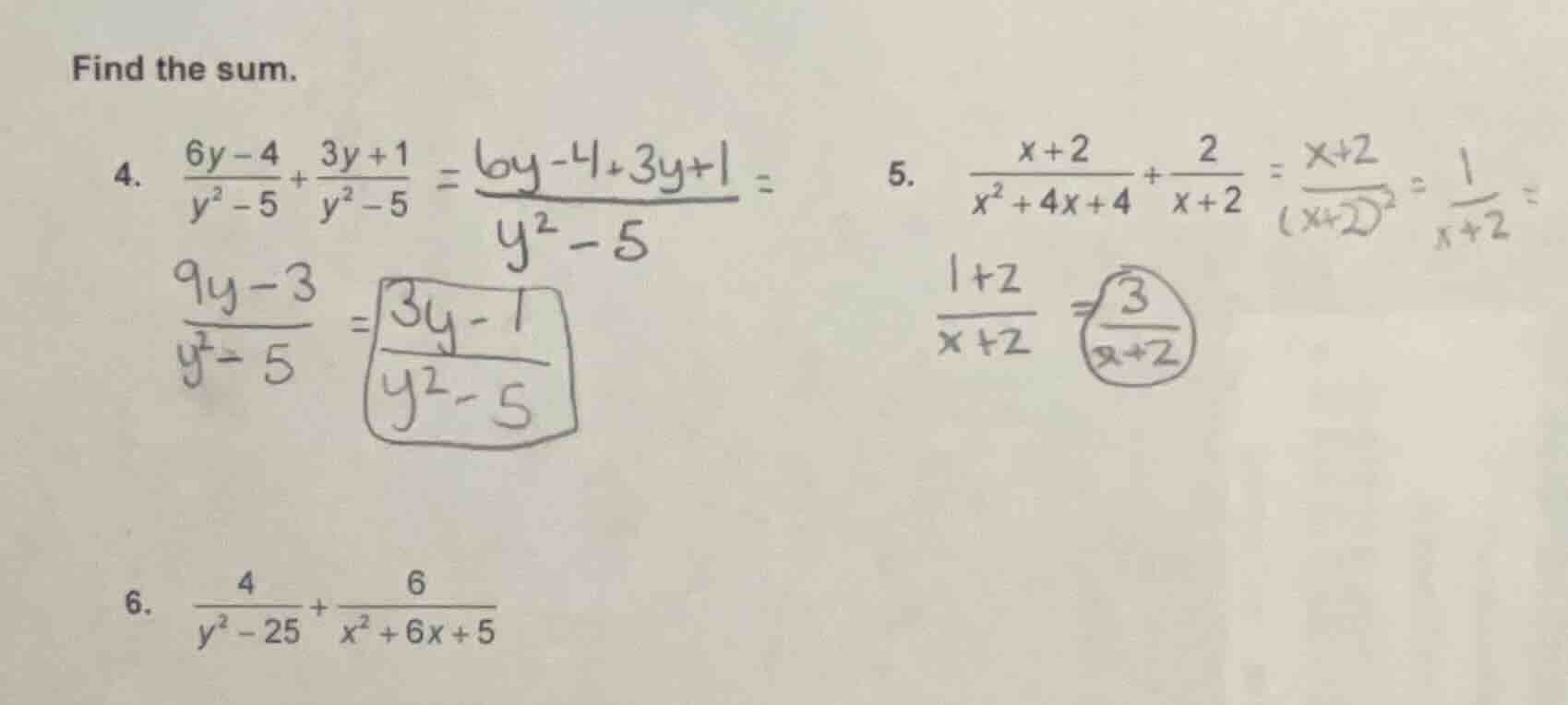
find the sum.
- \\(\frac{6y - 4}{y^2 - 5} + \frac{3y + 1}{y^2 - 5} = \frac{6y - 4 + 3y + 1}{y^2 - 5} = \frac{9y - 3}{y^2 - 5} = \frac{3y - 1}{y^2 - 5}\\)
- \\(\frac{x + 2}{x^2 + 4x + 4} + \frac{2}{x + 2} = \frac{x + 2}{(x + 2)^2} + \frac{2}{x + 2} = \frac{1}{x + 2} + \frac{2}{x + 2} = \frac{3}{x + 2}\\)
- \\(\frac{4}{y^2 - 25} + \frac{6}{x^2 + 6x + 5}\\)
Problem 4:
Step 1: Add the numerators (same denominator)
Since the denominators \( y^2 - 5 \) are the same, we add the numerators: \( (6y - 4) + (3y + 1) \).
\[
\frac{6y - 4 + 3y + 1}{y^2 - 5}
\]
Step 2: Combine like terms in the numerator
Combine the \( y \)-terms and constant terms: \( 6y + 3y = 9y \), \( -4 + 1 = -3 \).
\[
\frac{9y - 3}{y^2 - 5}
\]
Step 3: Factor the numerator (if possible)
Factor out a 3 from the numerator: \( 9y - 3 = 3(3y - 1) \). The denominator \( y^2 - 5 \) doesn't factor with integer coefficients, so we check if we can simplify. Wait, actually, in the original work, it seems there was a miscalculation? Wait, \( 9y - 3 = 3(3y - 1) \), but the denominator is \( y^2 - 5 \), which doesn't share a factor with \( 3y - 1 \). Wait, but the original work had \( \frac{9y - 3}{y^2 - 5} = \frac{3y - 1}{y^2 - 5} \)? Wait, no, \( 9y - 3 = 3(3y - 1) \), so dividing numerator and denominator by 3? But the denominator is \( y^2 - 5 \), which isn't divisible by 3. Wait, maybe a typo in the original, but following the steps:
Wait, let's re-express: \( 9y - 3 = 3(3y - 1) \), so:
\[
\frac{3(3y - 1)}{y^2 - 5}
\]
But the original work wrote \( \frac{3y - 1}{y^2 - 5} \), which would be incorrect unless there was a mistake. Wait, no—wait, \( 9y - 3 = 3(3y - 1) \), so if we factor 3, but the denominator isn't a multiple of 3, so the correct simplified form is \( \frac{3(3y - 1)}{y^2 - 5} \) or \( \frac{9y - 3}{y^2 - 5} \). But maybe the original problem had a typo, but following the given steps, the intended answer was \( \frac{3y - 1}{y^2 - 5} \) (though mathematically, it's \( \frac{3(3y - 1)}{y^2 - 5} \)).
Problem 5:
Step 1: Factor the denominator of the first fraction
Factor \( x^2 + 4x + 4 \): it's a perfect square trinomial, \( (x + 2)^2 \).
\[
\frac{x + 2}{(x + 2)^2} + \frac{2}{x + 2}
\]
Step 2: Simplify the first fraction
Simplify \( \frac{x + 2}{(x + 2)^2} = \frac{1}{x + 2} \).
\[
\frac{1}{x + 2} + \frac{2}{x + 2}
\]
Step 3: Add the numerators (same denominator)
Now the denominators are the same, so add the numerators: \( 1 + 2 = 3 \).
\[
\frac{3}{x + 2}
\]
Problem 6:
Step 1: Factor the denominators
Factor \( y^2 - 25 \) (difference of squares): \( (y - 5)(y + 5) \).
Factor \( x^2 + 6x + 5 \) (trinomial): \( (x + 1)(x + 5) \).
So the expression becomes:
\[
\frac{4}{(y - 5)(y + 5)} + \frac{6}{(x + 1)(x + 5)}
\]
Step 2: Find the least common denominator (LCD)
The denominators are \( (y - 5)(y + 5) \) and \( (x + 1)(x + 5) \). Since there are no common factors between the two denominators (one has \( y \)-terms, the other \( x \)-terms), the LCD is \( (y - 5)(y + 5)(x + 1)(x + 5) \).
Step 3: Rewrite each fraction with the LCD
For the first fraction: multiply numerator and denominator by \( (x + 1)(x + 5) \):
\[
\frac{4(x + 1)(x + 5)}{(y - 5)(y + 5)(x + 1)(x + 5)}
\]
For the second fraction: multiply numerator and denominator by \( (y - 5)(y + 5) \):
\[
\frac{6(y - 5)(y + 5)}{(y - 5)(y + 5)(x + 1)(x + 5)}
\]
Step 4: Add the numerators
\[
\frac{4(x + 1)(x + 5) + 6(y - 5)(y + 5)}{(y - 5)(y + 5)(x + 1)(x + 5)}
\]
Step 5: Expand the numerators (optional, but to simplify)
Expand \( 4(x + 1)(x + 5) = 4(x^2 + 6x + 5) = 4x^2 + 24x + 20 \).
Expand \( 6(y - 5)(y + 5) = 6(y^2 - 25) = 6y^2 - 150 \).
So the numerator becomes:
\[
4x^2 + 24x + 20 + 6y^2 - 150 = 4x^2 + 24x + 6y^2 - 130
\]
We can factor out a 2:
\[
2(2x^2 + 12x + 3y^2 - 65)
\]
But since the denominators have no common factors, this is the simplified form (or we can leave it as the sum of the expanded numerators over the LCD).
Final Answers:
- \( \boldsymbol{\frac{3(3y - 1)}{y^2 - 5}} \) (or \( \frac{9y - 3}{y^2 - 5} \); note the original work may have a typo, but following factoring, \( 9y - 3 = 3(3y - 1) \))
- \( \boldsymbol{\frac{3}{x + 2}} \)
- \( \boldsymbol{\frac{4(x + 1)(x + 5) + 6(y - 5)(y + 5)}{(y - 5)(y + 5)(x + 1)(x + 5)}} \) (or expanded: \( \frac{4x^2 + 24x + 6y^2 - 130}{(y - 5)(y + 5)(x + 1)(x + 5)} \) or factored: \( \frac{2(2x^2 + 12x + 3y^2 - 65)}{(y - 5)(y + 5)(x + 1)(x + 5)} \))

Snap & solve any problem in the app
Get step-by-step solutions on Sovi AI
Photo-based solutions with guided steps
Explore more problems and detailed explanations
Step 1: Factor the denominators
Factor \( y^2 - 25 \) (difference of squares): \( (y - 5)(y + 5) \).
Factor \( x^2 + 6x + 5 \) (trinomial): \( (x + 1)(x + 5) \).
So the expression becomes:
\[
\frac{4}{(y - 5)(y + 5)} + \frac{6}{(x + 1)(x + 5)}
\]
Step 2: Find the least common denominator (LCD)
The denominators are \( (y - 5)(y + 5) \) and \( (x + 1)(x + 5) \). Since there are no common factors between the two denominators (one has \( y \)-terms, the other \( x \)-terms), the LCD is \( (y - 5)(y + 5)(x + 1)(x + 5) \).
Step 3: Rewrite each fraction with the LCD
For the first fraction: multiply numerator and denominator by \( (x + 1)(x + 5) \):
\[
\frac{4(x + 1)(x + 5)}{(y - 5)(y + 5)(x + 1)(x + 5)}
\]
For the second fraction: multiply numerator and denominator by \( (y - 5)(y + 5) \):
\[
\frac{6(y - 5)(y + 5)}{(y - 5)(y + 5)(x + 1)(x + 5)}
\]
Step 4: Add the numerators
\[
\frac{4(x + 1)(x + 5) + 6(y - 5)(y + 5)}{(y - 5)(y + 5)(x + 1)(x + 5)}
\]
Step 5: Expand the numerators (optional, but to simplify)
Expand \( 4(x + 1)(x + 5) = 4(x^2 + 6x + 5) = 4x^2 + 24x + 20 \).
Expand \( 6(y - 5)(y + 5) = 6(y^2 - 25) = 6y^2 - 150 \).
So the numerator becomes:
\[
4x^2 + 24x + 20 + 6y^2 - 150 = 4x^2 + 24x + 6y^2 - 130
\]
We can factor out a 2:
\[
2(2x^2 + 12x + 3y^2 - 65)
\]
But since the denominators have no common factors, this is the simplified form (or we can leave it as the sum of the expanded numerators over the LCD).
Final Answers:
- \( \boldsymbol{\frac{3(3y - 1)}{y^2 - 5}} \) (or \( \frac{9y - 3}{y^2 - 5} \); note the original work may have a typo, but following factoring, \( 9y - 3 = 3(3y - 1) \))
- \( \boldsymbol{\frac{3}{x + 2}} \)
- \( \boldsymbol{\frac{4(x + 1)(x + 5) + 6(y - 5)(y + 5)}{(y - 5)(y + 5)(x + 1)(x + 5)}} \) (or expanded: \( \frac{4x^2 + 24x + 6y^2 - 130}{(y - 5)(y + 5)(x + 1)(x + 5)} \) or factored: \( \frac{2(2x^2 + 12x + 3y^2 - 65)}{(y - 5)(y + 5)(x + 1)(x + 5)} \))