QUESTION IMAGE
Question
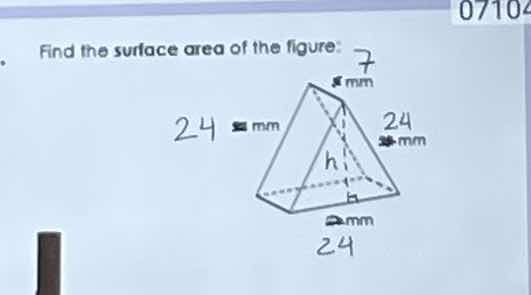
find the surface area of the figure:
The figure appears to be a square pyramid (assuming the base is a square with side length \( s = 24 \) mm and the slant height of each triangular face is \( l = 7 \) mm? Wait, no, maybe I misread. Wait, the base is a square with side 24 mm, and the triangular faces: wait, maybe the slant height? Wait, no, let's re-express. Wait, the base is a square (area \( 24 \times 24 \)), and four triangular faces. Each triangular face has base 24 mm and height... Wait, maybe the given "7 mm" is the slant height? Wait, no, maybe the figure is a square pyramid with base side 24 mm and slant height 7 mm? Wait, no, that seems too small. Wait, maybe the "24 mm" is the height? No, the surface area of a square pyramid is \( \text{Base Area} + 4 \times \text{Area of one triangular face} \). The base area is \( s^2 \) (where \( s \) is side of square base), and each triangular face has area \( \frac{1}{2} \times s \times l \) (where \( l \) is slant height). Wait, maybe the base is a square with side 24 mm, and each triangular face has base 24 mm and height 7 mm? Wait, let's check:
Step 1: Calculate Base Area
Base is a square with side \( s = 24 \) mm. So base area \( A_{base} = 24 \times 24 = 576 \) \( \text{mm}^2 \).
Step 2: Calculate Area of One Triangular Face
Each triangular face has base \( b = 24 \) mm and height \( h = 7 \) mm (assuming the 7 mm is the height of the triangle). The area of a triangle is \( \frac{1}{2} \times b \times h \). So one triangular face area: \( \frac{1}{2} \times 24 \times 7 = 84 \) \( \text{mm}^2 \).
Step 3: Calculate Total Surface Area
There are 4 triangular faces, so total area of triangular faces is \( 4 \times 84 = 336 \) \( \text{mm}^2 \). Then total surface area is base area + triangular areas: \( 576 + 336 = 912 \) \( \text{mm}^2 \). Wait, but that seems if the triangular height is 7. But maybe I misinterpret the figure. Wait, maybe the base is a square with side 24, and the slant height is 7? No, slant height for a square pyramid is different, but maybe the problem is a square pyramid with base side 24 and triangular face height 7. Alternatively, maybe the figure is a different pyramid? Wait, maybe the base is a square, and the four triangular faces: maybe the "24 mm" is the height of the triangle? Wait, the user's figure: "24 mm" is written twice, and "7 mm". Let's assume the base is a square with side 24 mm, and each triangular face has base 24 mm and height 7 mm. Then:
Base area: \( 24 \times 24 = 576 \)
Each triangular face: \( 0.5 \times 24 \times 7 = 84 \)
Four triangular faces: \( 4 \times 84 = 336 \)
Total surface area: \( 576 + 336 = 912 \) \( \text{mm}^2 \).
Wait, but maybe the figure is a triangular pyramid? No, the base is a square (since 24 is repeated, maybe square base). Alternatively, maybe the "7 mm" is the height of the pyramid, not slant height. Then we need to calculate slant height. The slant height \( l \) of a square pyramid is \( \sqrt{h^2 + (\frac{s}{2})^2} \), where \( h \) is height of pyramid, \( s \) is base side. If \( h = 7 \) mm, \( s = 24 \) mm, then \( \frac{s}{2} = 12 \) mm, so slant height \( l = \sqrt{7^2 + 12^2} = \sqrt{49 + 144} = \sqrt{193} \approx 13.89 \) mm. Then surface area would be \( 24^2 + 4 \times 0.5 \times 24 \times 13.89 \approx 576 + 4 \times 166.68 \approx 576 + 666.72 = 1242.72 \), which is different. But the given "7 mm" is probably the slant height (the height of the triangular face), so the first calculation.
Wait, maybe the figure is a square pyramid with base side 24 mm and slant height 7 mm. Then:
Base area: \( 24 \times 24 = 576 \)…

Snap & solve any problem in the app
Get step-by-step solutions on Sovi AI
Photo-based solutions with guided steps
Explore more problems and detailed explanations
The surface area of the figure (assuming square pyramid with base side 24 mm and triangular face height 7 mm) is \(\boxed{912}\) square millimeters.