QUESTION IMAGE
Question
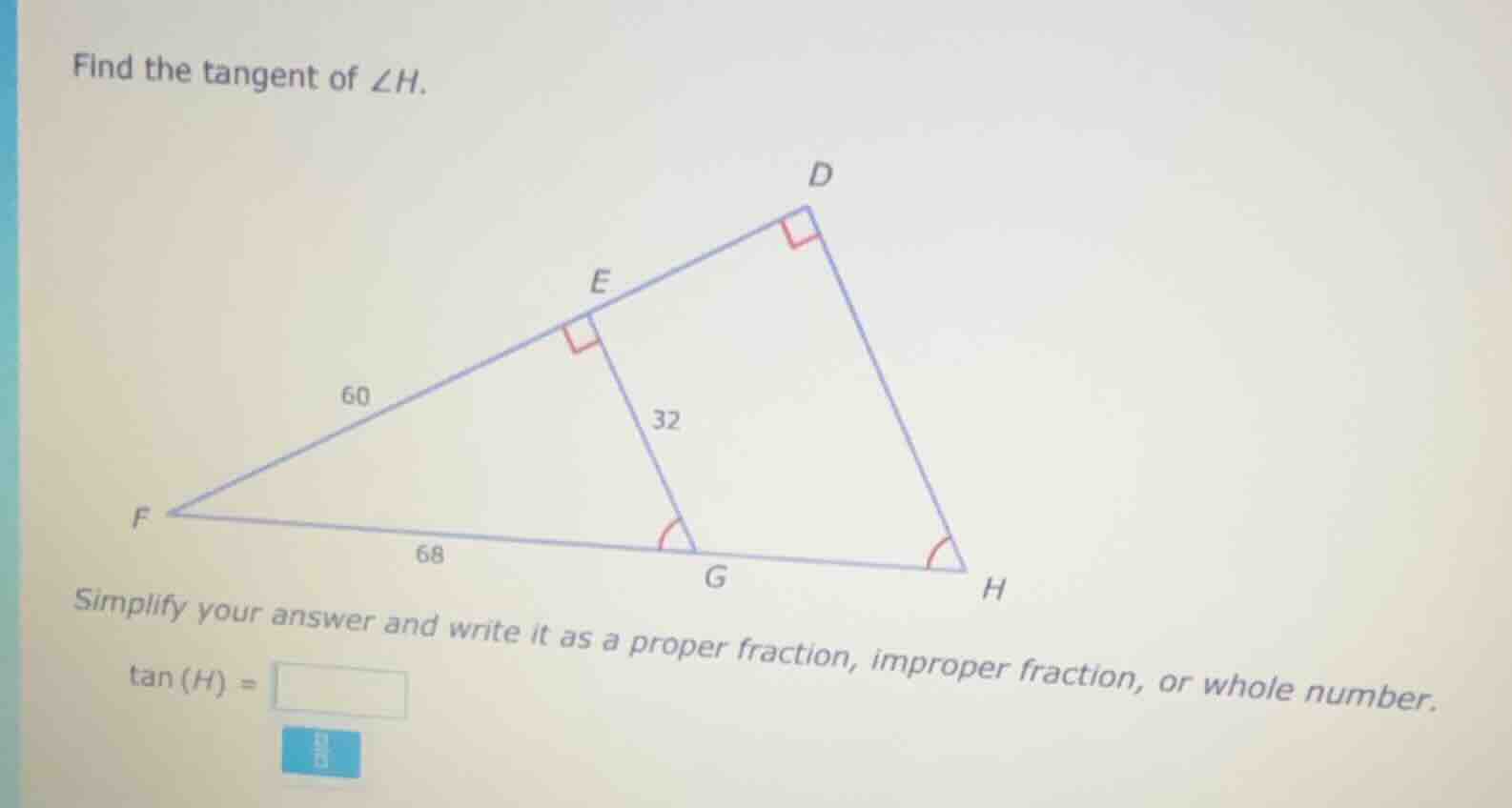
find the tangent of ∠h.
simplify your answer and write it as a proper fraction, improper fraction, or whole number.
tan(h) =
Step1: Find length of FE
In right triangle FEG, we know hypotenuse \( FG = 68 \), hypotenuse \( FF = 60 \) (wait, correction: \( FG = 68 \), \( FE = 60 \), so by Pythagorean theorem, \( EG=\sqrt{FG^{2}-FE^{2}}=\sqrt{68^{2}-60^{2}} \). Calculate \( 68^{2}=4624 \), \( 60^{2}=3600 \), so \( EG=\sqrt{4624 - 3600}=\sqrt{1024}=32 \). Wait, but in the diagram, \( EG = 32 \) is given? Wait, no, actually, triangles FEG and FDH are similar (since both are right triangles and share angle F). Also, \( ED \) and \( EG \) are both perpendicular, so \( ED \parallel EG \)? Wait, maybe better to find the length of the opposite and adjacent sides for angle H.
Wait, angle H is in triangle FDH (right triangle at D) and triangle FEG (right triangle at E). Since \( \angle F \) is common, triangles FEG and FDH are similar. So \( \tan(H)=\tan(F) \) because \( \angle H + \angle F=90^{\circ} \)? Wait, no, in right triangle, \( \tan(\theta)=\frac{\text{opposite}}{\text{adjacent}} \). For angle H, in triangle FDH (right-angled at D), the opposite side to H would be FD, and adjacent side would be DH? Wait, no, maybe I got the angles wrong. Wait, let's look at the diagram: points F, G, H are colinear (since G is on FH). E is on FD, with FE = 60, FG = 68, EG = 32 (right angle at E). D is on FD, right angle at D (so HD is perpendicular to FD). So angle at H: in triangle DFH, right-angled at D, so angle H and angle F are complementary. In triangle FEG, right-angled at E, \( \tan(F)=\frac{EG}{FE}=\frac{32}{60}=\frac{8}{15} \)? Wait, no, \( FE = 60 \), \( FG = 68 \), so \( EG = 32 \) (as calculated). Wait, but for angle H, in triangle DFH, \( \tan(H)=\frac{FD}{DH} \). But since triangles FEG and FDH are similar (both right-angled, same angle at F), so \( \frac{EG}{FE}=\frac{FD}{FH} \)? Wait, maybe not. Wait, alternatively, since \( \angle H \) and \( \angle F \) are complementary, \( \tan(H)=\cot(F)=\frac{FE}{EG} \)? Wait, no, \( \tan(F)=\frac{EG}{FE}=\frac{32}{60}=\frac{8}{15} \), so \( \tan(H)=\cot(F)=\frac{FE}{EG}=\frac{60}{32}=\frac{15}{8} \)? Wait, no, that can't be. Wait, maybe I mixed up opposite and adjacent.
Wait, let's re-express: in right triangle FEG (right at E), angle at F: opposite side is EG = 32, adjacent side is FE = 60. So \( \tan(F)=\frac{32}{60}=\frac{8}{15} \). In right triangle FDH (right at D), angle at H: opposite side is FD, adjacent side is DH. But since \( \angle F + \angle H = 90^{\circ} \), \( \tan(H)=\cot(F)=\frac{1}{\tan(F)}=\frac{60}{32}=\frac{15}{8} \)? Wait, no, that's not right. Wait, maybe I have the opposite and adjacent wrong for angle H. Let's consider angle H: in triangle DFH, right-angled at D, so the sides: FH is the hypotenuse, FD is one leg, DH is the other leg. Angle at H: the sides adjacent to H is DH, opposite is FD. So \( \tan(H)=\frac{FD}{DH} \). Now, in triangle FEG, right-angled at E, \( FE = 60 \), \( EG = 32 \), \( FG = 68 \). So \( FD = FE + ED \), but ED is equal to DH? Wait, no, EG is parallel to DH (both perpendicular to FD), so EG and DH are both perpendicular to FD, so EG || DH. Therefore, triangles FEG and FDH are similar (by AA similarity: right angles, common angle at F). Therefore, the ratio of corresponding sides is equal. So \( \frac{EG}{DH}=\frac{FE}{FD}=\frac{FG}{FH} \). Wait, \( FG = 68 \), \( FH = FG + GH \), but we don't know GH. Wait, but \( FE = 60 \), \( FG = 68 \), \( EG = 32 \). Let's compute \( FH \): in triangle FEG, \( FG = 68 \), \( FE = 60 \), \( EG = 32 \). Then, in triangle FDH, since EG || DH, \( \frac{EG}{DH}=\frac{FE}{FD}=\frac{FG}{FH} \). But we can also note that \( \tan(H)=\f…

Snap & solve any problem in the app
Get step-by-step solutions on Sovi AI
Photo-based solutions with guided steps
Explore more problems and detailed explanations
\( \frac{15}{8} \)