QUESTION IMAGE
Question
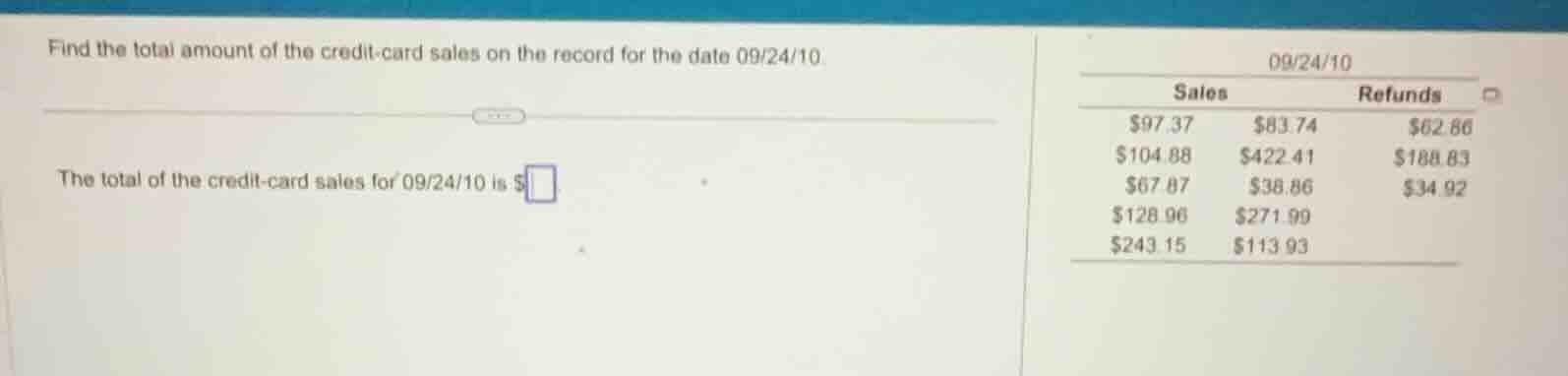
find the total amount of the credit - card sales on the record for the date 09/24/10.
the total of the credit - card sales for 09/24/10 is $square$
09/24/10
sales
$97.37
$83.74
$62.86
$104.88
$422.41
$188.83
$67.87
$38.86
$34.92
$128.96
$271.99
$243.15
$113.93
refunds
Step1: Identify sales amounts
The sales amounts for 09/24/10 are $97.37, $104.88, $67.87, $128.96, $243.15, $83.74, $422.41, $38.86, $271.99, $113.93. Wait, no—wait, the table has "Sales" and "Refunds"? Wait, no, looking at the table: the first column under 09/24/10, first row: $97.37, $83.74, $62.86? Wait, no, the table structure: maybe the first column is sales, second? Wait, the problem says "credit - card sales", so we need to sum all the sales amounts. Wait, let's re - examine the table:
Looking at the right - hand table, the columns: first column (maybe sales), second column (maybe another sales?), third column (refunds)? Wait, the problem is to find total credit - card sales. Let's list all the sales amounts. Let's parse the table:
Row 1: $97.37, $83.74, $62.86
Row 2: $104.88, $422.41, $188.83
Row 3: $67.87, $38.86, $34.92
Row 4: $128.96, $271.99
Row 5: $243.15, $113.93
Wait, maybe the first two columns are sales and the third is refunds? Wait, the problem says "credit - card sales", so we need to sum all the amounts in the sales columns. Let's assume that the first two columns are sales (since refunds are a different category). So let's list all the sales amounts:
$97.37, $83.74, $104.88, $422.41, $67.87, $38.86, $128.96, $271.99, $243.15, $113.93. Wait, no, that might be wrong. Wait, maybe the table is structured as: for each row, the first two are sales and the third is refund? Wait, no, let's check the number of entries. Let's count the number of sales amounts. Let's look again:
First row: 3 amounts: $97.37, $83.74, $62.86
Second row: 3 amounts: $104.88, $422.41, $188.83
Third row: 3 amounts: $67.87, $38.86, $34.92
Fourth row: 2 amounts: $128.96, $271.99
Fifth row: 2 amounts: $243.15, $113.93
Wait, this is confusing. Wait, maybe the "Sales" column is the first column, and the second column is another sales (like different types of sales) and the third is refunds. Let's sum all the non - refund amounts. Wait, maybe the problem is that the table has two columns of sales and one of refunds. Let's sum all the amounts in the first two columns:
First column (sales 1): $97.37, $104.88, $67.87, $128.96, $243.15
Second column (sales 2): $83.74, $422.41, $38.86, $271.99, $113.93
Now sum the first column:
$97.37+104.88 = 202.25; 202.25+67.87 = 270.12; 270.12+128.96 = 399.08; 399.08+243.15 = 642.23
Sum the second column:
$83.74+422.41 = 506.15; 506.15+38.86 = 545.01; 545.01+271.99 = 817; 817+113.93 = 930.93
Now total sales: 642.23+930.93 = 1573.16? Wait, that can't be right. Wait, maybe I misread the table. Let's look again. Maybe the table is:
Sales amounts are: $97.37, $104.88, $67.87, $128.96, $243.15, $83.74, $422.41, $38.86, $271.99, $113.93. Let's sum them one by one.
Start with $97.37 + 104.88 = 202.25
202.25+67.87 = 270.12
270.12+128.96 = 399.08
399.08+243.15 = 642.23
642.23+83.74 = 725.97
725.97+422.41 = 1148.38
1148.38+38.86 = 1187.24
1187.24+271.99 = 1459.23
1459.23+113.93 = 1573.16
Wait, but let's check again. Maybe the third column is refunds, so we should not include them. Let's list the sales amounts (excluding refunds):
From row 1: $97.37, $83.74
Row 2: $104.88, $422.41
Row 3: $67.87, $38.86
Row 4: $128.96, $271.99
Row 5: $243.15, $113.93
Now sum these:
First, sum the first elements of each row: 97.37+104.88+67.87+128.96+243.15
97.37+104.88 = 202.25; 202.25+67.87 = 270.12; 270.12+128.96 = 399.08; 399.08+243.15 = 642.23
Sum the second elements of each row: 83.74+422.41+38.86+271.99+113.93
83.74+422.41 = 506.15; 506.15+38.86 = 545.01; 545.01+271.99 = 817; 817+113.93 = 930.93…

Snap & solve any problem in the app
Get step-by-step solutions on Sovi AI
Photo-based solutions with guided steps
Explore more problems and detailed explanations
1573.16