QUESTION IMAGE
Question
find m.
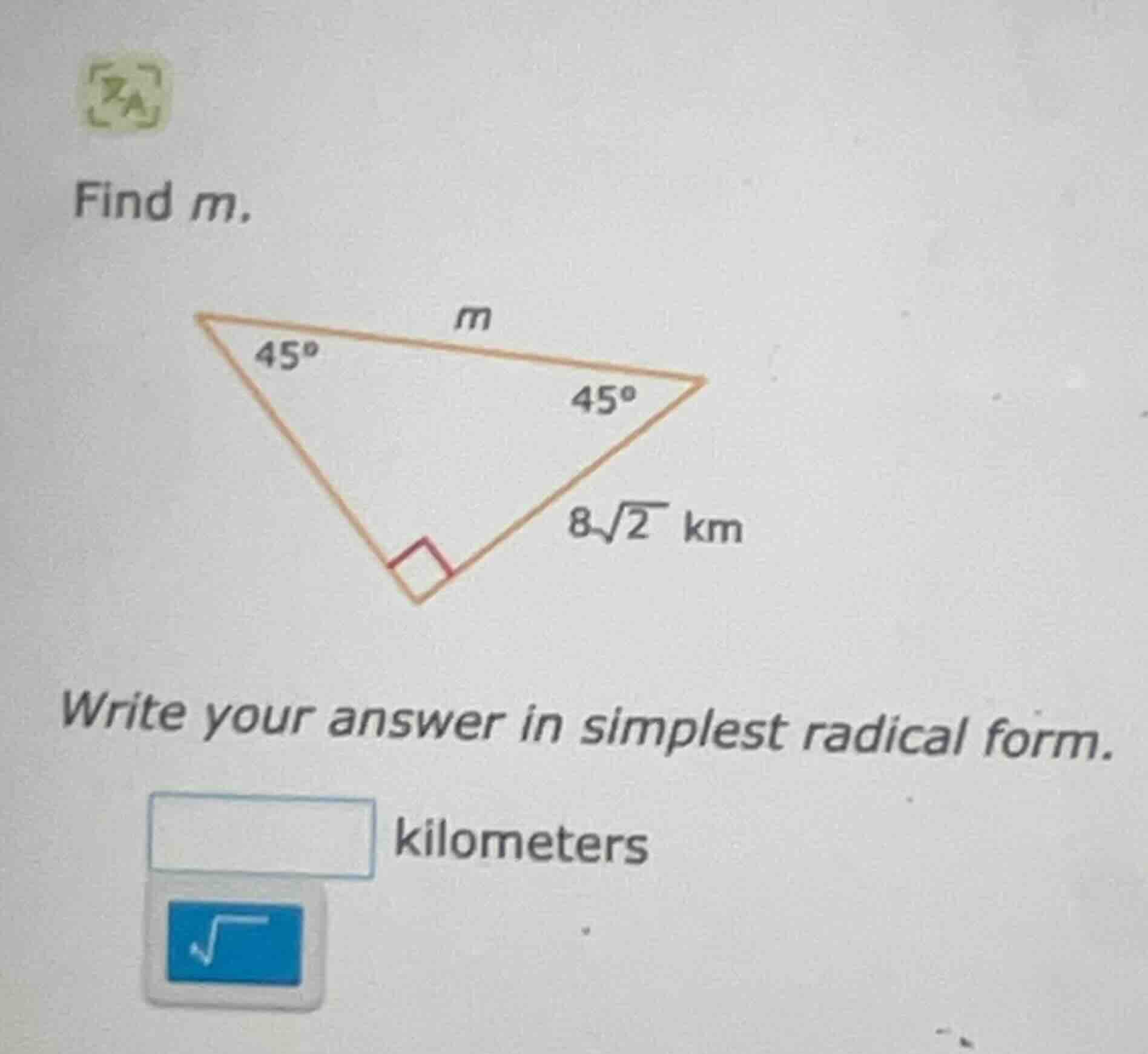
triangle with angles 45°, 45°, right angle, one leg 8√2 km, hypotenuse m
write your answer in simplest radical form.
blank kilometers
Step1: Identify triangle type
The triangle has two \(45^\circ\) angles and a right angle, so it's a 45 - 45 - 90 triangle. In such a triangle, the legs are equal, and the hypotenuse \(h\) is related to a leg \(l\) by \(h = l\sqrt{2}\). Here, one leg is \(8\sqrt{2}\) km, and \(m\) is the hypotenuse? Wait, no—wait, in the triangle, the right angle is between the two legs, and the angles at the other two vertices are \(45^\circ\). Wait, actually, in a 45 - 45 - 90 triangle, the legs are congruent, and the hypotenuse is leg \(\times\sqrt{2}\). Wait, but here, one leg is \(8\sqrt{2}\), and we need to find the hypotenuse \(m\)? Wait, no, wait: let's check the angles. The two non - right angles are \(45^\circ\), so the legs are equal, and the hypotenuse is \(leg\times\sqrt{2}\). Wait, but if a leg is \(l\), hypotenuse \(h = l\sqrt{2}\). Alternatively, if hypotenuse is \(h\), then leg \(l=\frac{h}{\sqrt{2}}\). Wait, let's re - examine the triangle. The right angle is at the vertex where the two legs meet. The other two angles are \(45^\circ\), so it's an isosceles right triangle, so the two legs are equal. Wait, but the side labeled \(8\sqrt{2}\) is a leg, and \(m\) is the hypotenuse? Wait, no, wait: in a 45 - 45 - 90 triangle, the hypotenuse is \(\sqrt{2}\) times the length of each leg. Wait, let's denote the legs as \(a\) and \(b\), and hypotenuse as \(c\). Then \(a = b\), and \(c=a\sqrt{2}\). So if one leg \(a = 8\sqrt{2}\), then hypotenuse \(c=(8\sqrt{2})\times\sqrt{2}\)? Wait, no, that would be if we are going from leg to hypotenuse. Wait, no: if \(c=a\sqrt{2}\), and \(a\) is the leg, then \(c\) is hypotenuse. Wait, let's compute \((8\sqrt{2})\times\sqrt{2}\). \(\sqrt{2}\times\sqrt{2}=2\), so \(8\times2 = 16\). Wait, but maybe I got the legs and hypotenuse reversed. Wait, maybe the side labeled \(8\sqrt{2}\) is the hypotenuse? No, the right angle is between the two legs, so the sides adjacent to the right angle are legs, and the side opposite is hypotenuse. So the two legs are equal, and hypotenuse is leg\(\times\sqrt{2}\). Wait, let's check the angles. The angles at the ends of the hypotenuse are \(45^\circ\), so the legs are equal. So if a leg is \(x\), hypotenuse is \(x\sqrt{2}\). But here, one leg is \(8\sqrt{2}\), so hypotenuse \(m=x\sqrt{2}=(8\sqrt{2})\times\sqrt{2}\)? Wait, no, that would be wrong. Wait, no: if \(x\) is the leg, then hypotenuse is \(x\sqrt{2}\). So if \(x = 8\sqrt{2}\), then hypotenuse \(m=(8\sqrt{2})\times\sqrt{2}=8\times2 = 16\). Wait, let's do the calculation: \((8\sqrt{2})\times\sqrt{2}=8\times(\sqrt{2}\times\sqrt{2})=8\times2 = 16\). So that's the hypotenuse.
Step2: Calculate \(m\)
In a 45 - 45 - 90 triangle, hypotenuse \(m=\text{leg}\times\sqrt{2}\). Here, the leg length is \(8\sqrt{2}\) km. So \(m = 8\sqrt{2}\times\sqrt{2}\). Since \(\sqrt{2}\times\sqrt{2}=2\), we have \(m = 8\times2=16\) km.

Snap & solve any problem in the app
Get step-by-step solutions on Sovi AI
Photo-based solutions with guided steps
Explore more problems and detailed explanations
16