QUESTION IMAGE
Question
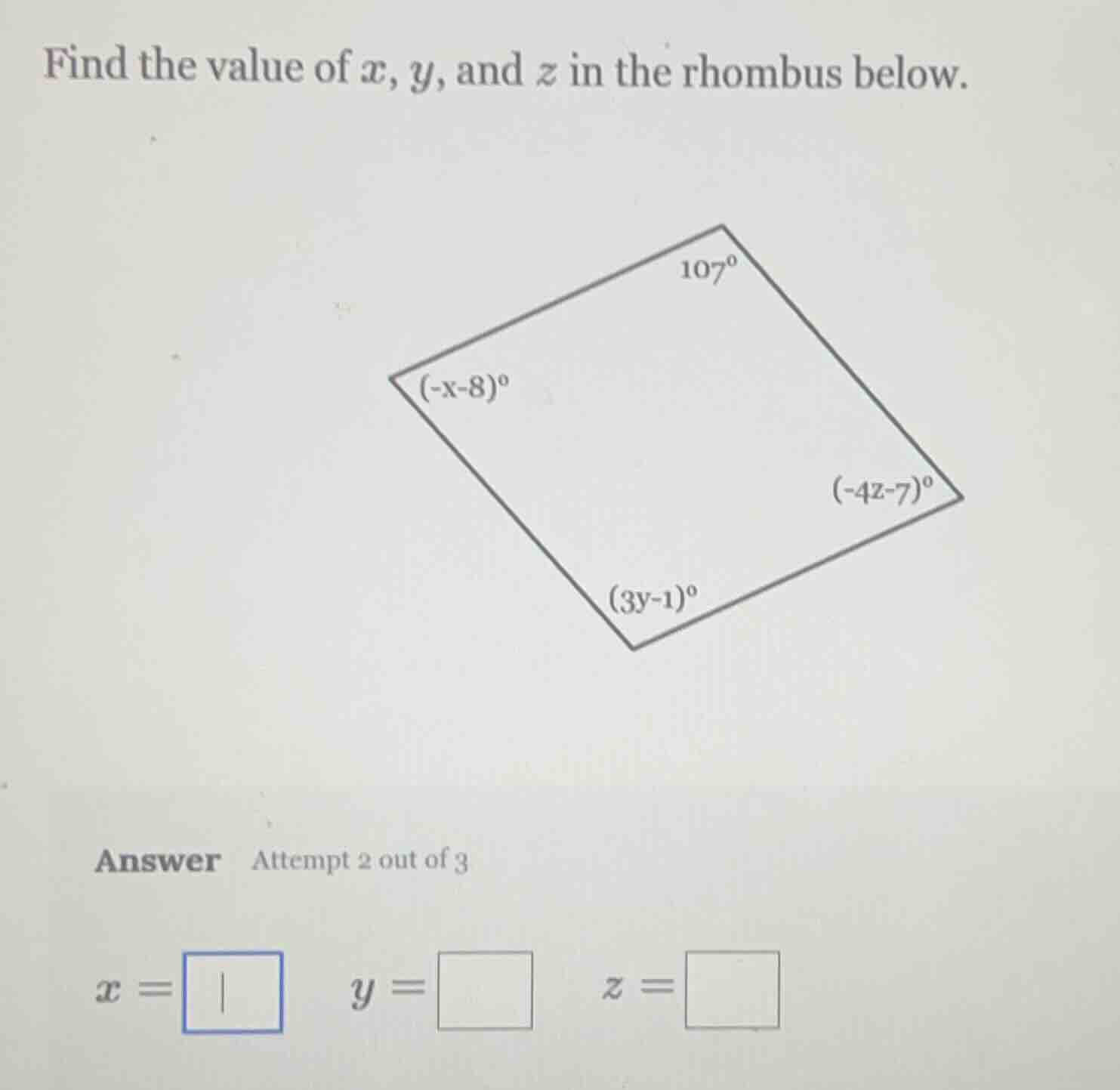
find the value of x, y, and z in the rhombus below.
(-x-8)°
107°
(3y-1)°
(-4z-7)°
answer attempt 2 out of 3
x =
y =
z =
Step1: Recall properties of a rhombus
In a rhombus, opposite angles are equal, and consecutive angles are supplementary (sum to \(180^\circ\)).
Step2: Solve for \(x\)
One angle is \(107^\circ\) and its opposite angle is \((-x - 8)^\circ\)? Wait, no, consecutive angles. Wait, in a rhombus, consecutive angles are supplementary. Wait, actually, opposite angles are equal. Wait, let's check the angles. Let's assume the angle \(107^\circ\) and \((3y - 1)^\circ\) are opposite? No, wait, maybe the angle \(107^\circ\) and \((-x - 8)^\circ\) are consecutive? Wait, no, let's re - examine. Wait, in a rhombus, opposite angles are equal. So if one angle is \(107^\circ\), then its opposite angle should also be \(107^\circ\), and the other two opposite angles should be equal and supplementary to \(107^\circ\) (since consecutive angles in a rhombus are supplementary, i.e., sum to \(180^\circ\)).
Wait, let's correct: In a rhombus, opposite angles are equal, and consecutive angles are supplementary (sum to \(180^\circ\)). So if we have an angle of \(107^\circ\), then the angle consecutive to it (adjacent) should be \(180 - 107=73^\circ\).
So let's find which angle is equal to \(107^\circ\) or supplementary.
Looking at the angles: \(107^\circ\), \((-x - 8)^\circ\), \((3y - 1)^\circ\), \((-4z - 7)^\circ\)
First, let's find \(x\). Let's assume that \(107^\circ\) and \((-x - 8)^\circ\) are supplementary (consecutive angles). So:
\(107+(-x - 8)=180\)
\(107 - x - 8 = 180\)
\(99 - x=180\)
\(-x=180 - 99\)
\(-x = 81\)
\(x=- 81\)? Wait, that can't be right. Wait, maybe I made a mistake. Wait, maybe the angle \((-x - 8)^\circ\) is equal to the angle \((-4z - 7)^\circ\), and \(107^\circ\) is equal to \((3y - 1)^\circ\)? Wait, let's try that.
If \(107=(3y - 1)\), then:
\(3y-1 = 107\)
\(3y=107 + 1\)
\(3y=108\)
\(y = 36\)
Now, for the other pair of angles: \((-x - 8)\) and \((-4z - 7)\) should be equal, and they should be supplementary to \(107^\circ\) (since consecutive angles in a rhombus are supplementary). So:
\((-x - 8)+107 = 180\)
\(-x+99 = 180\)
\(-x=180 - 99\)
\(-x = 81\)
\(x=-81\)
Wait, but let's check the other angle: \((-4z - 7)\) should be equal to \((-x - 8)\). Since \(x = - 81\), \(-x - 8=81 - 8 = 73\). So \(-4z-7 = 73\)
\(-4z=73 + 7\)
\(-4z=80\)
\(z=-20\)
Wait, but let's verify the properties.
First, check opposite angles:
Angle 1: \(107^\circ\), Angle 3: \(3y - 1=3\times36 - 1 = 108 - 1=107^\circ\) (opposite angles are equal, good).
Angle 2: \(-x - 8=-(-81)-8 = 81 - 8 = 73^\circ\), Angle 4: \(-4z - 7=-4\times(-20)-7 = 80 - 7 = 73^\circ\) (opposite angles are equal, good).
Check consecutive angles: \(107+73 = 180\) (supplementary, good).
So let's redo the steps properly:
Step 1: Solve for \(y\)
Since opposite angles in a rhombus are equal, the angle \(107^\circ\) and \((3y - 1)^\circ\) are opposite angles. So we set them equal:
\(3y-1 = 107\)
Add 1 to both sides: \(3y=107 + 1=108\)
Divide both sides by 3: \(y=\frac{108}{3}=36\)
Step 2: Solve for \(x\)
The angle \((-x - 8)^\circ\) and \(107^\circ\) are consecutive angles (adjacent), so they are supplementary (sum to \(180^\circ\)):
\((-x - 8)+107 = 180\)
Simplify the left - hand side: \(-x+99 = 180\)
Subtract 99 from both sides: \(-x=180 - 99 = 81\)
Multiply both sides by - 1: \(x=-81\)
Step 3: Solve for \(z\)
The angle \((-4z - 7)^\circ\) and \((-x - 8)^\circ\) are opposite angles (so they are equal). We know \(x=-81\), so \(-x - 8=81 - 8 = 73\)
Set \(-4z - 7 = 73\)
Add 7 to both sides: \(-4z=73 + 7 = 80\)
Divide both sides by - 4: \(z=\fra…

Snap & solve any problem in the app
Get step-by-step solutions on Sovi AI
Photo-based solutions with guided steps
Explore more problems and detailed explanations
\(x=-81\), \(y = 36\), \(z=-20\)