QUESTION IMAGE
Question
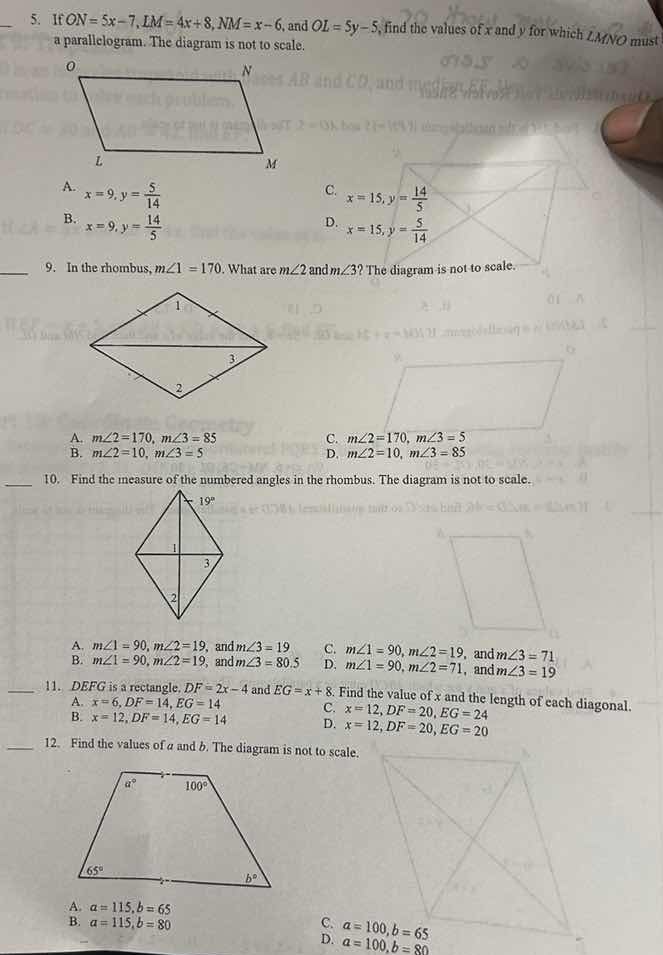
- if $on=5x-7, lm=4x+8, nm=x-6$, and $ol=5y-5$, find the values of $x$ and $y$ for which $lmno$ must be a parallelogram. the diagram is not to scale.
a. $x=9, y=\frac{5}{14}$
c. $x=15, y=\frac{14}{5}$
b. $x=9, y=\frac{14}{5}$
d. $x=15, y=\frac{5}{14}$
- in the rhombus, $m\angle1=170$. what are $m\angle2$ and $m\angle3$? the diagram is not to scale.
a. $m\angle2=170, m\angle3=85$
c. $m\angle2=170, m\angle3=5$
b. $m\angle2=10, m\angle3=5$
d. $m\angle2=10, m\angle3=85$
- find the measure of the numbered angles in the rhombus. the diagram is not to scale.
$19^\circ$
a. $m\angle1=90, m\angle2=19$, and $m\angle3=19$
c. $m\angle1=90, m\angle2=19$, and $m\angle3=71$
b. $m\angle1=90, m\angle2=19$, and $m\angle3=80.5$
d. $m\angle1=90, m\angle2=71$, and $m\angle3=19$
- $defg$ is a rectangle, $df=2x-4$ and $eg=x+8$. find the value of $x$ and the length of each diagonal.
a. $x=6, df=14, eg=14$
c. $x=12, df=20, eg=24$
b. $x=12, df=14, eg=14$
d. $x=12, df=20, eg=20$
- find the values of $a$ and $b$. the diagram is not to scale.
$a^\circ$
$100^\circ$
$65^\circ$
$b^\circ$
a. $a=115, b=65$
c. $a=100, b=65$
b. $a=115, b=80$
d. $a=100, b=80$
Problem 5
Step1: Set opposite sides equal
In a parallelogram, $ON = LM$ and $OL = NM$.
First equation: $5x - 7 = 4x + 8$
Second equation: $5y - 5 = x - 6$
Step2: Solve for x
Subtract $4x$ from both sides:
$5x - 4x -7 = 8$
$x -7 = 8$
$x = 8 + 7 = 15$
Step3: Substitute x to find y
Substitute $x=15$ into $5y - 5 = 15 - 6$:
$5y -5 = 9$
$5y = 9 + 5 = 14$
$y = \frac{14}{5}$
In a rhombus, opposite angles are equal, and consecutive angles are supplementary. Also, the diagonal bisects the angles. $\angle1$ and $\angle2$ are opposite angles, so $m\angle2 = m\angle1 = 170^\circ$. The diagonal splits $\angle1$ into two equal angles, so $m\angle3 = \frac{180^\circ - 170^\circ}{2} = 5^\circ$.
In a rhombus, the diagonals are perpendicular, so $m\angle1 = 90^\circ$. The diagonal bisects the vertex angles, so $m\angle2 = 19^\circ$. The angles of a triangle sum to $180^\circ$, so $m\angle3 = 90^\circ - 19^\circ = 71^\circ$.

Snap & solve any problem in the app
Get step-by-step solutions on Sovi AI
Photo-based solutions with guided steps
Explore more problems and detailed explanations
C. $x=15, y=\frac{14}{5}$
---