QUESTION IMAGE
Question
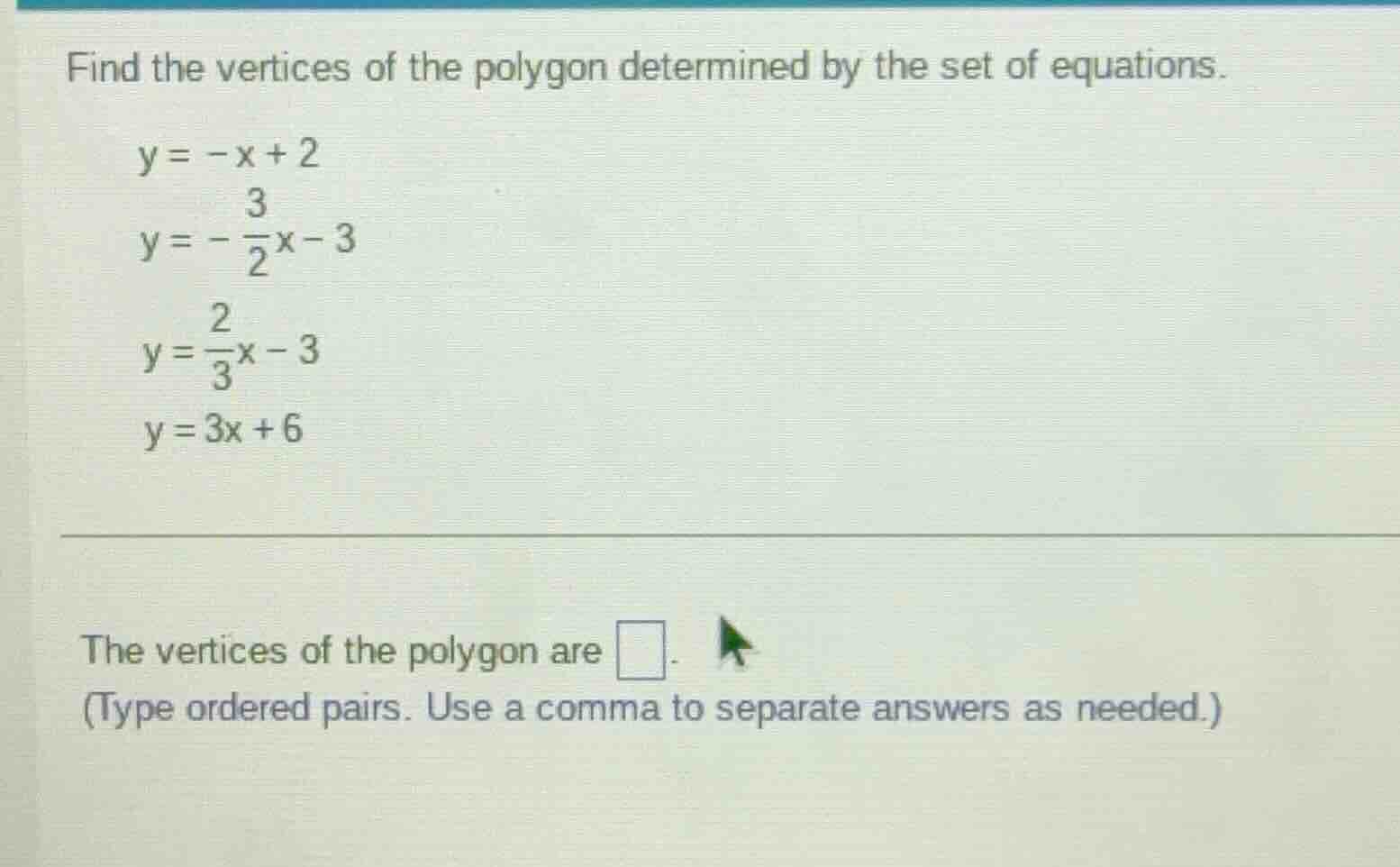
find the vertices of the polygon determined by the set of equations.
$y = -x + 2$
$y = -dfrac{3}{2}x - 3$
$y = dfrac{2}{3}x - 3$
$y = 3x + 6$
the vertices of the polygon are \boxed{}.
(type ordered pairs. use a comma to separate answers as needed.)
Step1: Find intersection of \( y = -x + 2 \) and \( y = 3x + 6 \)
Set \( -x + 2 = 3x + 6 \)
\( -x - 3x = 6 - 2 \)
\( -4x = 4 \)
\( x = -1 \)
Substitute \( x = -1 \) into \( y = -x + 2 \): \( y = -(-1) + 2 = 3 \)
So, intersection point: \( (-1, 3) \)
Step2: Find intersection of \( y = 3x + 6 \) and \( y = -\frac{3}{2}x - 3 \)
Set \( 3x + 6 = -\frac{3}{2}x - 3 \)
\( 3x + \frac{3}{2}x = -3 - 6 \)
\( \frac{6x + 3x}{2} = -9 \)
\( \frac{9x}{2} = -9 \)
\( x = -2 \)
Substitute \( x = -2 \) into \( y = 3x + 6 \): \( y = 3(-2) + 6 = 0 \)
Wait, error here. Let's recalculate:
\( 3x + 6 = -\frac{3}{2}x - 3 \)
Multiply both sides by 2: \( 6x + 12 = -3x - 6 \)
\( 6x + 3x = -6 - 12 \)
\( 9x = -18 \)
\( x = -2 \)
\( y = 3(-2) + 6 = 0 \)? Wait, no, \( y = -\frac{3}{2}(-2) - 3 = 3 - 3 = 0 \). So point: \( (-2, 0) \)? Wait, no, let's check with \( y = 3x + 6 \): \( 3*(-2)+6 = 0 \). Correct.
Step3: Find intersection of \( y = -\frac{3}{2}x - 3 \) and \( y = \frac{2}{3}x - 3 \)
Set \( -\frac{3}{2}x - 3 = \frac{2}{3}x - 3 \)
\( -\frac{3}{2}x - \frac{2}{3}x = -3 + 3 \)
\( -\frac{9x + 4x}{6} = 0 \)
\( -\frac{13x}{6} = 0 \)
\( x = 0 \)
Substitute \( x = 0 \) into \( y = \frac{2}{3}x - 3 \): \( y = -3 \)
So, intersection point: \( (0, -3) \)
Step4: Find intersection of \( y = \frac{2}{3}x - 3 \) and \( y = -x + 2 \)
Set \( \frac{2}{3}x - 3 = -x + 2 \)
\( \frac{2}{3}x + x = 2 + 3 \)
\( \frac{2x + 3x}{3} = 5 \)
\( \frac{5x}{3} = 5 \)
\( x = 3 \)
Substitute \( x = 3 \) into \( y = -x + 2 \): \( y = -3 + 2 = -1 \)
So, intersection point: \( (3, -1) \)
Wait, but we have four lines, so the polygon is a quadrilateral? Wait, maybe I missed some intersections. Wait, let's list all pairs:
- \( y = -x + 2 \) & \( y = 3x + 6 \): \( (-1, 3) \)
- \( y = 3x + 6 \) & \( y = -\frac{3}{2}x - 3 \): Let's recalculate correctly.
\( 3x + 6 = -\frac{3}{2}x - 3 \)
\( 3x + \frac{3}{2}x = -3 - 6 \)
\( \frac{6x + 3x}{2} = -9 \)
\( \frac{9x}{2} = -9 \)
\( x = -2 \)
\( y = 3*(-2) + 6 = 0 \). Correct. So \( (-2, 0) \)
- \( y = -\frac{3}{2}x - 3 \) & \( y = \frac{2}{3}x - 3 \): \( (0, -3) \) (as above)
- \( y = \frac{2}{3}x - 3 \) & \( y = -x + 2 \): \( (3, -1) \) (as above)
- \( y = -x + 2 \) & \( y = \frac{2}{3}x - 3 \): Wait, we did that, got (3, -1)
- \( y = 3x + 6 \) & \( y = \frac{2}{3}x - 3 \): Let's check.
Set \( 3x + 6 = \frac{2}{3}x - 3 \)
\( 3x - \frac{2}{3}x = -3 - 6 \)
\( \frac{9x - 2x}{3} = -9 \)
\( \frac{7x}{3} = -9 \)
\( x = -\frac{27}{7} \), which is not a nice number. So maybe the polygon is formed by the intersections of adjacent lines? Wait, the four lines: let's see their slopes.
Slope of \( y = -x + 2 \): -1
Slope of \( y = 3x + 6 \): 3
Slope of \( y = -\frac{3}{2}x - 3 \): -3/2
Slope of \( y = \frac{2}{3}x - 3 \): 2/3
Notice that \( -\frac{3}{2} \) and \( \frac{2}{3} \) are negative reciprocals? No, \( -\frac{3}{2} * \frac{2}{3} = -1 \), so they are perpendicular.
Wait, maybe the correct intersections are:
- \( y = -x + 2 \) and \( y = 3x + 6 \): \( (-1, 3) \)
- \( y = 3x + 6 \) and \( y = -\frac{3}{2}x - 3 \): Let's solve again.
\( 3x + 6 = -\frac{3}{2}x - 3 \)
\( 3x + \frac{3}{2}x = -9 \)
\( \frac{9x}{2} = -9 \)
\( x = -2 \)
\( y = 3*(-2) + 6 = 0 \). So (-2, 0)
- \( y = -\frac{3}{2}x - 3 \) and \( y = \frac{2}{3}x - 3 \): \( (0, -3) \) (since when x=0, both y=-3)
- \( y = \frac{2}{3}x - 3 \) and \( y = -x + 2 \): \( (3, -1) \) (solved earlier)
- \( y = -x + 2 \) and \( y = \frac{2}{3}x - 3 \): Wait, we did that, got (3, -1)
- \( y = 3x + 6 \) and \( y = \frac{2}{3}x - 3 \): As above, not a vertex of the polygon.
Wait, maybe the p…

Snap & solve any problem in the app
Get step-by-step solutions on Sovi AI
Photo-based solutions with guided steps
Explore more problems and detailed explanations
\((-1, 3)\), \((-2, 0)\), \((0, -3)\), \((3, -1)\)