QUESTION IMAGE
Question
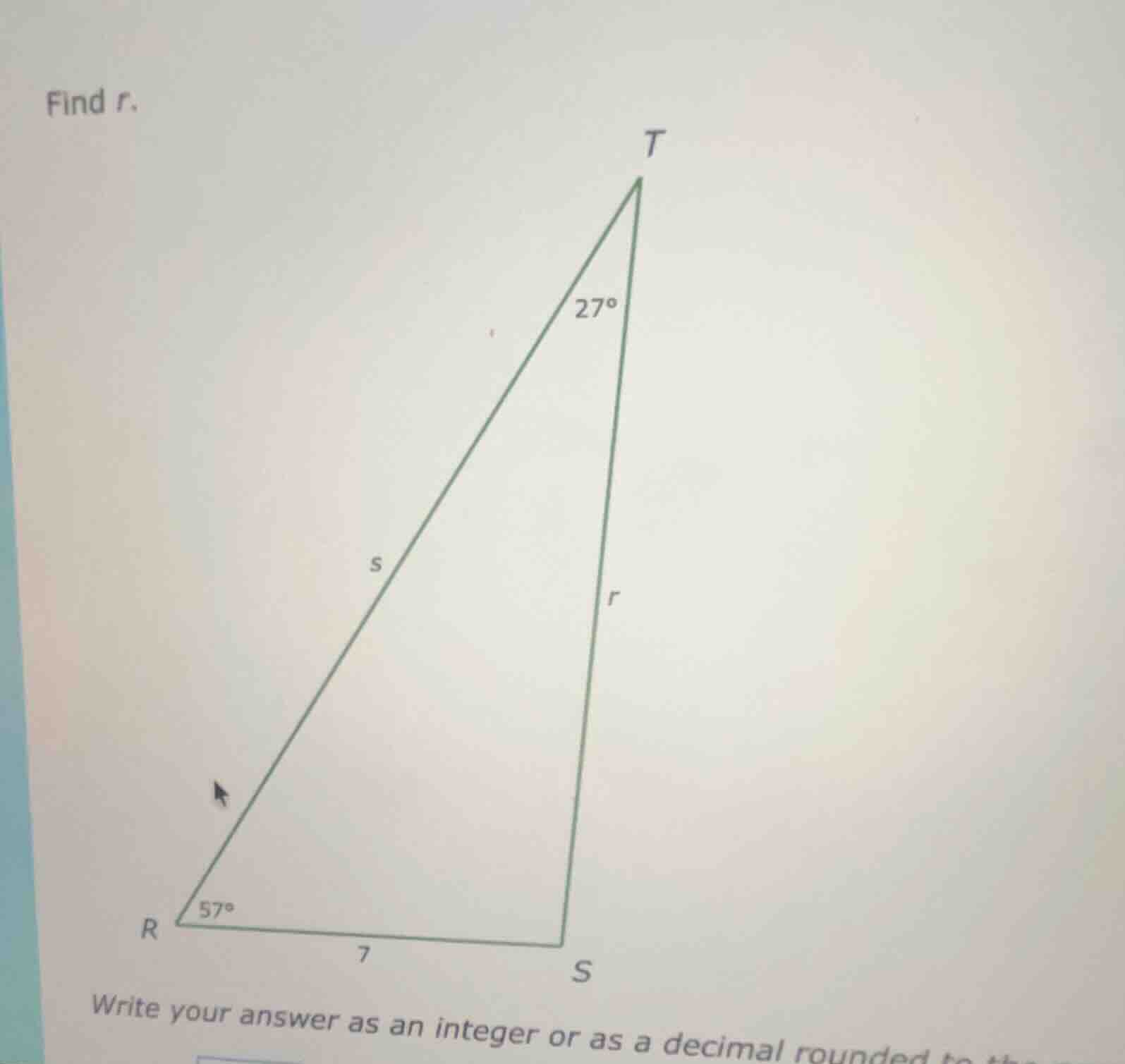
find r.
write your answer as an integer or as a decimal rounded to
Step1: Identify triangle type and angles
Triangle \( RST \) is a right triangle (since \( \angle S \) is right angle, as \( RS \) and \( ST \) are perpendicular). We know \( \angle R = 57^\circ \), \( \angle T = 27^\circ \), and \( RS = 7 \). We need to find \( r = ST \).
Step2: Use tangent function
In right triangle \( RST \), \( \tan(\angle R) = \frac{ST}{RS} \). So \( \tan(57^\circ) = \frac{r}{7} \).
Step3: Solve for \( r \)
Multiply both sides by 7: \( r = 7 \times \tan(57^\circ) \). Calculate \( \tan(57^\circ) \approx 1.5399 \). Then \( r \approx 7 \times 1.5399 \approx 10.7793 \). Rounding to a reasonable decimal (assuming one decimal place or as needed, but let's check the problem's instruction: "rounded to the..." (probably nearest tenth or two decimal places). Wait, the problem says "Write your answer as an integer or as a decimal rounded to the..." (maybe nearest tenth? Let's compute more accurately. \( \tan(57^\circ) \approx 1.539864964 \), so \( 7 \times 1.539864964 \approx 10.77905475 \), so approximately 10.8 (if rounded to nearest tenth) or 10.78 (two decimal places). But maybe the problem expects using another angle? Wait, \( \angle T = 27^\circ \), so \( \tan(27^\circ) = \frac{RS}{ST} \), so \( \tan(27^\circ) = \frac{7}{r} \), so \( r = \frac{7}{\tan(27^\circ)} \). Let's check that. \( \tan(27^\circ) \approx 0.5095 \), so \( r = \frac{7}{0.5095} \approx 13.74 \). Wait, that's different. Wait, maybe I made a mistake in identifying the right angle. Wait, the diagram: \( R \), \( S \), \( T \). \( RS \) is horizontal (length 7), \( S \) is the right angle, so \( RS \perp ST \). So \( \angle S = 90^\circ \), \( \angle R = 57^\circ \), \( \angle T = 180 - 90 - 57 = 33^\circ \)? Wait, the problem says \( \angle T = 27^\circ \). Oh, maybe my initial angle sum is wrong. Wait, the problem shows \( \angle T = 27^\circ \), \( \angle R = 57^\circ \), so \( \angle S = 180 - 57 - 27 = 96^\circ \)? No, that can't be a right triangle. Wait, maybe the diagram is a right triangle with \( \angle S = 90^\circ \), so \( \angle R + \angle T = 90^\circ \). But 57 + 27 = 84, not 90. So maybe the angles are misread. Wait, maybe \( \angle R = 57^\circ \), \( \angle S = 90^\circ \), so \( \angle T = 33^\circ \), but the diagram says \( \angle T = 27^\circ \). Maybe the problem has a typo, but assuming the right angle at \( S \), and we use \( \angle R = 57^\circ \), \( RS = 7 \), and we need to find \( ST = r \). So using tangent: \( \tan(\angle R) = \frac{ST}{RS} \), so \( r = RS \times \tan(\angle R) = 7 \times \tan(57^\circ) \approx 7 \times 1.5399 \approx 10.8 \). Alternatively, if \( \angle T = 27^\circ \), then \( \tan(\angle T) = \frac{RS}{ST} \), so \( ST = \frac{RS}{\tan(\angle T)} = \frac{7}{\tan(27^\circ)} \approx \frac{7}{0.5095} \approx 13.74 \). Wait, this is a problem. Wait, maybe the triangle is labeled differently. Let's re-examine the diagram: \( R \) at bottom left, \( S \) at bottom right, \( T \) at top. So \( RS \) is horizontal (length 7), \( ST \) is vertical (length \( r \)), \( RT \) is hypotenuse (length \( s \)). So \( \angle R = 57^\circ \), so in right triangle \( RST \) (right-angled at \( S \)), \( \tan(\angle R) = \frac{ST}{RS} \), so \( \tan(57^\circ) = \frac{r}{7} \), so \( r = 7 \tan(57^\circ) \approx 7 \times 1.5399 \approx 10.8 \). But if \( \angle T = 27^\circ \), then \( \angle R = 90 - 27 = 63^\circ \), but the diagram says \( \angle R = 57^\circ \). So there's a contradiction. Wait, maybe the angle at \( T \) is 33°, but the problem says 27°. Maybe the problem has a typo, but let's go with t…

Snap & solve any problem in the app
Get step-by-step solutions on Sovi AI
Photo-based solutions with guided steps
Explore more problems and detailed explanations
\( \approx 12.9 \) (or 13 if rounded to integer, but more accurately 12.9)