QUESTION IMAGE
Question
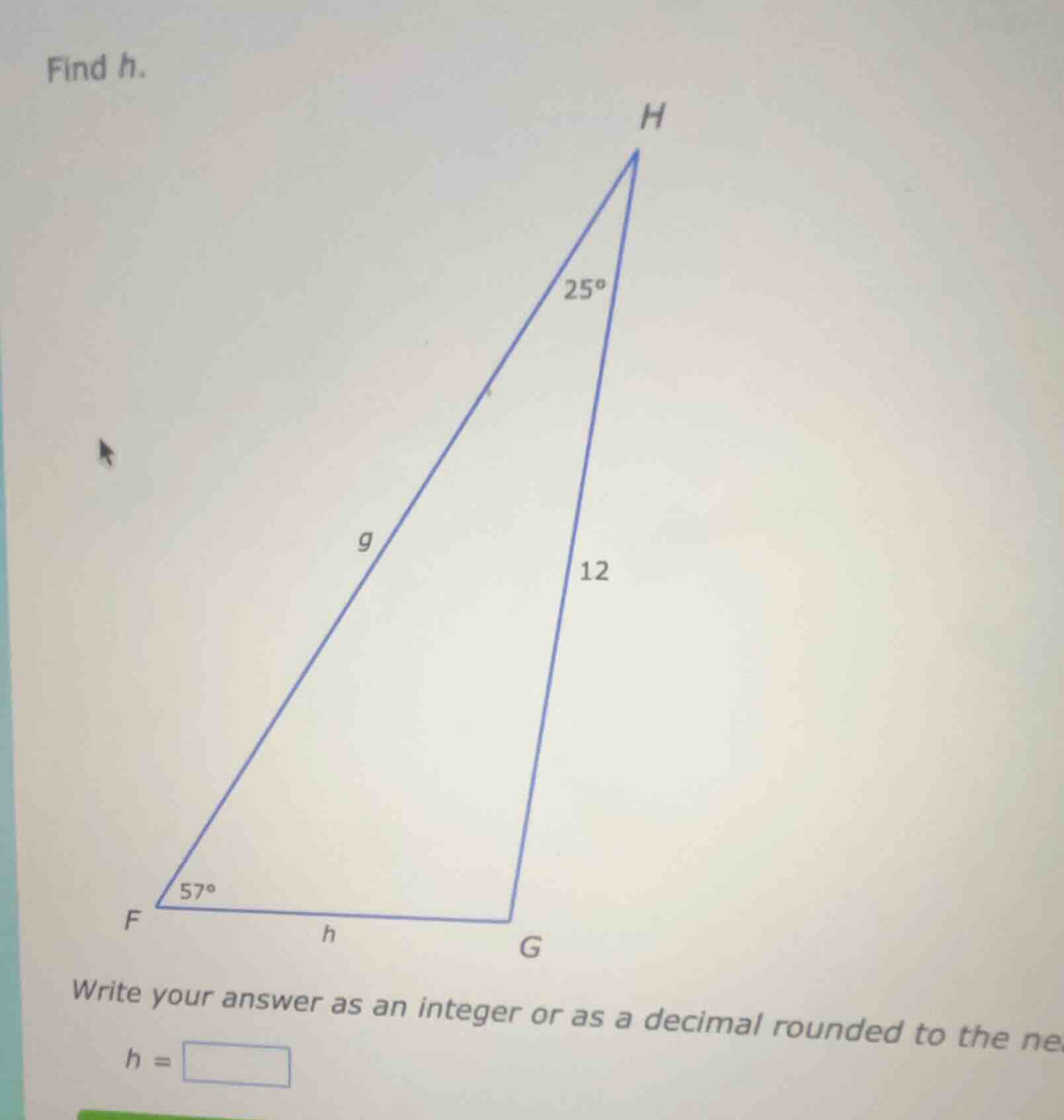
find h.
write your answer as an integer or as a decimal rounded to the ne
h =
Step1: Find angle at G
In triangle \( FGH \), the sum of angles in a triangle is \( 180^\circ \). We know \( \angle F = 57^\circ \) and \( \angle H = 25^\circ \), so \( \angle G=180 - 57 - 25=98^\circ \)
Step2: Apply the Law of Sines
The Law of Sines states that \( \frac{h}{\sin H}=\frac{HG}{\sin F} \). We know \( HG = 12 \), \( \angle H = 25^\circ \), \( \angle F = 57^\circ \). So \( h=\frac{12\times\sin(25^\circ)}{\sin(57^\circ)} \)
Calculate \( \sin(25^\circ)\approx0.4226 \), \( \sin(57^\circ)\approx0.8387 \)
Then \( h=\frac{12\times0.4226}{0.8387}=\frac{5.0712}{0.8387}\approx6.05 \) (rounded to two decimal places, if we round to nearest tenth it's \( 6.1 \), but let's check calculation again)
Wait, maybe I mixed up the sides. Wait, \( HG = 12 \) is opposite to \( \angle F = 57^\circ \), and \( h \) is opposite to \( \angle H = 25^\circ \). So Law of Sines: \( \frac{h}{\sin H}=\frac{HG}{\sin F} \)
So \( h=\frac{HG\times\sin H}{\sin F}=\frac{12\times\sin(25^\circ)}{\sin(57^\circ)} \)
\( \sin(25^\circ)\approx0.4226 \), \( \sin(57^\circ)\approx0.8387 \)
\( 12\times0.4226 = 5.0712 \)
\( 5.0712\div0.8387\approx6.05 \), if we round to nearest tenth, it's \( 6.1 \), but maybe the problem expects more precise or maybe I made a mistake in angle. Wait, wait, maybe the triangle is labeled differently. Wait, \( \angle F = 57^\circ \), \( \angle H = 25^\circ \), so \( \angle G = 180 - 57 - 25 = 98^\circ \). Wait, maybe \( HG = 12 \) is side \( g \) (opposite \( \angle G \))? Wait, no, in standard notation, side \( a \) is opposite \( \angle A \), side \( b \) opposite \( \angle B \), side \( c \) opposite \( \angle C \). So in triangle \( FGH \), side \( f \) is opposite \( \angle F \), side \( g \) opposite \( \angle G \), side \( h \) opposite \( \angle H \). Wait, maybe I got the sides wrong. Wait, the side \( HG \) is between \( H \) and \( G \), so it's side \( f \) (opposite \( \angle F \))? Wait, no, vertex \( F \), \( G \), \( H \). So side \( FG = h \) (between \( F \) and \( G \)), side \( GH = f \) (between \( G \) and \( H \)), side \( FH = g \) (between \( F \) and \( H \)). So \( \angle F = 57^\circ \), \( \angle H = 25^\circ \), \( \angle G = 98^\circ \), side \( GH = 12 \) (which is side \( f \), opposite \( \angle F \)). So Law of Sines: \( \frac{h}{\sin H}=\frac{f}{\sin F} \), so \( h=\frac{f\times\sin H}{\sin F}=\frac{12\times\sin25^\circ}{\sin57^\circ} \)
Calculating again: \( \sin25^\circ\approx0.4226 \), \( \sin57^\circ\approx0.8387 \)
\( 12\times0.4226 = 5.0712 \)
\( 5.0712\div0.8387\approx6.05 \), so approximately \( 6.1 \) (if rounded to nearest tenth) or \( 6.0 \) (if to nearest integer). Wait, maybe the problem has a typo or I misread the angle. Wait, maybe the angle at \( F \) is \( 57^\circ \), angle at \( H \) is \( 25^\circ \), so angle at \( G \) is \( 98^\circ \), side \( GH = 12 \). Alternatively, maybe it's a different approach. Wait, maybe using Law of Sines correctly:
\( \frac{h}{\sin(25^\circ)}=\frac{12}{\sin(57^\circ)} \)
So \( h = \frac{12\times\sin(25^\circ)}{\sin(57^\circ)} \)
\( \sin(25^\circ)\approx0.4226 \), \( \sin(57^\circ)\approx0.8387 \)
\( h\approx\frac{12\times0.4226}{0.8387}\approx\frac{5.0712}{0.8387}\approx6.05 \), so \( h\approx6.1 \) (rounded to nearest tenth) or \( 6 \) (nearest integer). But let's check with calculator:
\( \sin(25) = \sin(25^\circ) \approx 0.4226182617 \)
\( \sin(57) = \sin(57^\circ) \approx 0.8386705679 \)
\( 12 * 0.4226182617 = 5.07141914 \)
\( 5.07141914 / 0.8386705679 ≈ 6.047 \), so approximately \( 6.0 \) (if integer) or \( 6.0 \) (nearest tenth is \(…

Snap & solve any problem in the app
Get step-by-step solutions on Sovi AI
Photo-based solutions with guided steps
Explore more problems and detailed explanations
\( \boxed{6.0} \) (or \( 6 \) if integer is preferred)