QUESTION IMAGE
Question
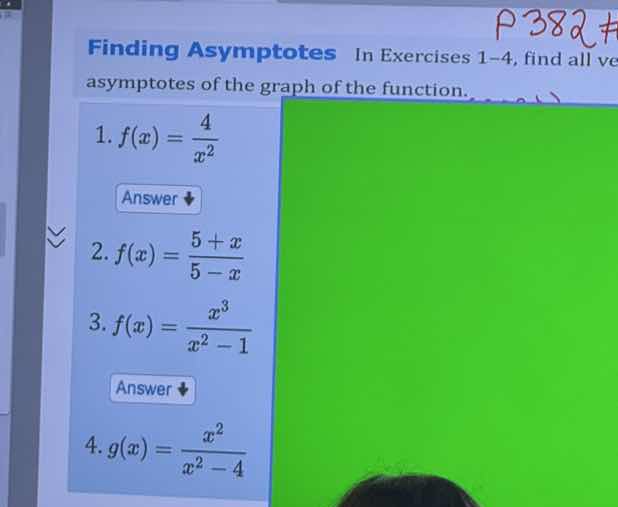
finding asymptotes in exercises 1–4, find all ve asymptotes of the graph of the function.
- $f(x)=\frac{4}{x^2}$
answer
- $f(x)=\frac{5 + x}{5 - x}$
- $f(x)=\frac{x^3}{x^2 - 1}$
answer
- $g(x)=\frac{x^2}{x^2 - 4}$
Let's solve each function for its vertical asymptotes (I'll assume "ve" in the problem is a typo for "vertical"). A vertical asymptote occurs where the function is undefined (denominator is zero) and the limit as \( x \) approaches that value is \( \pm\infty \).
1. \( f(x) = \frac{4}{x^2} \)
Step 1: Find where the denominator is zero.
The denominator is \( x^2 \). Set \( x^2 = 0 \):
\( x = 0 \).
Step 2: Check the limit as \( x \to 0 \).
As \( x \to 0^+ \) (approaches 0 from the right), \( x^2 \to 0^+ \), so \( \frac{4}{x^2} \to +\infty \).
As \( x \to 0^- \) (approaches 0 from the left), \( x^2 \to 0^+ \) (since squaring a negative number gives a positive), so \( \frac{4}{x^2} \to +\infty \).
Thus, \( x = 0 \) is a vertical asymptote.
2. \( f(x) = \frac{5 + x}{5 - x} \)
Step 1: Find where the denominator is zero.
The denominator is \( 5 - x \). Set \( 5 - x = 0 \):
\( x = 5 \).
Step 2: Check the limit as \( x \to 5 \).
As \( x \to 5^+ \) (approaches 5 from the right), \( 5 - x \to 0^- \) (negative), so \( \frac{5 + x}{5 - x} \to \frac{10}{0^-} = -\infty \).
As \( x \to 5^- \) (approaches 5 from the left), \( 5 - x \to 0^+ \) (positive), so \( \frac{5 + x}{5 - x} \to \frac{10}{0^+} = +\infty \).
Thus, \( x = 5 \) is a vertical asymptote.
3. \( f(x) = \frac{x^3}{x^2 - 1} \)
Step 1: Factor the denominator.
\( x^2 - 1 = (x - 1)(x + 1) \) (difference of squares).
Step 2: Find where the denominator is zero.
Set \( (x - 1)(x + 1) = 0 \):
\( x = 1 \) or \( x = -1 \).
Step 3: Check limits for \( x = 1 \) and \( x = -1 \).
- For \( x = 1 \):
As \( x \to 1^+ \), \( x^2 - 1 \to 0^+ \), \( x^3 \to 1 \), so \( \frac{x^3}{x^2 - 1} \to \frac{1}{0^+} = +\infty \).
As \( x \to 1^- \), \( x^2 - 1 \to 0^- \), \( x^3 \to 1 \), so \( \frac{x^3}{x^2 - 1} \to \frac{1}{0^-} = -\infty \).
- For \( x = -1 \):
As \( x \to -1^+ \), \( x^2 - 1 \to 0^- \), \( x^3 \to -1 \), so \( \frac{x^3}{x^2 - 1} \to \frac{-1}{0^-} = +\infty \).
As \( x \to -1^- \), \( x^2 - 1 \to 0^+ \), \( x^3 \to -1 \), so \( \frac{x^3}{x^2 - 1} \to \frac{-1}{0^+} = -\infty \).
Thus, vertical asymptotes at \( x = 1 \) and \( x = -1 \).
4. \( g(x) = \frac{x^2}{x^2 - 4} \)
Step 1: Factor the denominator.
\( x^2 - 4 = (x - 2)(x + 2) \) (difference of squares).
Step 2: Find where the denominator is zero.
Set \( (x - 2)(x + 2) = 0 \):
\( x = 2 \) or \( x = -2 \).
Step 3: Check limits for \( x = 2 \) and \( x = -2 \).
- For \( x = 2 \):
As \( x \to 2^+ \), \( x^2 - 4 \to 0^+ \), \( x^2 \to 4 \), so \( \frac{x^2}{x^2 - 4} \to \frac{4}{0^+} = +\infty \).
As \( x \to 2^- \), \( x^2 - 4 \to 0^- \), \( x^2 \to 4 \), so \( \frac{x^2}{x^2 - 4} \to \frac{4}{0^-} = -\infty \).
- For \( x = -2 \):
As \( x \to -2^+ \), \( x^2 - 4 \to 0^- \), \( x^2 \to 4 \), so \( \frac{x^2}{x^2 - 4} \to \frac{4}{0^-} = -\infty \).
As \( x \to -2^- \), \( x^2 - 4 \to 0^+ \), \( x^2 \to 4 \), so \( \frac{x^2}{x^2 - 4} \to \frac{4}{0^+} = +\infty \).
Thus, vertical asymptotes at \( x = 2 \) and \( x = -2 \).
Final Answers:
- \( \boldsymbol{x = 0} \)
- \( \boldsymbol{x = 5} \)
- \( \boldsymbol{x = 1} \) and \( \boldsymbol{x = -1} \)
- \( \boldsymbol{x = 2} \) and \( \boldsymbol{x = -2} \)

Snap & solve any problem in the app
Get step-by-step solutions on Sovi AI
Photo-based solutions with guided steps
Explore more problems and detailed explanations
Let's solve each function for its vertical asymptotes (I'll assume "ve" in the problem is a typo for "vertical"). A vertical asymptote occurs where the function is undefined (denominator is zero) and the limit as \( x \) approaches that value is \( \pm\infty \).
1. \( f(x) = \frac{4}{x^2} \)
Step 1: Find where the denominator is zero.
The denominator is \( x^2 \). Set \( x^2 = 0 \):
\( x = 0 \).
Step 2: Check the limit as \( x \to 0 \).
As \( x \to 0^+ \) (approaches 0 from the right), \( x^2 \to 0^+ \), so \( \frac{4}{x^2} \to +\infty \).
As \( x \to 0^- \) (approaches 0 from the left), \( x^2 \to 0^+ \) (since squaring a negative number gives a positive), so \( \frac{4}{x^2} \to +\infty \).
Thus, \( x = 0 \) is a vertical asymptote.
2. \( f(x) = \frac{5 + x}{5 - x} \)
Step 1: Find where the denominator is zero.
The denominator is \( 5 - x \). Set \( 5 - x = 0 \):
\( x = 5 \).
Step 2: Check the limit as \( x \to 5 \).
As \( x \to 5^+ \) (approaches 5 from the right), \( 5 - x \to 0^- \) (negative), so \( \frac{5 + x}{5 - x} \to \frac{10}{0^-} = -\infty \).
As \( x \to 5^- \) (approaches 5 from the left), \( 5 - x \to 0^+ \) (positive), so \( \frac{5 + x}{5 - x} \to \frac{10}{0^+} = +\infty \).
Thus, \( x = 5 \) is a vertical asymptote.
3. \( f(x) = \frac{x^3}{x^2 - 1} \)
Step 1: Factor the denominator.
\( x^2 - 1 = (x - 1)(x + 1) \) (difference of squares).
Step 2: Find where the denominator is zero.
Set \( (x - 1)(x + 1) = 0 \):
\( x = 1 \) or \( x = -1 \).
Step 3: Check limits for \( x = 1 \) and \( x = -1 \).
- For \( x = 1 \):
As \( x \to 1^+ \), \( x^2 - 1 \to 0^+ \), \( x^3 \to 1 \), so \( \frac{x^3}{x^2 - 1} \to \frac{1}{0^+} = +\infty \).
As \( x \to 1^- \), \( x^2 - 1 \to 0^- \), \( x^3 \to 1 \), so \( \frac{x^3}{x^2 - 1} \to \frac{1}{0^-} = -\infty \).
- For \( x = -1 \):
As \( x \to -1^+ \), \( x^2 - 1 \to 0^- \), \( x^3 \to -1 \), so \( \frac{x^3}{x^2 - 1} \to \frac{-1}{0^-} = +\infty \).
As \( x \to -1^- \), \( x^2 - 1 \to 0^+ \), \( x^3 \to -1 \), so \( \frac{x^3}{x^2 - 1} \to \frac{-1}{0^+} = -\infty \).
Thus, vertical asymptotes at \( x = 1 \) and \( x = -1 \).
4. \( g(x) = \frac{x^2}{x^2 - 4} \)
Step 1: Factor the denominator.
\( x^2 - 4 = (x - 2)(x + 2) \) (difference of squares).
Step 2: Find where the denominator is zero.
Set \( (x - 2)(x + 2) = 0 \):
\( x = 2 \) or \( x = -2 \).
Step 3: Check limits for \( x = 2 \) and \( x = -2 \).
- For \( x = 2 \):
As \( x \to 2^+ \), \( x^2 - 4 \to 0^+ \), \( x^2 \to 4 \), so \( \frac{x^2}{x^2 - 4} \to \frac{4}{0^+} = +\infty \).
As \( x \to 2^- \), \( x^2 - 4 \to 0^- \), \( x^2 \to 4 \), so \( \frac{x^2}{x^2 - 4} \to \frac{4}{0^-} = -\infty \).
- For \( x = -2 \):
As \( x \to -2^+ \), \( x^2 - 4 \to 0^- \), \( x^2 \to 4 \), so \( \frac{x^2}{x^2 - 4} \to \frac{4}{0^-} = -\infty \).
As \( x \to -2^- \), \( x^2 - 4 \to 0^+ \), \( x^2 \to 4 \), so \( \frac{x^2}{x^2 - 4} \to \frac{4}{0^+} = +\infty \).
Thus, vertical asymptotes at \( x = 2 \) and \( x = -2 \).
Final Answers:
- \( \boldsymbol{x = 0} \)
- \( \boldsymbol{x = 5} \)
- \( \boldsymbol{x = 1} \) and \( \boldsymbol{x = -1} \)
- \( \boldsymbol{x = 2} \) and \( \boldsymbol{x = -2} \)