QUESTION IMAGE
Question
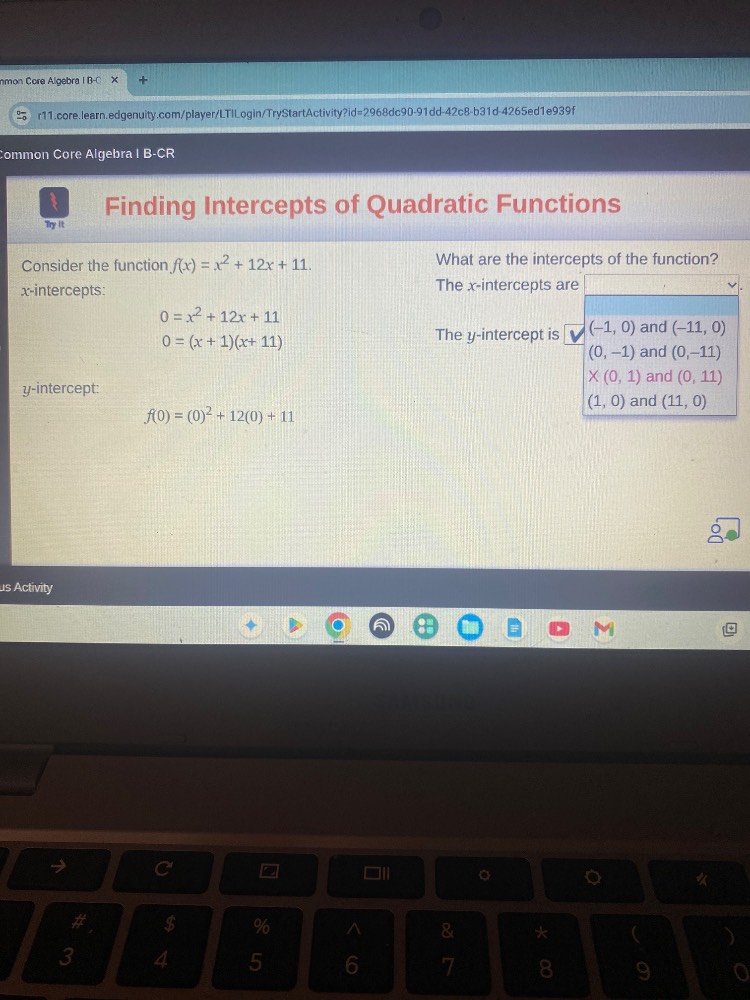
finding intercepts of quadratic functions
consider the function ( f(x) = x^2 + 12x + 11 ).
( x )-intercepts:
( 0 = x^2 + 12x + 11 )
( 0 = (x + 1)(x + 11) )
( y )-intercept:
( f(0) = (0)^2 + 12(0) + 11 )
what are the intercepts of the function?
the ( x )-intercepts are
the ( y )-intercept is
options for ( x )-intercepts and ( y )-intercept: ((-1, 0)) and ((-11, 0)); ((0, -1)) and ((0, -11)); ((0, 1)) and ((0, 11)); ((1, 0)) and ((11, 0))
Step1: Find x - intercepts
To find the x - intercepts, we set \(y = f(x)=0\). The equation is \(0=x^{2}+12x + 11\). We factor the quadratic equation: \(x^{2}+12x + 11=(x + 1)(x + 11)\) (by finding two numbers that multiply to 11 and add to 12, which are 1 and 11). Then we set each factor equal to zero: \(x+1 = 0\) gives \(x=-1\) and \(x + 11=0\) gives \(x=-11\). So the x - intercepts are the points where \(x=-1\) and \(x=-11\) with \(y = 0\), so the x - intercepts are \((-1,0)\) and \((-11,0)\).
Step2: Find y - intercept
To find the y - intercept, we set \(x = 0\) in the function \(f(x)=x^{2}+12x + 11\). So \(f(0)=(0)^{2}+12(0)+11=11\). So the y - intercept is the point \((0,11)\)? Wait, no, wait. Wait, \(f(0)=0 + 0+11 = 11\), so the y - intercept is \((0,11)\)? But in the options, there is \((0,1)\) and \((0,11)\)? Wait, no, let's recalculate. \(f(0)=0^{2}+12\times0 + 11=11\), so the y - intercept is \((0,11)\). But in the given options for y - intercept, the correct one should be \((0,11)\)? Wait, no, the original function is \(f(x)=x^{2}+12x + 11\). Let's check again. \(f(0)=0 + 0+11 = 11\), so the y - intercept is \((0,11)\). But in the options, the third option is \((0,1)\) and \((0,11)\)? Wait, no, the options for y - intercept: the first checked is wrong, the second is \((0,-1)\) and \((0,-11)\) (wrong), third is \((0,1)\) and \((0,11)\) (wait, no, \(f(0)=11\), so the y - intercept is \((0,11)\), so the point is \((0,11)\), so the y - intercept is \((0,11)\), so the correct y - intercept option is \((0,1)\) and \((0,11)\)? Wait, no, a function has only one y - intercept (since it's a function, for \(x = 0\) there is only one \(y\) value). Wait, the function \(f(x)=x^{2}+12x + 11\) is a quadratic function, so it has one y - intercept. So when \(x = 0\), \(y=11\), so the y - intercept is \((0,11)\). But in the options, the third option is \((0,1)\) and \((0,11)\)? No, that's two points, but a function can only have one y - intercept. Wait, maybe a typo in the options. But according to the calculation, \(f(0)=11\), so the y - intercept is \((0,11)\). And the x - intercepts are \((-1,0)\) and \((-11,0)\).

Snap & solve any problem in the app
Get step-by-step solutions on Sovi AI
Photo-based solutions with guided steps
Explore more problems and detailed explanations
The x - intercepts are \((-1, 0)\) and \((-11, 0)\).
The y - intercept is \((0, 11)\) (from the option \((0, 1)\) and \((0, 11)\) – note: likely a formatting error in the option, as a function has one y - intercept, but the correct y - intercept point is \((0, 11)\)).
For the x - intercepts, the correct option is \((-1, 0)\) and \((-11, 0)\).
For the y - intercept, the correct option is \((0, 1)\) and \((0, 11)\) (with the understanding that the y - intercept is \((0, 11)\)).