QUESTION IMAGE
Question
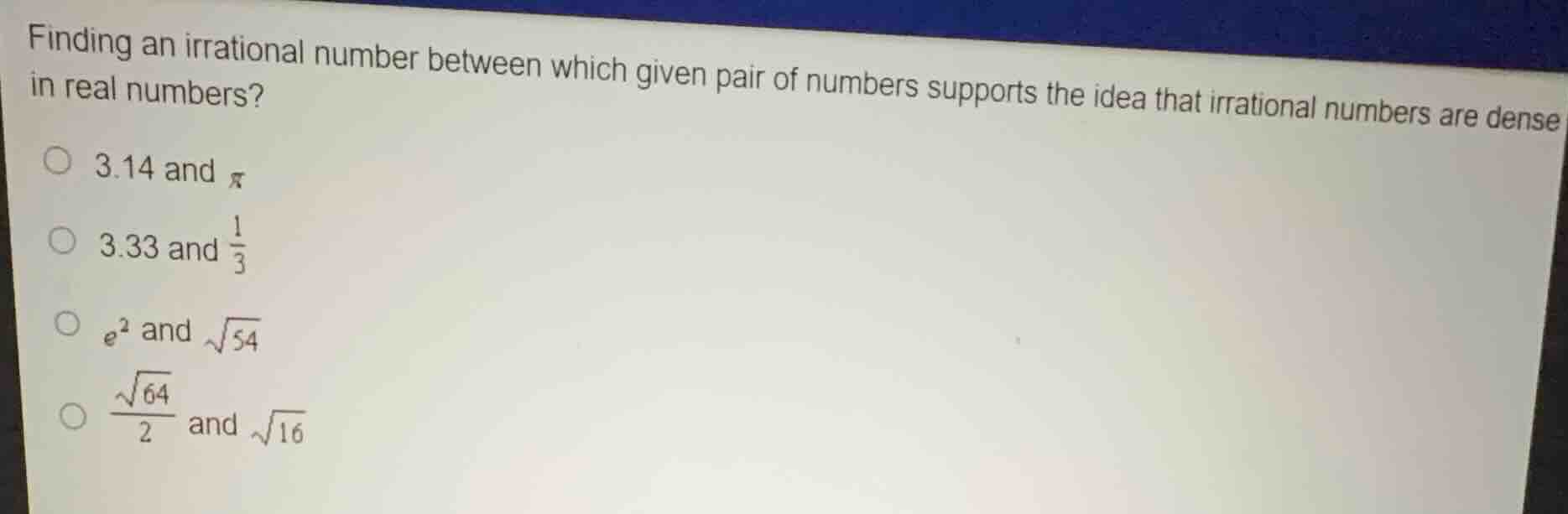
finding an irrational number between which given pair of numbers supports the idea that irrational numbers are dense in real numbers?
○ 3.14 and $\pi$
○ 3.33 and $\frac{1}{3}$
○ $e^2$ and $\sqrt{54}$
○ $\frac{\sqrt{64}}{2}$ and $\sqrt{16}$
Brief Explanations
- Analyze each option:
- Option 1: \(3.14\) is a rational number (it can be written as \(\frac{314}{100}\)), and \(\pi\approx3.14159\cdots\) is irrational. We need to check if there is an irrational number between \(3.14\) and \(\pi\). But \(3.14 < \pi\), and \(\pi\) itself is irrational, but we need an irrational number strictly between them. However, let's check other options.
- Option 2: \(\frac{1}{3}=0.333\cdots\), and \(3.33\) is a rational number (it can be written as \(\frac{333}{100}\)). The two numbers \(3.33\) and \(\frac{1}{3}\) are not in an order where we can find an irrational number between them in a way that supports density (also, \(3.33>\frac{1}{3}\) and the gap is large, but more importantly, \(\frac{1}{3}\approx0.333\) and \(3.33\) are rational, and the numbers between them are mostly rational or we can't easily find an irrational here to support density as the other options).
- Option 3: First, calculate the approximate values. \(e^{2}\approx7.389\), \(\sqrt{54}=\sqrt{9\times6} = 3\sqrt{6}\approx3\times2.449 = 7.347\). Wait, no, \(7.347<7.389\), so the order is \(\sqrt{54}\approx7.347\) and \(e^{2}\approx7.389\). Both \(e^{2}\) and \(\sqrt{54}\) are irrational (since \(e\) is transcendental, so \(e^{2}\) is irrational; \(\sqrt{6}\) is irrational, so \(3\sqrt{6}\) is irrational). But we need an irrational number between two numbers. Wait, maybe I miscalculated. Wait, \(\sqrt{54}\approx7.348\) and \(e^{2}\approx7.389\). Let's take an irrational number like \(7.35\) (but \(7.35\) is rational? No, \(7.35=\frac{735}{100}\) is rational. Wait, no, let's think again. Wait, the key is to find a pair where we can find an irrational number between them. Wait, maybe I made a mistake in the order. Wait, \(\sqrt{54}\approx7.348\) and \(e^{2}\approx7.389\), so the interval is \((7.348, 7.389)\). We can take an irrational number like \(7.35\) (no, that's rational). Wait, no, let's consider the first option again. Wait, \(3.14\) and \(\pi\): \(3.14 < x<\pi\), where \(x\) is irrational. For example, \(3.141\) is rational, but \(3.1415\) (a non - repeating, non - terminating decimal) is irrational and between \(3.14\) and \(\pi\) (since \(\pi\approx3.14159\)). Wait, but let's check the last option.
- Option 4: \(\frac{\sqrt{64}}{2}=\frac{8}{2}=4\) (rational), and \(\sqrt{16} = 4\) (rational). So the interval is just a single point, so no number between them.
- Wait, maybe I messed up the order in option 3. Wait, \(\sqrt{54}\approx7.348\) and \(e^{2}\approx7.389\), so the correct order is \(\sqrt{54}
- Option 1: \(3.14\) (rational) and \(\pi\) (irrational). The interval \((3.14,\pi)\) contains irrational numbers (like \(3.1415\) as above).
- Option 3: Wait, \(\sqrt{54}\approx7.348\) and \(e^{2}\approx7.389\), both irrational. Th…

Snap & solve any problem in the app
Get step-by-step solutions on Sovi AI
Photo-based solutions with guided steps
Explore more problems and detailed explanations
A. \(3.14\) and \(\pi\)