QUESTION IMAGE
Question
finding missing angles
$x = \square ^\circ$
related content
Step1: Identify straight angle sum
A straight angle equals $180^\circ$.
Step2: Calculate the unknown adjacent angle
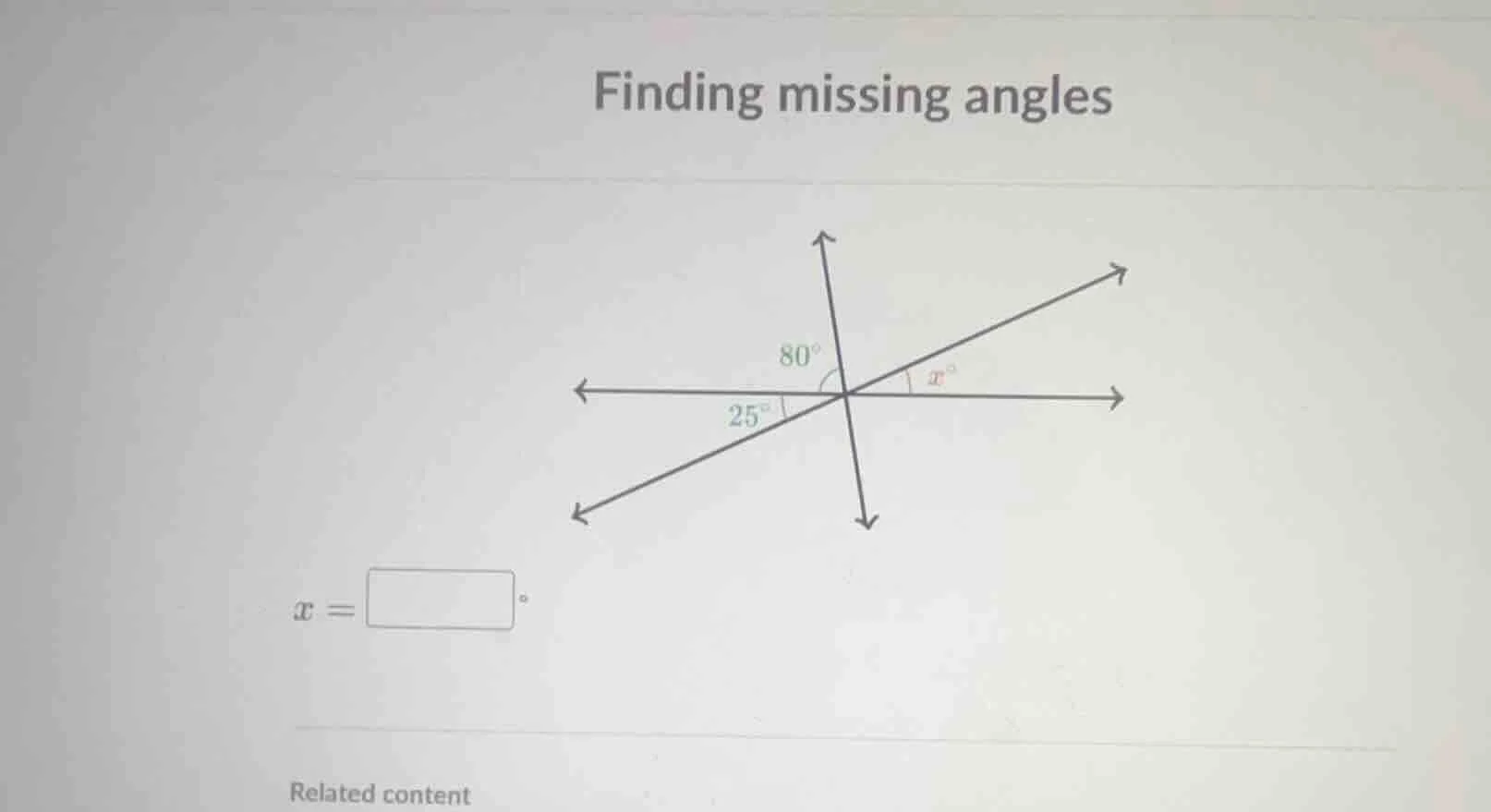
Let the angle between $25^\circ$ and the vertical line be $y$.
$y = 180^\circ - 25^\circ - 80^\circ = 75^\circ$
Step3: Use vertical angle congruence
$x$ and $25^\circ + 80^\circ$ are not vertical angles; instead, $x$ is equal to the angle supplementary to $80^\circ + y$? No, correct: $x$ is vertical to the angle that is $180 - 80 -25$. Wait, simpler: The three angles on one side of the horizontal line sum to $180^\circ$, so $25 + 80 + x = 180$? No, no: The vertical line forms $80^\circ$ with horizontal, so the other angle on that side is $100^\circ$, but no, the $25^\circ$ is on the opposite horizontal. Correct: $x$ is equal to $180^\circ - 80^\circ - 90^\circ$? No, wait, vertical angles: The angle opposite to $25^\circ + 80^\circ$? No, the horizontal line is straight, so the angle adjacent to $80^\circ$ and $x$ is $90^\circ$? No, no, the vertical line is perpendicular? No, the $80^\circ$ is between horizontal and vertical, so the vertical line is not perpendicular. Correct approach: The three angles that make up a straight line (the horizontal one) on the left: $25^\circ$, $80^\circ$, and the angle opposite $x$? No, vertical angles are equal. The angle opposite to $x$ is equal to $180^\circ - 80^\circ - 25^\circ$? No, the angle between the downward vertical and the lower left line is equal to $80^\circ$ (vertical angles). Then, on the right horizontal, $x + 80^\circ + 25^\circ$? No, no, straight line is $180^\circ$. Let's use the fact that the sum of angles around a point is $360^\circ$, but we can use straight line:
On the upper side of the horizontal line: $80^\circ +$ (right angle between vertical and upper right line) $+ x^\circ = 180^\circ$. The angle between lower left line and lower horizontal is $25^\circ$, so the vertical angle to that is the angle between upper right line and upper horizontal? No, no, vertical angles are equal. The angle between the upper vertical and upper left horizontal is $80^\circ$, so the angle between lower vertical and lower right horizontal is also $80^\circ$. Then, on the lower right horizontal: $x^\circ + 80^\circ + 25^\circ = 180^\circ$? No, that can't be. Wait, correct: The angle between the upper vertical and upper right line is equal to $25^\circ$ (alternate interior? No, vertical angles: The $25^\circ$ and the angle between upper right line and upper horizontal are vertical angles? No, no, the intersection: the $25^\circ$ is between lower left line and lower horizontal, so the vertical angle to that is between upper right line and upper horizontal, which is $x$? No, no, the $80^\circ$ is between upper left horizontal and upper vertical. So upper left horizontal to upper vertical is $80^\circ$, upper vertical to upper right line is $x$? No, no, upper left horizontal to upper right line is a straight line, so $80^\circ + x +$ (angle between upper vertical and upper right line) $= 180^\circ$. But the angle between upper vertical and upper right line is equal to $25^\circ$ (vertical angle to the $25^\circ$ below). Oh right! Vertical angles are equal, so the angle opposite $25^\circ$ is $25^\circ$. Then:
Step1: Recognize vertical angle equality
The angle opposite $25^\circ$ is $25^\circ$.
Step2: Sum angles on straight line
$80^\circ + 25^\circ + x^\circ = 180^\circ$
Step3: Solve for $x$
$x = 180 - 80 - 25 = 75$

Snap & solve any problem in the app
Get step-by-step solutions on Sovi AI
Photo-based solutions with guided steps
Explore more problems and detailed explanations
$75$