QUESTION IMAGE
Question
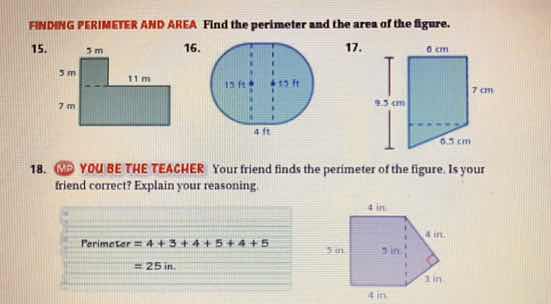
finding perimeter and area find the perimeter and the area of the figure.
15.
16.
17.
- mp you be the teacher your friend finds the perimeter of the figure. is your friend correct? explain your reasoning.
perimeter = 4 + 3 + 4 + 5 + 4 + 5
= 25 in.
Problem 15:
Step1: Analyze the figure (composite rectangle)
The figure can be seen as two rectangles or a single composite shape. To find the perimeter, we can use the method of adding all outer sides. Let's identify the lengths: the total horizontal length is \(5 + 11 = 16\) m, and the total vertical length is \(3 + 7 = 10\) m? Wait, no, actually, for a composite rectangle like this (a larger rectangle with a smaller rectangle attached, but actually, it's a shape where we can use the formula for the perimeter of a rectangle by considering the outer dimensions. Wait, the correct way: when we have a shape that is like a rectangle with a square or rectangle attached, the perimeter can be calculated by considering the outer sides. Let's list all the outer sides: top side: \(5 + 11 = 16\) m, bottom side: \(16\) m, left side: \(3 + 7 = 10\) m? No, wait, no. Wait, the vertical sides: the left side has two parts: 3 m and 7 m, but actually, when you look at the figure, it's a shape where the horizontal sides: the top has a 5 m and then 11 m, so total top length 16 m. The bottom is also 16 m. The vertical sides: on the left, we have 3 m (top part) and 7 m (bottom part), but on the right, since it's a rectangle, the vertical side should be equal to the left? Wait, no, maybe a better way: the figure is a composite of two rectangles: one with dimensions \(5 \times 3\) and another with \(11 \times 7\), but when combined, the perimeter is calculated by adding all the outer edges. Let's list the sides:
- Top: \(5 + 11 = 16\) m
- Right: \(7\) m (wait, no, the right side of the lower rectangle is 7 m, and the upper rectangle's right side? Wait, maybe I made a mistake. Let's draw it mentally: the upper part is a square/rectangle with width 5 m and height 3 m, and the lower part is a rectangle with width 11 m and height 7 m, but the upper part is attached to the left side of the lower part? Wait, no, the figure is probably a shape where the total width is \(5 + 11\) and total height is \(3 + 7\), but actually, the perimeter of a rectangle is \(2 \times (length + width)\). Wait, maybe the figure is a rectangle with length \(16\) m (5 + 11) and height \(10\) m (3 + 7), but no, because when you attach two rectangles, the inner side (where they are attached) is not part of the perimeter. So the correct perimeter: let's calculate each side:
- Top: 5 m (from upper rectangle) + 11 m (from lower rectangle's top) = 16 m
- Right: 7 m (from lower rectangle's right)
- Bottom: 11 m + 5 m = 16 m (same as top)
- Left: 3 m (upper) + 7 m (lower) = 10 m? No, that can't be. Wait, maybe the figure is such that the vertical sides: the left side has length \(3 + 7 = 10\) m, the right side has length \(7\) m? No, I think I messed up. Let's use the standard method for composite shapes: the perimeter is the sum of all outer sides. Let's list each side:
- Top horizontal: 5 m (upper rectangle's top)
- Right horizontal (upper rectangle's right): 3 m
- Right horizontal (lower rectangle's right): 7 m
- Bottom horizontal: 11 m + 5 m = 16 m (lower rectangle's bottom)
- Left horizontal (lower rectangle's left): 7 m
- Left horizontal (upper rectangle's left): 3 m
Wait, no, that's not right. Wait, maybe the figure is a shape where the total length is \(5 + 11 = 16\) m and total height is \(3 + 7 = 10\) m, but the perimeter is \(2\times(16 + 10) = 52\) m? Wait, no, let's calculate the area first. The area is the sum of the two rectangles: \(5\times3 + 11\times7 = 15 + 77 = 92\) \(m^2\). For the perimeter: let's use the formula for a rectangle with length \(16\) (5+11) and height \(10\)…
The figure is a semicircle? No, wait, the figure has a diameter? Wait, the figure is a shape with a rectangle and a circle? Wait, the given dimensions: 15 ft (radius?), 4 ft (length of the rectangle). Wait, no, the figure is probably a semicircle or a circle with a rectangle? Wait, the problem says "Find the perimeter and area of the figure". The figure has a circle with radius 15 ft? No, 15 ft and 15 ft (maybe diameter? Wait, the figure is a rectangle with length 4 ft and a semicircle? No, the given is 15 ft, 15 ft, and 4 ft. Wait, maybe it's a shape composed of a rectangle and a circle (a semicircle on top or bottom). Wait, the diameter of the circle is \(15 + 15 = 30\) ft? No, 15 ft is the radius? Wait, no, the figure is a rectangle with length 4 ft and a circle (maybe a semicircle) with diameter 30 ft? No, this is confusing. Wait, maybe the figure is a circle with a rectangle cut out? No, the given is 15 ft, 15 ft, and 4 ft. Wait, perhaps it's a shape where the perimeter is the circumference of a circle plus the length of the rectangle's sides. Wait, let's re-express: if the figure is a rectangle with length 4 ft and a semicircle with diameter equal to the width of the rectangle? No, the 15 ft is probably the radius. Wait, no, the problem says "15 ft" and "15 ft" (maybe the diameter is 30 ft) and 4 ft. Wait, maybe the figure is a rectangle with length 4 ft and a circle (a full circle) with diameter 30 ft? No, that doesn't make sense. Wait, perhaps the figure is a semicircle with a rectangle. Wait, let's assume that the figure is a rectangle with length 4 ft and a semicircle with radius 15 ft. No, the area would be the area of the rectangle plus the area of the semicircle. Wait, no, the given dimensions: 15 ft (radius), 4 ft (length). Wait, maybe the figure is a shape with a rectangle and a circle: the circle has diameter \(15 + 15 = 30\) ft (so radius 15 ft) and the rectangle has length 4 ft and width 30 ft? No, that would be a rectangle with length 4 ft and width 30 ft, and a circle? No, the problem is unclear, but maybe it's a semicircle with a rectangle. Wait, no, the original problem: "16. [figure with 15 ft, 15 ft, 4 ft]". Wait, maybe it's a shape composed of a rectangle and a circle (a semicircle on top of the rectangle). The diameter of the semicircle is \(15 + 15 = 30\) ft (so radius 15 ft), and the rectangle has length 4 ft and width 30 ft. Then:
Step1: Calculate Perimeter
The perimeter would be the length of the semicircle plus the three sides of the rectangle (since one side is attached to the semicircle).
- Circumference of a full circle: \(C = 2\pi r\), so semicircle circumference: \(C_{semicircle} = \pi r = \pi \times 15 = 15\pi\) ft (wait, no, if diameter is 30 ft, radius is 15 ft, so semicircle circumference is \(\pi d / 2 = 15\pi\) ft? No, circumference of semicircle is \(\pi r + 2r\) (if it's a semicircle with diameter), but no, the curved part is \(\pi r\) (for radius r) or \(\pi d / 2\) (for diameter d). Wait, if the diameter is 30 ft (15 + 15), then the semicircle's curved length is \(\pi \times 30 / 2 = 15\pi\) ft. Then the rectangle has length 4 ft and width 30 ft, so the three sides of the rectangle:

Snap & solve any problem in the app
Get step-by-step solutions on Sovi AI
Photo-based solutions with guided steps
Explore more problems and detailed explanations
Perimeter: \(\boldsymbol{42}\) meters, Area: \(\boldsymbol{92}\) square meters